
R-37M Missile
- 22 Apr 2026
In News:
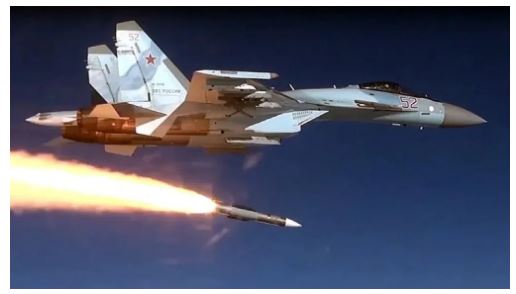
In a major strategic recalibration following the air combat lessons of 2025, Russia has officially greenlit the export of the R-37M (AA-13 Axehead) ultra-long-range air-to-air missile to India. Valued at approximately $1.2 billion for nearly 300 missiles, this deal is designed to restore the "Beyond Visual Range" (BVR) edge for the Indian Air Force (IAF) against the growing influence of Chinese-made missile systems in the region.
The Strategic Context: Operation Sindoor (2025)
- The urgency of the R-37M acquisition stems from the aftermath of Operation Sindoor (May 2025). Triggered by a terror attack in Pahalgam, the operation involved high-intensity air skirmishes where the IAF encountered Pakistani J-10C fighters armed with Chinese-origin PL-15 missiles.
- Reports from the clash suggested that the PL-15's range created a "technological gap," allowing adversary aircraft to threaten Indian fighters before they could return fire. To counter this, and the even more formidable PL-17 (range ~400 km) deployed by China, India has opted for the R-37M as a vital interim stabilizer while domestic programs like Astra Mk-2 and Mk-3 move toward operationalization.
The "AWACS Killer": Technical Specifications
The R-37M is not a standard dogfight missile; it is a specialist weapon designed for long-range air denial.
- Hypersonic Speed: It is the world’s fastest air-to-air missile in its class, reaching speeds of Mach 6. This velocity is critical for intercepting fast-moving jets and high-value assets.
- Massive Engagement Range: With a range of 300 to 400 kilometers, it enables the IAF to strike from deep within its own territory.
- Trajectory Profile: The missile employs a lofted trajectory, climbing into the thinner atmosphere before diving onto its target. This conserves kinetic energy and maximizes the "No-Escape Zone" for the enemy.
- The Target Profile: Its primary role is that of an "AWACS Killer." It targets high-value enablers such as Airborne Warning and Control Systems (AWACS), refueling tankers, and jamming aircraft, effectively "blinding" the enemy's air network.
Integration with the Su-30MKI Fleet
A major factor in selecting the R-37M is its compatibility with the Su-30MKI, the backbone of the IAF.
- Seamless Fit: Since the missile is already integrated into the Russian Su-30SM (a variant very similar to India’s MKI), technical risks are minimal.
- Modernization Link: The deployment is being synchronized with the "Super Sukhoi" upgrade program, which involves 84 aircraft. A fully upgraded Su-30MKI will be capable of carrying between six to eight R-37M missiles.
- Force Multiplier: By integrating the R-37M, the IAF can more than triple the current BVR engagement envelope of its frontline fighters.
Impact on Regional Air Dynamics
The acquisition shifts the focus from fighter-versus-fighter dogfights to network-centric warfare:
- Standoff Parity: It neutralizes the range advantage currently held by the Chinese PL-15 and PL-17 missiles.
- Deterrence: By threatening support aircraft (like the KJ-500 AEW&C), India forces the adversary to push their "enablers" further back from the frontline, reducing their coordination and radar coverage.
- Strategic Stabilizer: While India pursues indigenous "Astra" variants, the R-37M ensures there is no "capability vacuum" during the transition period.
R-37M Missile
- 13 Feb 2025
In News:
Russia has recently offered the R-37M missile, a state-of-the-art, long-range air-to-air missile, to India. This missile, one of the world’s most advanced, has the potential to transform India's aerial defense capabilities. The offer also comes with the opportunity for India to license the production of this missile domestically. However, the acquisition of such a potent weapon is raising tensions in the region, particularly with Pakistan, China, and Bangladesh, and has broader strategic implications.
Overview of R-37M Missile:
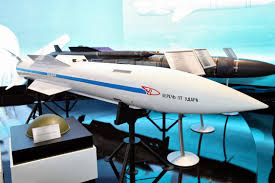
The R-37M, also known by its NATO reporting name AA-13 Axehead, is a hypersonic, long-range air-to-air missile developed by Russia.
It is designed to target high-value assets, such as AWACS (Airborne Warning and Control Systems), tanker aircraft, and other support platforms, beyond visual range (BVR).
Evolved from the R-33 missile, the R-37M significantly enhances air combat capabilities due to its range, speed, and precision.
- Speed and Range: The missile can travel at speeds of up to Mach 6 (approximately 7,400 km/h), enabling it to intercept fast-moving aerial threats. It has an operational range of 300-400 km (160-220 nautical miles), making it one of the longest-reaching air-to-air missiles.
- Weight: The missile weighs 510 kg, with a 60 kg warhead.
- Guidance System: It uses an advanced combination of inertial navigation with mid-course updates, active radar homing, and semi-active radar guidance for the terminal phase.
- Combat Advantage: The R-37M can target beyond visual range, enabling the launching aircraft to engage enemy targets while remaining outside the reach of enemy missiles.
Impact on the Indian Air Force (IAF):
The R-37M missile could replace the current R-77 missile used by India’s Sukhoi Su-30MKI fighter jets. This acquisition will bolster India's air defense by providing enhanced capabilities to intercept aerial threats at greater distances. Additionally, the offer to license the local production of the missile is a significant step toward strengthening India’s defense industry and reducing its dependence on foreign weapon systems. This move can also contribute to India's strategic autonomy in military engagements.
Strategic Implications for Pakistan:
Pakistan’s Air Force (PAF) primarily relies on F-16 fighter jets for its aerial superiority. However, these aircraft are vulnerable to interception beyond the Line of Control (LoC) by the R-37M, which has an engagement range of up to 400 kilometers. This could significantly alter Pakistan's defense posture, as its aircraft would be exposed to threats from Indian aircraft even before crossing the LoC.
Potential Effects on China:
China, which already possesses advanced air-to-air missiles such as the PL-15 and PL-21, will closely monitor India’s acquisition of the R-37M missile. While China is not directly threatened by the missile due to its own advanced defense systems, India’s missile capabilities could alter the balance of air superiority in the region. The acquisition could prompt China to accelerate the development of counter-hypersonic technologies, potentially altering the trajectory of military developments in the region.
Impact on Bangladesh:
Bangladesh, which shares friendly relations with India, could find itself caught in the strategic competition between India and Pakistan, despite its own military capabilities not directly challenging India. The regional military dynamics, influenced by India’s acquisition of advanced weapons like the R-37M, may push Bangladesh to enhance its defense capabilities, either through regional alliances or by procuring advanced defense technologies.
India-Russia Defense Relations:
India’s defense cooperation with Russia has been longstanding and substantial. Between 2015 and 2020, India’s defense imports from Russia were valued at approximately $10 billion, making Russia one of India’s largest defense suppliers. Around 70% of India's defense equipment is of Russian origin. Key joint defense projects include:
- BrahMos Missile: A joint venture to develop a supersonic cruise missile.
- S-400 Triumph: A $5.4 billion deal for five S-400 air defense systems.
- AK-203 Assault Rifles: A project for the local manufacturing of over 700,000 rifles.
- Military Exercises: India and Russia conduct joint military exercises, such as the INDRA (focused on counter-terrorism) and AVIAINDRA (aerial exercises between the Indian Air Force and Russian Aerospace Forces).