
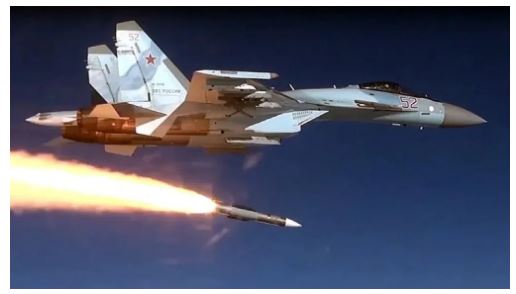
R-37M Missile
- 22 Apr 2026
In News:
In a major strategic recalibration following the air combat lessons of 2025, Russia has officially greenlit the export of the R-37M (AA-13 Axehead) ultra-long-range air-to-air missile to India. Valued at approximately $1.2 billion for nearly 300 missiles, this deal is designed to restore the "Beyond Visual Range" (BVR) edge for the Indian Air Force (IAF) against the growing influence of Chinese-made missile systems in the region.
The Strategic Context: Operation Sindoor (2025)
- The urgency of the R-37M acquisition stems from the aftermath of Operation Sindoor (May 2025). Triggered by a terror attack in Pahalgam, the operation involved high-intensity air skirmishes where the IAF encountered Pakistani J-10C fighters armed with Chinese-origin PL-15 missiles.
- Reports from the clash suggested that the PL-15's range created a "technological gap," allowing adversary aircraft to threaten Indian fighters before they could return fire. To counter this, and the even more formidable PL-17 (range ~400 km) deployed by China, India has opted for the R-37M as a vital interim stabilizer while domestic programs like Astra Mk-2 and Mk-3 move toward operationalization.
The "AWACS Killer": Technical Specifications
The R-37M is not a standard dogfight missile; it is a specialist weapon designed for long-range air denial.
- Hypersonic Speed: It is the world’s fastest air-to-air missile in its class, reaching speeds of Mach 6. This velocity is critical for intercepting fast-moving jets and high-value assets.
- Massive Engagement Range: With a range of 300 to 400 kilometers, it enables the IAF to strike from deep within its own territory.
- Trajectory Profile: The missile employs a lofted trajectory, climbing into the thinner atmosphere before diving onto its target. This conserves kinetic energy and maximizes the "No-Escape Zone" for the enemy.
- The Target Profile: Its primary role is that of an "AWACS Killer." It targets high-value enablers such as Airborne Warning and Control Systems (AWACS), refueling tankers, and jamming aircraft, effectively "blinding" the enemy's air network.
Integration with the Su-30MKI Fleet
A major factor in selecting the R-37M is its compatibility with the Su-30MKI, the backbone of the IAF.
- Seamless Fit: Since the missile is already integrated into the Russian Su-30SM (a variant very similar to India’s MKI), technical risks are minimal.
- Modernization Link: The deployment is being synchronized with the "Super Sukhoi" upgrade program, which involves 84 aircraft. A fully upgraded Su-30MKI will be capable of carrying between six to eight R-37M missiles.
- Force Multiplier: By integrating the R-37M, the IAF can more than triple the current BVR engagement envelope of its frontline fighters.
Impact on Regional Air Dynamics
The acquisition shifts the focus from fighter-versus-fighter dogfights to network-centric warfare:
- Standoff Parity: It neutralizes the range advantage currently held by the Chinese PL-15 and PL-17 missiles.
- Deterrence: By threatening support aircraft (like the KJ-500 AEW&C), India forces the adversary to push their "enablers" further back from the frontline, reducing their coordination and radar coverage.
- Strategic Stabilizer: While India pursues indigenous "Astra" variants, the R-37M ensures there is no "capability vacuum" during the transition period.