
Operation RAGEPILL and the Captagon Narcotic Threat
- 18 May 2026
In News:
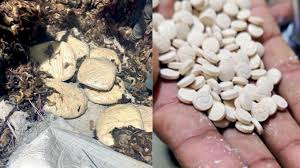
The Narcotics Control Bureau (NCB), in coordination with international enforcement agencies, executed Operation RAGEPILL. This landmark operation resulted in India’s first-ever seizure of Captagon—amounting to 227.7 kg of tablets and powder valued at approximately ?182 crore—effectively busting a sophisticated transnational syndicate attempting to weaponize India as a narco-transit pipeline.
Operation RAGEPILL: Modus Operandi and Seizure Dynamics
The multi-jurisdictional operation exposed a highly organized logistics chain connecting West Asia, India, and the Gulf region:
- The Domestic Nexus: Acting on foreign intelligence, the NCB first raided a residential hideout in Neb Sarai, New Delhi, seizing 31.5 kg of Captagon tablets meticulously hidden inside a commercial chapati-cutting machine. A Syrian national overstaying his tourist visa was arrested as the central logistics coordinator.
- The Domestic Manufacturing Angle: Further investigation revealed that the seized tablets were actively pressed within a leased herbal pharmaceutical facility in Dehradun, Uttarakhand, highlighting attempts by syndicates to exploit local manufacturing setups.
- The Maritime Pipeline: Interrogations led to a secondary breakthrough at Mundra Port, Gujarat, where the NCB intercepted 196.2 kg of high-grade Captagon powder imported directly from Syria, cleverly concealed within a cargo consignment declared as "sheep wool."
- The Intended Destination: The entire contraband chain was slated for onward transshipment to the Gulf region, primarily Jeddah, Saudi Arabia.
Profile of Captagon: Genesis and Chemical Architecture
- Original Formulation: Developed in Germany during the 1960s and 1970s, "Captagon" was the brand name for Fenethylline—a synthetic co-drug linking amphetamine and theophylline. It was initially indicated to treat Attention Deficit Hyperactivity Disorder (ADHD), narcolepsy, and depression.
- Metabolic Function: Once ingested, the human body metabolizes fenethylline into two independent active stimulants: amphetamine (which stimulates central nervous system alertness) and theophylline (a bronchodilator structurally similar to caffeine).
- The Modern Illicit Variant: Due to its highly addictive nature and severe psychological risks, medical production was halted and globally banned in the 1980s. Modern illicit Captagon pills—often stamped with a distinct double crescent moon logo (known in Arabic street slang as Abu Hilalain)—no longer contain pure fenethylline. Instead, they are highly toxic, clandestine cocktails of amphetamines, methamphetamine, caffeine, and industrial chemical fillers.
Socio-Economic Aliases
- "Poor Man's Cocaine": Dubbed so due to its low production cost relative to its immense retail street value, making it highly accessible and widely abused among young adults across the Middle East and North Africa (MENA) region.
Geopolitical and Geostrategic Implications
The Narco-Sovereignty of the Levant
Syria has evolved into the undisputed global epicenter of illicit Captagon manufacturing. The trade has transformed into a multi-billion-dollar shadow economy, generating revenues that outpace legitimate state exports. This narco-capitalism provides a parallel stream of funding for state-aligned entities, militias, and transnational criminal cartels operating in conflict-torn zones.
Containerized Trade as a Transnational Vulnerability
The tactical use of Mundra Port echoes a broader, alarming global trend where syndicates exploit heavy commercial maritime trade to camouflage synthetic narcotics. This pattern was mirrored in another major NCB interdiction involving 349 kg of cocaine routed through commercial cargo from Ecuador into Mumbai, demonstrating the increasing pressure on India's port security architecture.
Internal Security Architecture of India
Statutory and Institutional Framework
- The NDPS Act, 1985: Captagon’s chemical ingredients (Amphetamines and Fenethylline) are classified as strictly prohibited psychotropic substances under the Narcotic Drugs and Psychotropic Substances Act, 1985. It is also globally restricted under Schedule II of the UN Convention on Psychotropic Substances, 1971.
- The Narcotics Control Bureau (NCB): Operating under the Ministry of Home Affairs (MHA), the NCB acts as the apex coordinating and intelligence-gathering nodal agency, working to fulfill the state's vision of a "Drug-Free India" (Nasha Mukt Bharat).
Evolving Law Enforcement Strategies
- The Shift to "Narco-Purging": India's enforcement strategy is pivoting from localized consumer-level drug policing toward dismantling multi-layered transnational cartels, mapping financial hawala trails, and invoking the strict asset-seizure clauses of the PIT-NDPS Act, 1988.
- Collaborative Security: The operation establishes the absolute necessity of real-time, cross-border maritime and intelligence collaboration between the NCB, the Directorate of Revenue Intelligence (DRI), Indian Coast Guard, and foreign drug enforcement directorates.
- Tech-Driven Interdiction: The MHA's deployment of the MANAS Helpline (1933) and integrated data systems are increasingly augmented by AI-driven risk-analysis tools at major container freight stations to red-flag anomalous cargo vectors originating from high-risk geopolitical corridors.