
UNFF 21 and the Global Forest Goals Report 2026
- 18 May 2026
In News:
The Global Forest Goals Report 2026 was launched during the 21st session of the United Nations Forum on Forests (UNFF21) at the UN Headquarters in New York. The report provides a critical stocktake of the world's progress toward implementing the UN Strategic Plan for Forests 2017–2030 and its 6 Global Forest Goals (GFGs), warning that the world remains off-track to reverse forest loss by 2030.
Key Findings: State of Global Forests & Emergence of New Drivers
Sharp Decline in Forest Cover
- Overall Loss: Global forest area shrank from 4.18 billion hectares in 2015 to 4.14 billion hectares in 2025—a net loss of more than 40 million hectares over the decade.
- Annual Net Depletion: The world is losing an average of 4.12 million hectares of forest every year.
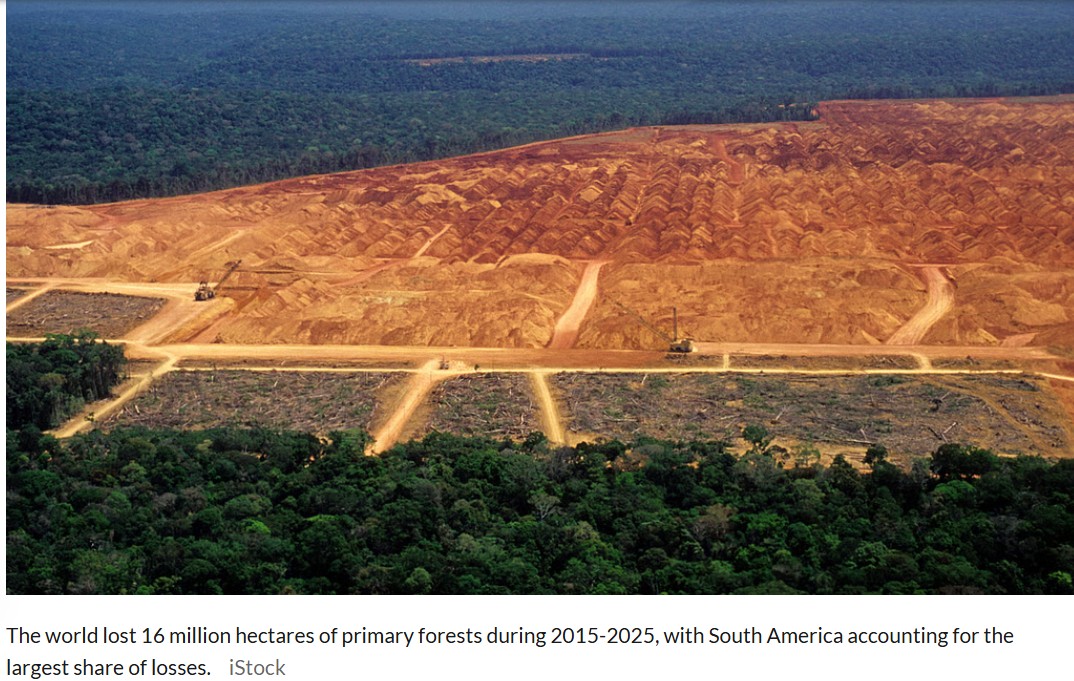
- Primary Forest Crisis: Around 16 million hectares of primary forests (unprecedented reservoirs of biodiversity and carbon storage) were destroyed. South America (particularly the Amazon) and Africa recorded the steepest regional losses.
Primary Drivers of Forest Loss
- Agricultural Expansion: Continues to be the largest absolute driver of global deforestation.
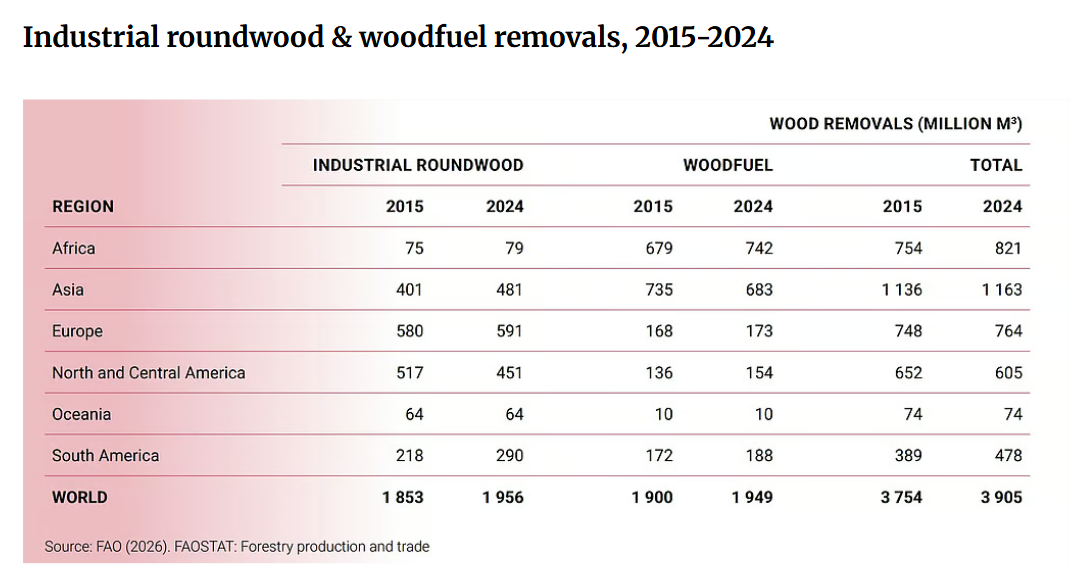
- Fuelwood & Charcoal Demand: The 2026 report specifically flags the surging demand for woodfuel (fuelwood and charcoal) as a major emerging driver of forest degradation, particularly across Sub-Saharan Africa and parts of Asia.
The Poverty-Energy Nexus: The report explicitly links fuelwood dependence to deep-rooted poverty and inadequate access to clean energy alternatives. In low-income regions, communities rely heavily on biomass for basic cooking and heating, compounding structural vulnerabilities like weak land tenure and institutional capacity.
Climate-Linked Multipliers
Forests are trapped in a vicious cycle. Anthropogenic degradation weakens their capacity to act as vital carbon sinks, while climate-induced pressures—including severe droughts, wildfires, heatwaves, pests, and diseases—further accelerate forest mortality.
Progress and Implementation Gaps (The 2030 Targets)
The report evaluates the 26 performance targets nested under the 6 Global Forest Goals, revealing highly uneven progress:
- Status Matrix:7 targets are broadly met, 17 are partially achieved, and 2 targets are completely off-track.
- The Off-Track Targets: Reversing net global forest cover loss (Target 1.1) and eradicating extreme poverty for all forest-dependent people (Target 2.1) have stalled or reversed.
- The Restoration Deficit: While 91 countries pledged to restore nearly 190 million hectares of forest under global pacts, only 44 million hectares had actually been restored by 2025.
- The Bright Spot:Asia has led global restoration initiatives, successfully rehabilitating over 31 million hectares (accounting for 42.2% of its total regional pledged area).
Institutional Framework: United Nations Forum on Forests (UNFF)
- Establishment: Founded in the year 2000 by the UN Economic and Social Council (ECOSOC).
- Type and Headquarters: High-level intergovernmental body headquartered in New York, USA.
- Membership Structure: Universal membership comprising all UN Member States and specialized agencies on an equal basis. India is a founding member and continues to play a proactive role in shaping global forest policy.
- Session Cycle: The forum meets annually, alternating between Technical Discussions in odd years and Policy Dialogue/Decision-making in even years (such as this 2026 session).
- Financial Arm: Operates the Global Forest Financing Facilitation Network (GFFFN), which helps developing nations mobilize resources, secure technical aid, and share best governance practices.
Core Mandate of UNFF
- Political Mobilization: Strengthening long-term global political commitment to sustainable forest management (SFM) and conservation worldwide.
- Policy Dialogue: Facilitating structural policy dialogue among countries, international organizations, and major stakeholder groups.
- International Cooperation: Promoting international, financial, and technical cooperation to bridge implementation gaps in developing nations.
- Legal and Institutional Frameworks: Considering future options for international forest policy, including the development of legally binding frameworks.
Policy Recommendations and Relevance to India
Global Strategic Interventions
- Deforestation-Free Supply Chains: Enforcing strict international standards for key commodities that drive land clearing, such as timber, palm oil, soy, beef, and cocoa.
- Universal Clean Cooking Access: Scaling up cleaner energy alternatives to directly displace rural reliance on woodfuel and charcoal.
- Empowered Forest Governance: Enhancing local community land-tenure security, scaling up community-led forestry, and clamping down on illegal timber trading.
Significance for India
This report highlights the critical friction between development, poverty alleviation, and conservation:
- Clean Energy Mitigation: The report’s focus on replacing fuelwood aligns perfectly with India's domestic success via Pradhan Mantri Ujjwala Yojana (PMUY), showing how socio-economic development directly prevents localized forest degradation.
- Restoration Targets: India's baseline forest and tree cover sits at approximately 25.17% (as per recent state reports), against a national target of 33%. Furthermore, under the international Bonn Challenge, India has committed to restoring 26 million hectares of degraded and deforested land by 2030.
- Institutional Blueprints: India's domestic strategies, including the National Mission for a Green India (GIM), the Compensatory Afforestation Fund (CAMPA), and Joint Forest Management (JFM) committees, serve as real-world examples of the multi-sectoral institutional cooperation urged by UNFF21.
Global Forest Goals Report 2026
- 13 May 2026
In News:
A landmark United Nations assessment, the Global Forest Goals Report 2026, has sounded a critical alarm regarding the state of the world’s terrestrial ecosystems. Prepared by the UN Department of Economic and Social Affairs (UNDESA) and the UN Forum on Forests Secretariat, the report highlights a shift in the drivers of environmental decline. While agricultural expansion remains the primary cause of deforestation, the rising demand for fuelwood and charcoal has emerged as a dominant driver of forest degradation, particularly across Africa and Asia.
The State of Global Forest Cover: 2015–2025
The report provides a sobering quantitative analysis of a decade of forest loss. Global forest cover has diminished from 4.18 billion hectares in 2015 to 4.14 billion hectares in 2025, representing a staggering net annual loss of 4.12 million hectares.
Perhaps most concerning is the fate of primary forests—undisturbed, biodiverse ecosystems that are essential for climate regulation. The world lost nearly 16 million hectares of primary forests in just ten years, with South America witnessing the most severe decline. This loss is irreversible in human timescales, as primary forests harbor unique genetic diversity and sequester significantly more carbon than secondary or plantation forests.
Emerging Drivers: The Fuelwood and Energy Poverty Nexus
While the conversion of forests for large-scale agriculture (industrial soy, palm oil, and cattle ranching) continues to lead in total deforestation, forest degradation—the thinning of forest density and health—is now increasingly driven by the energy needs of the poor.
- Sub-Saharan Africa and Asia: In these regions, a lack of access to clean cooking fuels (like LPG or electricity) forces millions to rely on wood and charcoal.
- The Vicious Cycle of Energy Poverty: Dependence on fuelwood creates a direct link between poverty and environmental decline. As forests are thinned for fuel, the ecosystem’s ability to provide services (water regulation, soil fertility) diminishes, further impoverishing the communities that depend on them.
- Charcoal Production: The report identifies charcoal as an especially destructive commodity, as its production is often inefficient and unregulated, leading to the rapid depletion of hardwood species.
Intensifying Environmental Pressures
The report stresses that forests are no longer just fighting human encroachment; they are also battling a changing climate. Abiotic and biotic stressors are accelerating degradation:
- Extreme Weather: Prolonged droughts and heatwaves are weakening tree resilience.
- Natural Disasters: An increase in the frequency and intensity of wildfires is turning forests from carbon sinks into carbon sources.
- Biological Threats: Rising temperatures have expanded the range of pests and diseases, devastating vast tracts of temperate and tropical forests alike.
The Restoration Gap: Pledges vs. Reality
A significant portion of the report is dedicated to the "Restoration Gap." While global awareness has led to ambitious pledges, implementation remains sluggish:
- The Deficit: 91 countries pledged to restore 190 million hectares of forest by 2025. However, only 44 million hectares—less than a quarter—have actually been restored.
- Asia as a Silver Lining: Asia has emerged as a global leader in forest recovery, accounting for the highest restoration performance. The region successfully restored over 31 million hectares, achieving 42.2% of its pledged area. This success is largely attributed to large-scale afforestation programs in countries like China and India.