
Committee on Empowerment of Women
- 18 May 2026
In News:
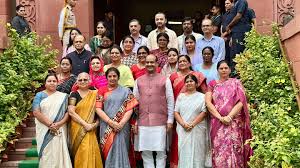
Lok Sabha Speaker Om Birla has reconstituted the Parliamentary Committee on Empowerment of Women for the legislative year 2026–27. Senior leader and Lok Sabha MP Dr. Daggubati Purandeswari has been appointed as the Chairperson of this crucial bicameral panel, which features prominent lawmakers across party lines (including Sudha Murty, P.T. Usha, and Swati Maliwal).
Evolution and Institutional Genesis
- Origin: The committee was established on April 29, 1997, during the 11th Lok Sabha.
- Historical Trigger: Its creation was driven by two identical resolutions moved in both Houses of Parliament on International Women’s Day (March 8, 1996), highlighting a dedicated focus on improving the status of women in India.
Structural Composition and Tenure
- Nature: It is a Joint Parliamentary Committee (JPC), bringing together members from both the Lower and Upper Houses of Parliament.
- Total Membership: It consists of 30 Members.
- Bicameral Breakdown:
- 20 Members are nominated by the Speaker from the Lok Sabha.
- 10 Members are nominated by the Chairman from the Rajya Sabha.
- Tenure: The term of the committee cannot exceed one year. It is reconstituted annually to bring fresh perspectives while maintaining continuous legislative oversight.
- Cross-Party Mandate: Members are expected to operate as a cohesive, non-partisan unit, rising above political affiliations to work collectively toward gender equity.
Core Functions and Statutory Mandate
The committee holds broad investigative and oversight powers under the rules of parliamentary procedure:
- Oversight of the National Commission for Women (NCW): It evaluates the statutory reports submitted by the NCW and suggests legislative and executive measures to improve the status and conditions of women.
- Constitutional Safeguards & Dignity: It reviews measures implemented by the Union Government to guarantee equality, status, and dignity for women in all spheres of public and private life.
- Representation & Affirmative Action: It monitors government initiatives aimed at securing comprehensive education and adequate representation for women in legislative bodies, public services, and other employment sectors.
- Appraisal of Welfare Welfare Schemes: It assesses the efficiency, grass-roots reach, and execution of central welfare programs and gender-responsive budgets dedicated to women.
- Implementation Auditing: It reviews Action Taken Reports (ATRs) from the Union Government and Union Territory administrations concerning prior recommendations made by the committee.
Constitutional and Statutory Alignment
The work of this committee gives functional teeth to several constitutional directives:
- Article 15(3): Enables the State to make special provisions for women.
- Articles 39(a) and 39(d): Mandate equal livelihood opportunities and equal pay for equal work.
- Article 42: Mandates just, humane working conditions and maternity relief.
- Article 51A(e): Enforces the Fundamental Duty to renounce practices derogatory to the dignity of women.
Core Institutional Challenges
While a key driver of policy oversight, the committee encounters structural constraints common to many parliamentary panels:
- Its findings and observations are purely advisory and not legally binding on the executive.
- It depends on administrative ministries to submit timely data and implement its recommendations, which often leads to bureaucratic delays.
- The wide scope of cross-cutting issues (safety, tech-driven economies, digital divide) must be evaluated within a limited one-year operational tenure.
Strategic Link: "Women-Led Development"
During recent national deliberations, the committee's focus has evolved from simple "women's welfare" to driving "Women-Led Development"—a key target for India's Viksit Bharat roadmap. Modern priorities focus heavily on closing the gender digital divide, scaling up women's participation in STEM fields, ensuring digital safety, and optimizing Gender Responsive Budgeting to make economic allocations transparently benefit women.