
Anaimangalam Copper Plates
- 19 May 2026
In News:
During Prime Minister Narendra Modi's recent visit to the Netherlands, the Dutch government formally returned the Anaimangalam Copper Plates — also called the Leiden Plates — to India. The repatriation marks a significant diplomatic achievement and revives interest in one of South Asia's most powerful medieval empires.
Historical Significance
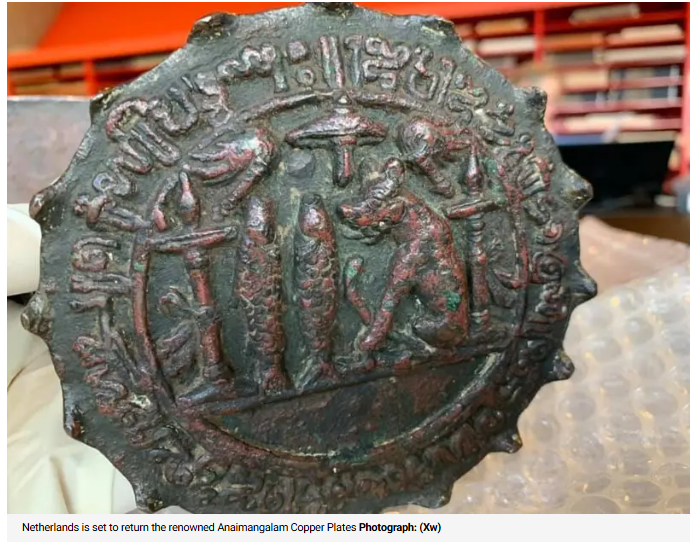
The Anaimangalam Copper Plates are a set of 21 inscribed copper sheets dating to the reign of Emperor Rajaraja Chola I (985–1014 CE) and his son Rajendra Chola I. Together, they weigh approximately 30 kg and are bound by a bronze ring bearing the royal seal of Rajendra Chola I. The plates are bilingual — early plates carry Sanskrit text tracing the Chola royal genealogy and invoking divine legitimacy, while the majority are in Tamil, recording administrative and grant-related details.
The Tamil section is of particular historical import: it documents Rajaraja Chola I's grant of land revenues from villages near Anaimangalam in Tamil Nadu to the Chudamani Vihara, a Buddhist monastery at the bustling port of Nagapattinam. Crucially, this monastery had been built by Sri Mara Vijayotunga Varman, the ruler of the Srivijaya kingdom — a maritime empire centred in present-day Indonesia. Although the grant was originally a verbal order of Rajaraja, Rajendra later had it formally engraved on copper to ensure its preservation — an act reflecting the period's administrative sophistication.
Why It Matters: Heritage, Trade and Pluralism
The plates offer rare primary evidence of the Chola Empire's cosmopolitan character. At their peak, the Cholas dominated South India, Sri Lanka, and launched naval campaigns across Southeast Asia. Their reign saw flourishing Indian Ocean trade networks, cross-cultural patronage, and — as these plates demonstrate — active religious pluralism, with a Hindu king endowing land revenues for a Buddhist monastery constructed by a foreign ruler.
This makes the Anaimangalam Copper Plates a unique document at the intersection of diplomacy, religion, and commerce across medieval Asia.
Colonial Displacement and Repatriation
The plates' displacement began around 1700 CE when Dutch missionary Florentius Camper acquired them during the Dutch East India Company's (VOC) control of Nagapattinam. They subsequently reached the Leiden University Library in the Netherlands, where they remained for over three centuries — accessible to scholars but not the general public.
India's systematic repatriation drive, strengthened since 2012, received a significant boost when the UNESCO Intergovernmental Committee (2023) validated India's claim as the country of origin and recommended bilateral talks. The Netherlands' decision to return the plates is a direct outcome of this sustained diplomatic engagement.