
Viksit Bharat–Guarantee for Rozgar and Ajeevika Mission (Gramin) Bill, 2025 (VB-G RaM G)
- 18 Dec 2025
In News:
The Union Government has introduced the Viksit Bharat–Guarantee for Rozgar and Ajeevika Mission (Gramin) Bill, 2025 (VB-G RaM G) in the Lok Sabha to replace the Mahatma Gandhi National Rural Employment Guarantee Act (MGNREGA), 2005.
It marks a structural shift in India’s rural wage employment framework in line with the Viksit Bharat @2047 vision.
What is VB-G RaM G?
It is a proposed statutory rural wage employment guarantee law that:
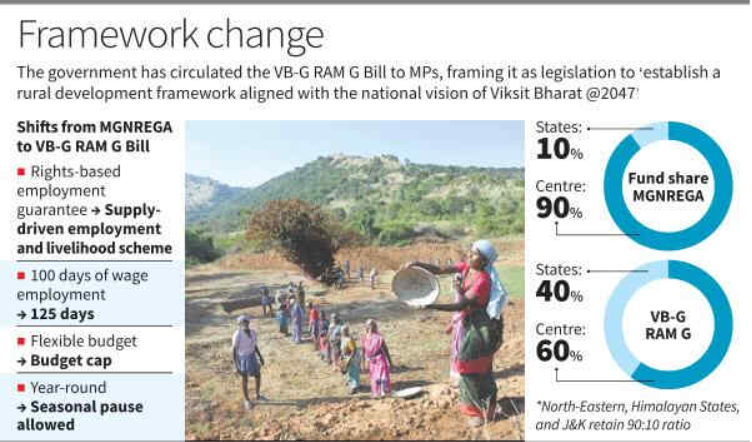
- Assures 125 days of wage employment per rural household per financial year (earlier 100 days under MGNREGA)
- Focuses on durable, productivity-enhancing rural assets
- Integrates employment generation with infrastructure creation, livelihoods, and climate resilience
Core Objectives
- Move from distress-relief employment to development-linked employment
- Ensure convergence of rural schemes
- Create durable and climate-resilient assets
- Improve transparency, digital monitoring, and accountability
Key Features of the Bill
1. Enhanced Employment Guarantee
- Increased from 100 to 125 days
- About 25% higher income potential for rural households
2. Four Priority Work Categories
Works are restricted to:
- Water security (water harvesting, irrigation, conservation)
- Core rural infrastructure (roads, connectivity)
- Livelihood infrastructure (storage, markets, productive assets)
- Climate-resilience works (flood control, drought mitigation, soil conservation)
All works will be mapped into a proposed Viksit Bharat National Rural Infrastructure Stack.
3. Shift to Normative Funding
- Moves from demand-driven (MGNREGA model) to budget-based normative allocation
- Funds distributed to States using objective parameters
- Unemployment allowance still payable if work is not provided
4. Funding Pattern (Centrally Sponsored Scheme)
- 60:40 – Centre : States (most States)
- 90:10 – North-Eastern & Himalayan States
- 100% Central funding – UTs without legislature
5. Digital Governance & Transparency
Mandatory provisions include:
- Biometric attendance
- Aadhaar-linked wage payments
- Geo-tagging of assets
- AI-based fraud detection
- Real-time MIS dashboards
- Weekly public disclosure meetings at Gram Panchayat level
- Strengthened social audits
6. Agricultural Season Safeguard
- States can declare up to 60 days (aggregate) when works will pause during peak sowing/harvesting
- Aims to:
- Ensure farm labour availability
- Prevent wage inflation in agriculture
7. Decentralised Planning
- Works planned through Viksit Gram Panchayat Plans (VGPPs)
- Spatial planning integration with PM Gati Shakti
- Plans aggregated from Gram Panchayat → Block → District → State
8. Institutional Mechanism
- Central & State Gramin Rozgar Guarantee Councils
- States must notify their operational scheme within 6 months of enactment
Why Replace MGNREGA? (Government’s Rationale)
- Rural poverty decline: From 25.7% (2011-12) to ~5% (2023-24)
- Need to shift from relief works to productive infrastructure
- Asset quality issues under MGNREGA
- Reported misappropriation (~?193 crore in 2024-25)
- Only a small % of households completed 100 days post-pandemic
- Rising need for climate-resilient rural infrastructure
Major Differences from MGNREGA
|
Feature |
MGNREGA |
VB-G RaM G (Proposed) |
|
Nature |
Demand-driven legal right |
Normative, budget-linked guarantee |
|
Workdays |
100 |
125 |
|
Work scope |
Broad categories |
4 focused priority sectors |
|
Funding |
Mostly Centre-funded wages |
60:40 cost sharing (most states) |
|
Technology |
Supportive |
Mandatory & codified |
|
Planning |
Gram Sabha-based |
VGPP + national infrastructure stack |