
Rowmari–Donduwa Wetland Complex
- 05 Nov 2025
In News:
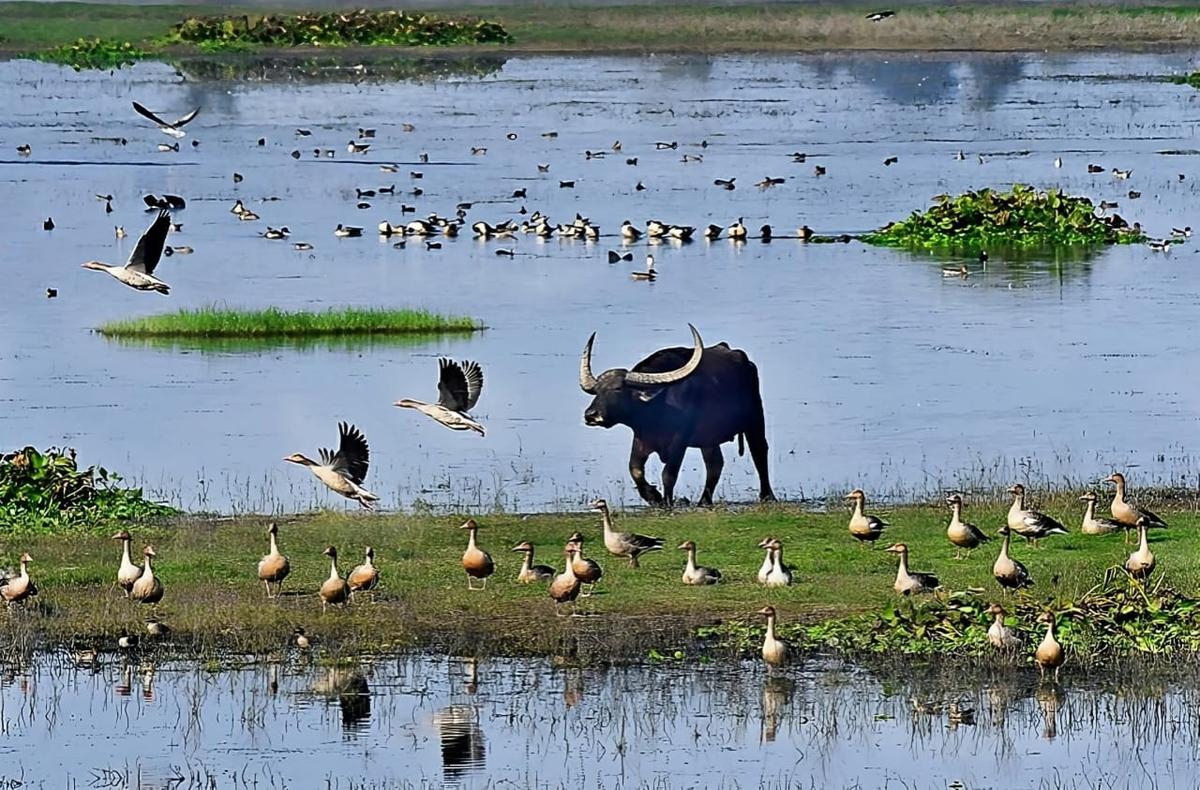
The Rowmari–Donduwa Wetland Complex in Assam has recently emerged as a strong contender for Ramsar Site designation, driven by its exceptional biodiversity, critical ecological functions, and strategic location within the Kaziranga landscape.
Location and Ecological Setting
- The Rowmari–Donduwa Wetland Complex lies within the Laokhowa Wildlife Sanctuary, a buffer zone of the Kaziranga Tiger Reserve.
- It forms an interconnected floodplain–marsh system extending 2.5–3 sq km.
- Together with the adjoining Burhachapori WLS, it serves as an important wildlife corridor between the Kaziranga–Orang landscape, with the Brahmaputra River shaping its riverine and wetland ecosystems.
Biodiversity Significance
1. Exceptional Avifaunal Diversity
- The 6th Kaziranga Wetland Bird Census (2025) reported
- 20,653 birds from 75 species at Rowmari Beel
- 26,480 birds from 88 species at Donduwa Beel
- Total: 47,000+ birds
- This exceeds the bird counts of Northeast India’s existing Ramsar sites—Deepor Beel (Assam) and Loktak Lake (Manipur).
- More than 120 species of resident and migratory birds recorded, including threatened species such as:
- Knob-billed Duck
- Black-necked Stork
- Ferruginous Pochard
2. Habitat Diversity: The wetland complex contains marshes, floodplain lakes, grasslands, and riverine islands (chars), supporting high ecological productivity.
3. Presence of Rare & Endangered Species: Recent surveys by scholars from Tezpur, Gauhati, and Nagaon Universities have documented rare and critically endangered waterbirds, emphasizing the site's international ecological value.
The Ramsar Convention (1971)
- A global treaty for conservation and wise use of wetlands, signed at Ramsar, Iran (1971).
- India joined in 1982 and today hosts 94 Ramsar Sites (as of Nov 2025)—the highest in Asia.
- Chilika Lake (Odisha) was India’s first Ramsar Site (1981).
- Tamil Nadu has the highest number of Ramsar Sites among Indian states.
- About 10% of India’s wetland area is under the Ramsar framework.
Laokhowa–Burhachapori Wildlife Sanctuary
- Serves as a buffer and migration corridor between Kaziranga and Orang National Parks.
- Home to key species:
- Great Indian One-horned Rhinoceros
- Royal Bengal Tiger
- Asiatic Elephant
- Asiatic Water Buffalo
- Otters, pangolins
- The Brahmaputra River supports the Gangetic River Dolphin.
Kaziranga National Park
- Established: 1908, National Park (1974)
- UNESCO World Heritage Site: 1985
- Tiger Reserve: 2006
- Supports ~2,200 one-horned rhinos (≈ two-thirds of global population).
- Rich in large mammals, birds, and aquatic fauna, forming the ecological backbone of the region.