
Preah Vihear Temple
- 17 Dec 2025
In News:
India has expressed concern and called for the protection of the Preah Vihear Temple amid renewed border tensions between Thailand and Cambodia, which reportedly affected areas near the temple complex.
Location and Setting
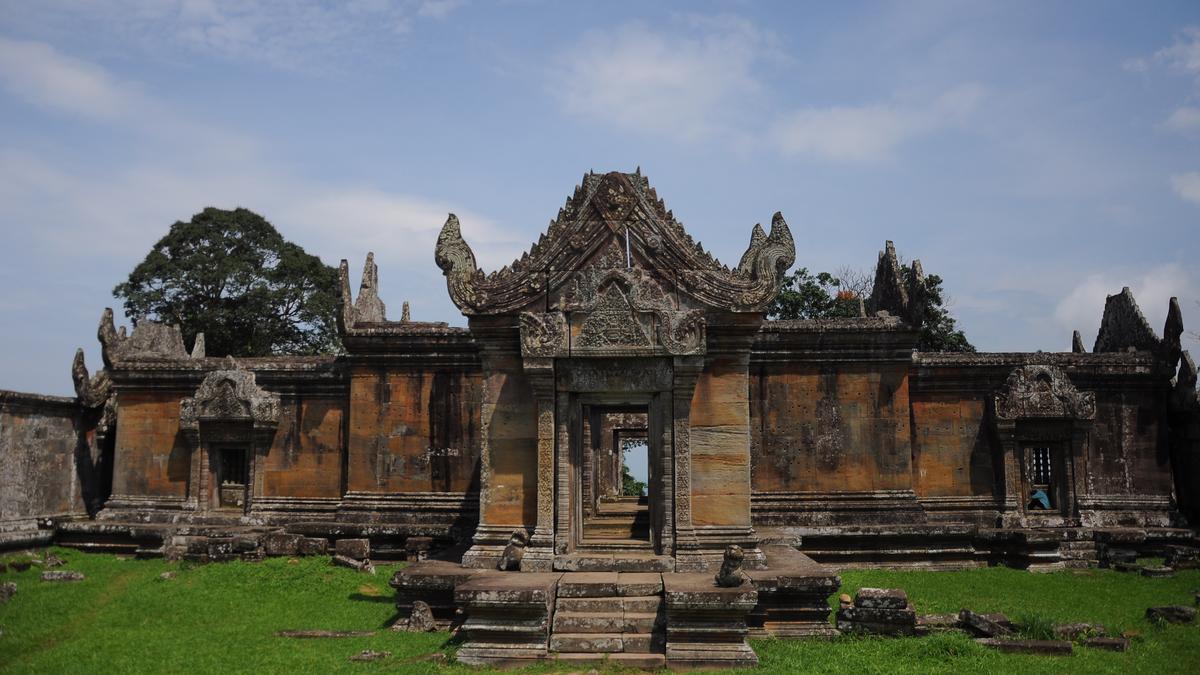
- Preah Vihear Temple is located in Preah Vihear Province in northern Cambodia, dramatically positioned atop a cliff in the Dangrek Mountain range along the Cambodia–Thailand border.
- Its elevated placement provides commanding views over the surrounding plains and has historically contributed to territorial disputes between the two countries.
Religious Significance
- The temple is dedicated to Lord Shiva and is an important example of Hindu religious architecture in mainland Southeast Asia, reflecting the spread of Indian cultural and religious influences across the region during the medieval period.
Historical Background
- The temple was constructed during the height of the Khmer Empire. Its earliest major construction phase is attributed to Suryavarman I (reigned 1002–1050 CE), and it was later expanded and refined under Suryavarman II (reigned 1113–1150 CE), the same ruler associated with major temple-building activity in the region.
- Preah Vihear was inscribed as a UNESCO World Heritage Site in 2008, recognizing its outstanding universal value in terms of architecture, history, and cultural significance.
Architectural Features
- Preah Vihear is considered an outstanding masterpiece of Khmer temple architecture. Unlike many other Khmer temples that are arranged concentrically, this complex is laid out along a long north–south axis stretching approximately 800 metres.
- The temple comprises a sequence of sanctuaries connected by pavements and steep staircases that climb the hillside. The approach includes multiple monumental gateways known as gopuras more than five in number which are linked by a long causeway rather than enclosed courtyards.
- Several of these gopuras are topped with multi-tiered platforms, and while some feature stone roofs, others historically had wooden superstructures, highlighting a blend of durable and perishable architectural elements.
Preah Vihear Temple Dispute
- 25 Jul 2025
In News:
Tensions between Thailand and Cambodia have sharply escalated in recent months, marked by armed clashes, airstrikes, and diplomatic fallout, all centering around the Preah Vihear Temple—a centuries-old Hindu monument of immense cultural and geopolitical significance.
About Preah Vihear Temple
- Location: Preah Vihear Province, northern Cambodia, atop a cliff in the Dangrek Mountain range, near the Cambodia–Thailand border.
- Religious Affiliation: Hindu temple dedicated to Lord Shiva.
- Historical Background:
- Constructed during the Khmer Empire, primarily in the 11th and 12th centuries.
- Key patrons: King Suryavarman I (1002–1050) and King Suryavarman II (1113–1150).
- UNESCO World Heritage Site: Inscribed in 2008 for its exceptional architectural and historical value.
Architectural Features
- Exemplifies Khmer temple architecture with a linear arrangement of sanctuaries linked by pavements and staircases over an 800-metre-long axis.
- Contains over five gopuras (monumental gateways) connected by a raised path and tiered platforms.
- Mixture of stone and wooden roofing, though many structures are partially in ruins.
Territorial Dispute Overview
- Historical Basis:
- Dispute stems from differing interpretations of a 1907 French map, which placed the temple inside Cambodian territory.
- Thailand disputes the map, arguing lack of formal acceptance.
- International Court of Justice (ICJ) Rulings:
- 1962: ICJ ruled the temple belongs to Cambodia, citing Thailand’s implicit acceptance of the 1907 map.
- Thailand was ordered to withdraw troops and return artifacts taken since 1954.
- 2013 (Reaffirmation): ICJ clarified that surrounding areas—particularly a 4.6 sq. km. disputed zone—also belong to Cambodia.
Major Flashpoints in the Conflict
- 2008: Cambodia registers Preah Vihear as a UNESCO World Heritage Site, triggering nationalist backlash in Thailand.
- 2008–2011: Border skirmishes escalate, culminating in a 2011 clash that killed at least 15 people.
- 2025 Escalation:
- Renewed violence erupted in July 2025, after a series of provocations:
- May 2025: Cambodian soldier killed.
- July 2025: Two Thai soldiers injured in landmine blasts.
- July 24, 2025: Armed conflict intensifies—Thai airstrikes target Cambodian positions near the temple.
- Casualties: At least 9 civilians killed, 14 injured in Thai provinces bordering Cambodia.
- Both nations expelled ambassadors and blamed each other for violations of sovereignty.
- Renewed violence erupted in July 2025, after a series of provocations:
Significance of the Dispute
- Cultural: Preah Vihear is a sacred site and national symbol for both nations.
- Strategic: Its location atop a cliff offers military advantage and control over surrounding terrain.
- Diplomatic: The temple remains a fault line in bilateral ties, with unresolved territorial claims despite multiple ICJ verdicts.