
Under-the-Skin Immunotherapy for Lung Cancer
- 17 May 2026
In News:
- In a major advancement for oncological care, Swiss pharmaceutical company Roche has launched India’s first under-the-skin (subcutaneous) immunotherapy drug, Tecentriq SC (atezolizumab).
- Approved by the Central Drugs Standard Control Organisation (CDSCO), this formulation marks a significant departure from traditional intravenous (IV) cancer treatments.
- Given that lung cancer is among the most prevalent malignancies in India—with approximately 80,000 to 81,000 new cases diagnosed annually, frequently at advanced stages—this clinical innovation is poised to reshape cancer management frameworks.
Mechanism of Action: Re-engineering Immunotherapy
Tecentriq SC functions by targeting and blocking the Programmed Death-Ligand 1 (PD-L1) protein. Cancer cells often express PD-L1 to suppress the host immune response and evade detection by T-cells. By inhibiting this specific interaction, atezolizumab removes the biochemical "off-signal," effectively allowing the body's native immune system to identify, target, and dismantle tumor cells.
To achieve rapid delivery under the skin, Tecentriq SC integrates Halozyme Therapeutics' Enhanze drug delivery technology. This process utilizes recombinant human hyaluronidase PH20 (rHuPH20), an enzyme that temporarily enhances permeability in the subcutaneous tissue, enabling the medication to disperse rapidly into the bloodstream.
Clinical Efficacy, Suitability, and Medical Advantages
The drug is indicated for the treatment of adult patients presenting with:
- Adjuvant Non-Small Cell Lung Cancer (NSCLC) (early-stage post-surgical treatment)
- Metastatic NSCLC (advanced-stage, spreading cancer)
As NSCLC accounts for nearly 80% to 85% of all lung cancer occurrences in India, the therapeutic scope of this innovation is broad. However, treatment suitability requires precise diagnostics. Patients must display high levels of PD-L1 expression on their tumor cells, making approximately half of the diagnosed NSCLC cohort eligible for this targeted, and occasionally chemotherapy-free, monotherapy.
Medical benefits include:
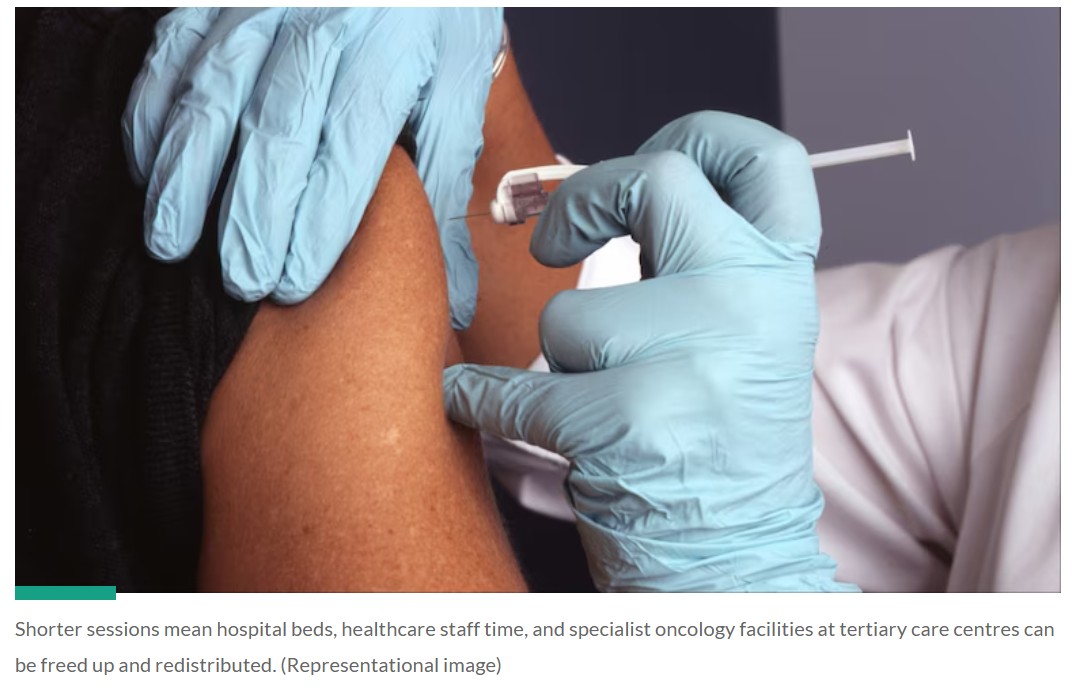
- Drastic Time Reduction: Administration drops from several hours of IV infusion to a localized injection (typically in the thigh) lasting roughly 7 minutes, reducing treatment time by approximately 80%.
- Enhanced Patient Well-being: Subcutaneous administration eliminates the physical distress and pain of finding viable veins in frail individuals. Shorter clinic stays also alleviate travel fatigue and emotional stress for both patients and caregivers.
- Improved Compliance: Streamlined administration enhances adherence to treatment schedules, crucial for positive long-term clinical outcomes.
Socio-Economic Realities and Health Economics
While clinically transformative, the introduction of Tecentriq SC highlights the persistent challenge of affordability in tertiary healthcare.
- Financial Implications: The maximum retail price is set at ?3.7 lakh per vial/dose. With a standard treatment regimen requiring roughly six cycles administered every 21 days, the cumulative expenditure poses a heavy financial burden on the average Indian family.
- Mitigation and Access Pathways: To alleviate this financial strain, Roche has introduced a patient assistance mechanism called the "Blue Tree" program, which offers financial support and Equated Monthly Instalment (EMI) options. Crucially, the drug has been integrated into the Central Government Health Scheme (CGHS), providing substantial relief to eligible public sector beneficiaries. Furthermore, medical experts point out that despite a slightly higher baseline cost for the subcutaneous drug formulation over its IV counterpart, the overall economic impact balances out by eliminating hospital bed charges, prolonged day-care monitoring fees, and ancillary costs.
Significance for India's Healthcare Infrastructure
For a developing nation grappling with an escalating non-communicable disease (NCD) burden, the deployment of subcutaneous immunotherapy has profound systemic implications:
- Optimization of Healthcare Resources: Because Tecentriq SC can be safely administered by trained nursing staff in outpatient departments, one infusion station can treat up to five patients in the time previously occupied by a single IV recipient. This dramatically increases patient throughput.
- Decentralization of Oncology Care: By mitigating the need for specialized, complex intravenous infrastructure, this model facilitates the shift of cancer care from overburdened tertiary hospitals in metropolitan zones to localized daycare centers, advancing the objective of equitable healthcare distribution.