
Startup India Fund of Funds 2.0 (FoF 2.0)
- 15 Apr 2026
In News:
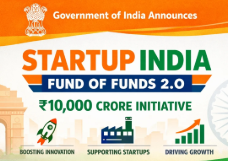
In a significant move to bolster India's entrepreneurial landscape, the Government of India officially notified the Startup India Fund of Funds 2.0 (FoF 2.0). With a massive corpus of ?10,000 crore, this second iteration aims to bridge funding gaps and catalyze domestic capital for the next generation of Indian innovators.
Background and Evolution
FoF 2.0 is the successor to the original Fund of Funds for Startups (FFS 1.0), which was launched in 2016 under the Startup India Action Plan. While the first phase focused on establishing the startup culture, the 2.0 version is designed to scale the ecosystem, particularly in capital-intensive and frontier technology sectors.
Core Objective
The primary goal is to mobilize venture and growth capital from domestic sources. By providing a "cornerstone" government commitment, the fund encourages private institutional investors to contribute, thereby reducing the Indian startup ecosystem's over-reliance on foreign capital.
Operational Mechanism: How it Works
The Startup India FoF 2.0 does not invest directly in startups. Instead, it follows a "Fund of Funds" model:
- Investment in AIFs: The government contributes capital to the corpus of SEBI-registered Alternative Investment Funds (AIFs).
- Downstream Investment: These AIFs then identify and invest in individual entities recognized as 'startups' by the Central Government.
- Implementation Agencies:SIDBI (Small Industries Development Bank of India) is the primary agency to operationalize the scheme. Notably, provisions exist to appoint an additional domestic implementing agency to expand the reach.
Key Features and Strategic Focus
|
Feature |
Details |
|
Total Corpus |
?10,000 Crore |
|
Time Frame |
Spread across the 16th and 17th Finance Commission cycles. |
|
Nodal Dept. |
Department for Promotion of Industry and Internal Trade (DPIIT). |
|
Priority Segments |
Deep Tech, Innovative Manufacturing, and Early Growth-stage startups. |
|
Flexibility |
Sector and stage agnostic; allows for larger corpus and longer-duration AIFs for capital-intensive sectors. |
Governance and Oversight
To ensure transparency and high-quality fund selection, a robust three-tier governance structure has been established:
- Venture Capital Investment Committee (VCIC): Composed of industry veterans, the VCIC undertakes the screening and selection of eligible AIFs.
- Empowered Committee (EC): This body provides high-level monitoring and oversight of the scheme's implementation and performance.
- Umbrella Framework: Includes provisions for co-investment by the government and institutional investors, backed by strict governance safeguards.
Startup India Fund of Funds 2.0
- 17 Feb 2026
In News:
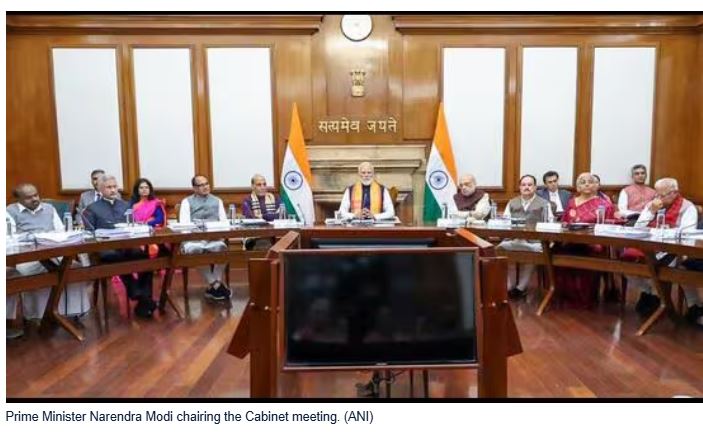
In February 2026, the Union Cabinet approved the establishment of Startup India Fund of Funds 2.0 (FoF 2.0) under the Startup India initiative. With a corpus of ?10,000 crore, the scheme aims to mobilise long-term domestic capital, strengthen the venture capital (VC) ecosystem, and accelerate innovation-led economic growth. It represents the next phase of India’s startup policy architecture, moving from ecosystem creation to strategic capital deepening.
Background: Evolution of Startup India
Launched in 2016, the Startup India initiative has transformed India into one of the world’s largest startup ecosystems.
- Growth from fewer than 500 startups in 2016 to over 2 lakh DPIIT-recognised startups today.
- 2025 recorded the highest-ever annual startup registrations, indicating sustained entrepreneurial momentum.
To address early-stage funding gaps, the Government launched the Fund of Funds for Startups (FFS 1.0) in 2016.
Performance of FFS 1.0
- ?10,000 crore corpus fully committed to 145 Alternative Investment Funds (AIFs).
- Supported AIFs invested over ?25,500 crore in 1,370 startups.
- Investments spanned agriculture, AI, robotics, clean tech, fintech, biotechnology, manufacturing, space tech and more.
FFS 1.0 catalysed domestic venture capital, crowded in private investment, and nurtured first-time founders, laying a strong foundation for innovation financing.
Rationale for FoF 2.0
Despite ecosystem growth, structural gaps remain:
- Limited availability of patient capital for deep tech and high-risk sectors.
- Over-concentration of funding in metro cities.
- Dependence on foreign capital in the VC space.
- Funding constraints for early-growth stage startups.
FoF 2.0 seeks to address these high-risk capital gaps and align startup financing with national economic priorities.
Key Features of Startup India FoF 2.0
1. Financial Outlay: ?10,000 crore corpus dedicated to mobilising venture capital for startups.
2. Targeted, Segmented Funding Approach
(a) Deep Tech & Tech-Driven Manufacturing
- Focus on breakthrough technologies requiring long-term, patient capital.
- Supports sectors critical for strategic and economic self-reliance.
(b) Early-Growth Stage Support
- Acts as a safety net for innovative ideas.
- Reduces early-stage failures caused by funding shortages.
(c) National Reach
- Encourages investments beyond major metropolitan hubs.
- Promotes geographically inclusive innovation.
(d) Addressing High-Risk Capital Gaps: Directs greater capital to priority areas aligned with self-reliance and economic growth.
(e) Strengthening Domestic VC Base
- Special emphasis on smaller domestic funds.
- Reduces overdependence on foreign venture capital flows.
Economic and Strategic Significance
- Innovation-Led Growth: Supports globally competitive technologies and products.
- Manufacturing Boost: Aligns with the push for advanced and tech-driven manufacturing.
- Job Creation: Facilitates high-quality employment opportunities.
- Economic Resilience: Strengthens domestic capital formation in strategic sectors.
- Regional Inclusivity: Democratizes access to venture funding across states.
The scheme aligns with the broader vision of Viksit Bharat @ 2047, positioning startups as engines of structural transformation rather than peripheral economic actors.