
Sperm Whales
- 22 May 2026
In News:
A study published in Proceedings of the Royal Society B by researchers from the University of California, Berkeley has revealed that sperm whale communication possesses a multi-layered acoustic structure strikingly parallel to human phonology — the organisational system underlying human language. The findings fundamentally challenge how scientists have understood non-human animal communication and open new frontiers in comparative linguistics and evolutionary biology.
What are Codas?
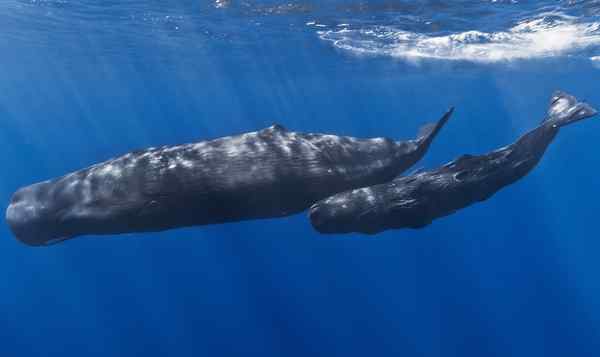
Sperm whales (Physeter macrocephalus) — the largest of the toothed whales (Odontocetes) and possessors of the largest brain of any creature in geological history — do not sing like humpback whales. Instead, they communicate using short rhythmic sequences of rapid clicks called codas, exchanged while coordinating within their highly social, matriarchal family and clan groups. Until now, codas were classified purely by timing and rhythm — the number of clicks and the spacing between them (inter-click intervals) — in a system likened to Morse code.
The Breakthrough: Whale "Vowels"
The new study reveals an entirely overlooked dimension. When researchers analysed the frequency components within individual clicks, they found two distinct categories: clicks with a single dominant frequency peak and those with two peaks. In human linguistics, such peaks are called formants — the resonant frequencies that allow humans to distinguish between vowels such as "ah" and "ee." The researchers accordingly labelled these whale click types "a" and "i".
Crucially, the same coda pattern — say, a 1 1 3 sequence — can be produced using either "a" clicks or "i" clicks, meaning whales control both timing and click type as independent variables. This represents a second, previously invisible layer of communicative structure.
Multiple Layers of Phonological Organisation
The study identifies several additional layers of structure:
- Length variation: "a" codas are consistently longer than "i" codas even when the timing pattern is identical, mirroring how vowel length carries meaning in human languages.
- Individual variation: Different individual whales produce codas of different lengths within the same type, yet all follow the same underlying "a longer than i" rule — indicating both individual identity and shared group conventions.
- Sequential dependency: The first click of a new coda is sometimes influenced by the type of coda that immediately preceded it — demonstrating that codas are not produced in isolation but form part of a structured sequence, again paralleling rules of human speech production.
Convergent Evolution: The Deeper Significance
The researchers invoke convergent evolution to explain these parallels — humans and sperm whales diverged tens of millions of years ago, yet both independently developed complex vocal systems organised by discrete sound categories, timing, and positional rules. The rich social and cultural lives of sperm whales — where behaviours are transmitted across generations within matriarchal clans — likely drove the evolution of this communicative complexity.
However, scientists caution against prematurely labelling sperm whale codas as "language." The fundamentally rhythmic nature of codas sets them apart from the combinatorial flexibility of human speech, and what specific information these patterns convey remains unknown. Project CETI (Cetacean Translation Initiative) — which uses machine learning and acoustic AI to decode whale communication — is expected to shed further light on the semantic content of these signals.