
Sea Slugs
- 26 Apr 2026
In News:
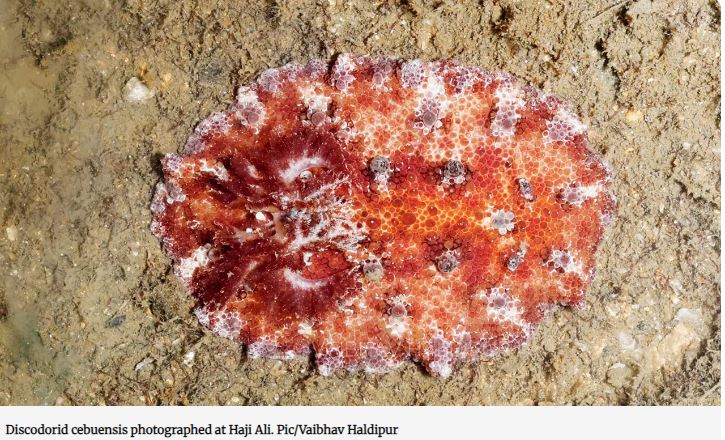
India's marine biodiversity documentation reached a significant milestone with the first-ever recorded sighting of a rare sea slug, Discodoriscebuensis (also referred to as Discodoridcebuensis), at Haji Ali, Mumbai. Previously documented in regions such as the Philippines and parts of the tropical Indo-West Pacific, this discovery highlights the ecological richness of Mumbai’s rocky intertidal zones and underscores the importance of urban coastal conservation.
Decoding the Sea Slug: Nature's Vibrant Gastropods
Sea slugs, often called nudibranchs, are soft-bodied marine mollusks. They belong to the class Gastropoda, a diverse group that includes common land snails and slugs. However, unlike their terrestrial relatives, marine sea slugs have undergone an evolutionary transition where they have completely lost their protective shells, quills, and mantle cavities.
Key Biological and Physiological Traits
- Sensory Mechanisms: On their heads, they possess specialized tentacles known as rhinophores. These act as chemo-sensory organs, allowing the slug to detect chemical signals and movement in the water to locate food or mates.
- Defense and Toxicity: Despite their lack of shells, they are far from defenseless. Many species utilize aposematism—bright, vibrant colors and intricate patterns that warn predators of their toxicity.
- Pigment Absorption: Interestingly, sea slugs derive their color and chemical defenses from their diet. By consuming sponges, algae, and jellyfish, they absorb pigments and can even store the stinging cells (nematocysts) of their prey within their own bodies for protection.
Ecological Significance: Sentinels of the Sea
Sea slugs are more than just visual marvels; they serve as critical bio-indicators of marine health.
- Habitat Indicators: They are primarily found in coral reefs and sponge-rich environments. A high diversity of sea slugs typically indicates a robust and thriving coral ecosystem.
- Ecological Balance: As slow-moving grazers, they control the populations of sponges, algae, and other small invertebrates, maintaining the delicate equilibrium of the seafloor.
- Genetics and Regeneration: Some species exhibit extraordinary biological traits, such as the ability to regenerate lost limbs, photosynthesize using chloroplasts stolen from algae (kleptoplasty), or even incorporate prey genes into their own DNA.
The Mumbai Discovery: Discodoriscebuensis
The specific species found at Haji Ali belongs to the family Discodorididae. Unlike some of its flashier relatives, Discodoriscebuensis is characterized by:
- A flat, oval body with a mottled brown or light red-brown appearance, helping it camouflage against rocks and sponges.
- Distinctive tubercles (small bumps) along its back, which may have white or dusky violet tips.
- A size typically ranging between 35 mm and 50 mm.
The discovery was made by local wildlife enthusiasts during a coastal survey, proving that even highly urbanized shorelines like Mumbai’s can harbor undocumented and rare marine life.
ZSI names a newly discovered head-shield sea slug after President Droupadi Murmu
- 01 Mar 2024
Why is it in the News?
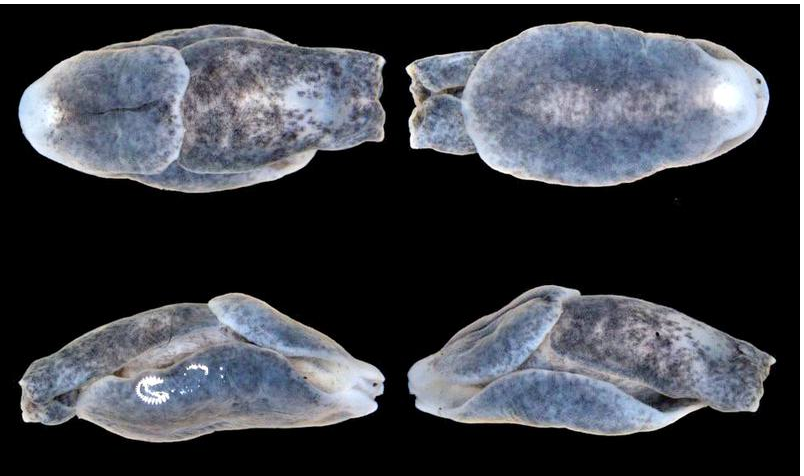
The Zoological Survey of India named a new marine species of head-shield sea slug with ruby red spot which was discovered from West Bengal and Odisha coast after President of India Droupadi Murmu.
About Melanochlamys Droupadi:
- Melanochlamys Droupadi is a newly discovered marine species of head-shield sea slug distinguished by its striking ruby red spot.
- This species, belonging to the Melanochlamys genus, was first identified along the coasts of Digha in West Bengal and Udaipur in Odisha.
Key Features:
- This small invertebrate typically measures up to 7 mm in length.
- It primarily inhabits wet and soft sandy beaches.
- Adorned in brownish-black hues, it features a distinctive ruby-red spot towards its hind end.
- Melanochlamys Droupadi exhibits hermaphroditic characteristics, possessing both male and female reproductive organs. However, it requires another sea slug for successful reproduction.
- Internally, it possesses a shell and a posterior segment comprising 61 per cent of its body length.
- To safeguard against sand infiltration, it continuously secretes transparent mucus, forming a protective sheath around its body.
- When in motion, it burrows beneath smooth sand, creating a moving capsule where its body remains mostly concealed, akin to a turtle, leaving behind a discernible trail.
What are Sea Slugs?
- Sea slugs are a diverse group of molluscs inhabiting marine environments, characterized by their slug-like appearance.
- They occupy a wide range of habitats, spanning from shallow intertidal zones to the depths of the ocean, and from polar regions to tropical waters.
- As agile predators, sea slugs prey on mobile organisms such as other shelled and unshelled sea slugs, roundworms, marine worms, and small fish.
- Currently, researchers have identified 18 species of sea slugs worldwide.
- While sea slugs predominantly inhabit temperate regions within the Indo-Pacific Oceanic realm, three species exhibit truly tropical distributions: Melanochlamys papillata from the Gulf of Thailand, Melanochlamys bengalensis from the West Bengal and Odisha coast, and the newly discovered species.