
SMILE Mission
- 20 May 2026
In News:
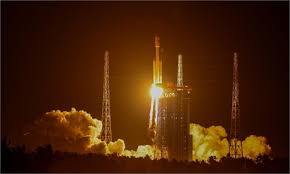
Recently, the SMILE spacecraft lifted off on a Vega-C rocket from Europe's Spaceport in French Guiana, marking the successful launch of one of the most ambitious international space science collaborations in recent years — and a landmark moment in China-Europe scientific cooperation.
What is SMILE?
SMILE stands for Solar wind Magnetosphere Ionosphere Link Explorer. It is the first mission-level, all-round, in-depth collaborative space science exploration project between the Chinese Academy of Sciences (CAS) and the European Space Agency (ESA), selected from a pool of 13 candidate missions proposed under a joint ESA-CAS call in 2015 and adopted into ESA's Science Programme in 2019.
SMILE's core objective is to study how Earth's magnetosphere — the planet's invisible magnetic shield — responds to the continuous bombardment of charged particles and radiation from the Sun, collectively called the solar wind. It will make the world's first X-ray observations of Earth's magnetic shield and use an ultraviolet camera to watch the northern lights non-stop for 45 hours at a time.
Orbit and Technical Specifications
SMILE will be placed in a highly inclined 73-degree, highly elliptical orbit, reaching approximately 121,000 km above the North Pole at apogee — about a third of the distance to the Moon. This vantage point allows continuous, uninterrupted observation of the magnetosphere's entirety during each orbit. Following launch, SMILE will spend around one month travelling to its operational orbit, with scientific data collection expected to officially begin in September 2026. The spacecraft weighs approximately 2,300 kg and has a nominal mission lifetime of three years.
Four Scientific Instruments
The mission carries four complementary instruments operating across X-ray and ultraviolet wavelengths, combining both remote sensing and in situ measurements:
- Soft X-ray Imager (SXI) — developed by ESA (University of Leicester/UKSA): It detects X-rays produced when heavy ions in the solar wind collide with neutral particles in Earth's exosphere through a process called solar wind charge exchange (SWCX), yielding the first global X-ray images of Earth's magnetosphere.
- Ultraviolet Aurora Imager (UVI) — jointly contributed by ESA and CAS: captures continuous ultraviolet imagery of auroral activity across polar regions.
- Light Ion Analyser (LIA) — developed by CAS: measures properties and behaviour of solar wind ions in situ near Earth.
- Magnetometer — developed by CAS: records magnetic field variations along SMILE's orbit.
Why It Matters: Space Weather and Civilisational Risk
Earth's magnetosphere is not merely a scientific curiosity — it is the essential shield that makes life possible. Without it, solar radiation would strip away the atmosphere and irradiate the surface. Understanding its dynamics has urgent practical implications: geomagnetic storms triggered by intense solar activity can disrupt power grids, satellite communications, GPS navigation, and aviation systems — risks that grow as human civilisation becomes more technologically dependent.