
Rusty-Spotted Cat
- 08 May 2026
In News:
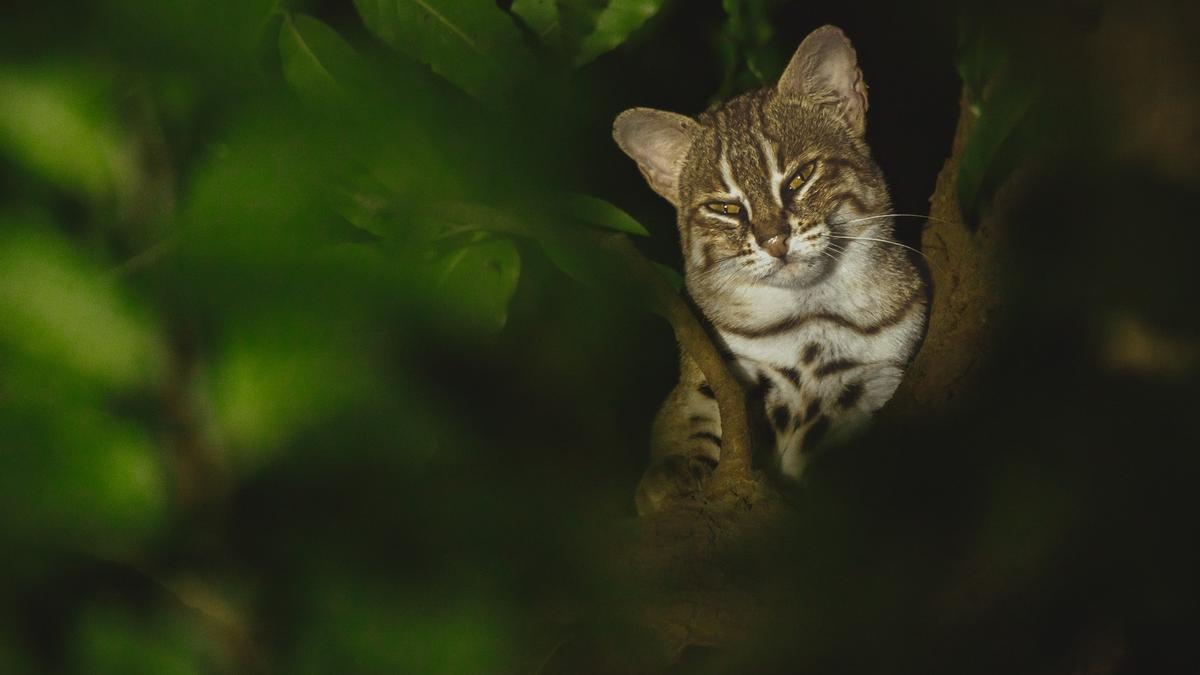
In a significant breakthrough for wildlife conservation, researchers have documented the first photographic evidence of a rusty-spotted cat (Prionailurus rubiginosus) breeding within the Aravalli hills of Delhi-NCR and Haryana. The sighting of a female with a kitten in the scrublands of Faridabad confirms that the species is actively reproducing outside traditionally protected areas. This discovery underscores the critical ecological role of the Aravallis as a biodiversity corridor amidst rapid urban expansion.
Profile of the "Hummingbird of the Cat Family"
The rusty-spotted cat is an evolutionary marvel, holding the title of the world's smallest wild cat species. Due to its diminutive size—weighing a mere 1 to 1.5 kg—it is often colloquially referred to as the "hummingbird of the cat family."
- Physical Features: It is characterized by a fawn-grey coat adorned with distinct rust-colored spots along its back and flanks. Its small stature and specialized markings provide excellent camouflage in dense scrub and rocky terrains.
- Behavioral Traits: The species is primarily nocturnal, highly agile, and significantly arboreal. Its diet is diverse, consisting of rodents, insects, frogs, and small birds.
- Adaptability: While traditionally thought to be shy and reliant on deep forests, the recent evidence suggests the cat is remarkably adaptable, surviving in agricultural fringes and human-modified landscapes.
Distribution and Global Significance
The rusty-spotted cat is endemic to the Indian subcontinent, found only in India, Sri Lanka, and Nepal.
- India’s Role: India is the primary stronghold for the species, harboring approximately 80% of its global population.
- Indian Range: Its presence in India is widespread, stretching from Tamil Nadu in the south to Jammu and Kashmir in the north, including significant populations in Madhya Pradesh, Odisha, and Gujarat.
- The Aravalli Context: The sighting in the Haryana-Delhi stretch of the Aravallis is pivotal. It proves that the "waste" scrublands of this ancient mountain range are vital habitats capable of supporting the full life cycle of rare carnivores.
Conservation Status and Legal Protection
Given its restricted range and small population size, the rusty-spotted cat is accorded high priority under various international and national legal frameworks:
- IUCN Red List: Classified as Near Threatened.
- Wildlife (Protection) Act, 1972: Listed under Schedule I, granting it the highest level of legal protection in India, equivalent to that of the Tiger or the Asiatic Lion.
- CITES: Included in Appendix I for the Indian population (prohibiting international trade) and Appendix II for the Sri Lankan population.
Critical Threats and Conservation Challenges
Despite its adaptability, the species faces multifaceted challenges that threaten its long-term survival in the Delhi-NCR region and beyond:
- Habitat Fragmentation: The Aravallis face relentless pressure from real estate development, illegal mining, and agricultural encroachment. This fragments the landscape, isolating breeding populations.
- Infrastructure Hazards: As nocturnal animals moving between forest patches, these cats face high roadkill mortality on the dense network of highways cutting through the Aravalli corridor.
- Human-Wildlife Conflict: In rural and semi-urban fringes, they are often victims of retaliatory killings by farmers who mistake them for pests or fear for their poultry.
- Environmental Degradation: Deforestation and the spread of invasive species reduce the availability of its natural prey base, such as rodents and small birds.
Rusty-Spotted Cat
- 01 Feb 2025
In News:
For the first time, the Rusty-Spotted Cat (Prionailurus rubiginosus) has been spotted in the forests of Purulia district, West Bengal, captured on a camera trap set up by the NGO HEAL during pangolin poaching surveillance. This marks a significant range extension and has excited conservationists and forest officials.
Key Features
- World’s smallest and lightest wild cat: Weighs between 900 grams to 1.5 kg
- Length: Approx. 1.5 feet, with a 1-foot-long tail
- Appearance:
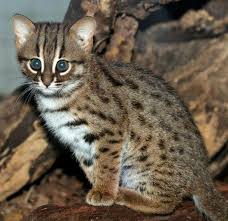
- Fawn-grey coat with rusty red spots on back and flanks
- Short, rounded head with two white facial streaks
- Large eyes with greyish-brown to amber irises – an adaptation to nocturnal behavior
- Short legs, black-soled feet, and an unmarked rusty tail
- Behavior:
- Nocturnal and elusive
- Uses scent marking to establish territory
- Gestation period: 66–70 days
Habitat and Distribution
- Found in dry deciduous and semi-deciduous forests, including:
- Northern & Central India, Western Ghats, Rajasthan, Kachchh, and Peninsular India
- Also present in Sri Lanka and Nepal
- India hosts 80% of the global population
Conservation Status
- IUCN Red List: Near Threatened, due to habitat loss, fragmentation, and human-wildlife conflict
- Wildlife Protection Act, 1972: Schedule I species (highest protection)
Significance of Purulia Sighting
- Located on the eastern edge of the Chota Nagpur Plateau
- Forests are interconnected with neighboring regions like Jharkhand and Odisha
- Notified as reserved forests, not protected forests
- Threats: Hunting by local communities, habitat degradation
Impact of Conservation Efforts
- Post-COVID, the forest ecosystem in Purulia has improved due to reduced human disturbance
- Past sightings of leopards, bears, jackals, and foxes indicate a thriving ecosystem
- HEAL and the Forest Department have launched livestock compensation programs to reduce retaliatory killings of carnivores