
Rupa Tarakasi
- 23 May 2026
In News:
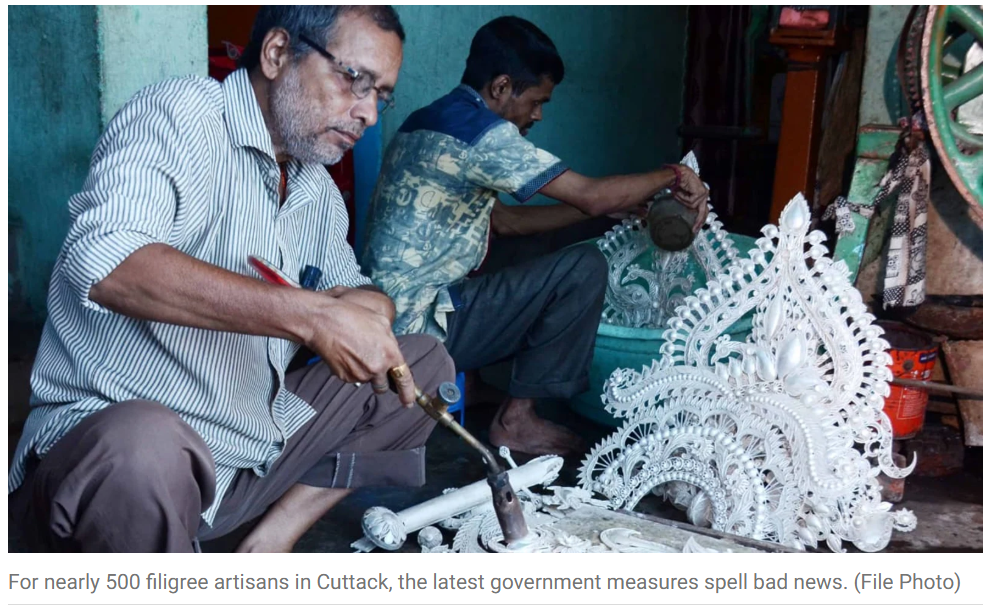
Cuttack's centuries-old Rupa Tarakasi (silver filigree) industry — the craft identity of Odisha's "Silver City" — is facing an acute livelihood crisis. Soaring silver prices and a steep hike in import duty from 5% to 15% have disrupted orders, delayed production, and pushed thousands of artisan families into financial uncertainty.
About Rupa Tarakasi
- Rupa Tarakasi is one of India's most sophisticated traditional crafts, practised in Cuttack, Odisha for nearly a millennium.
- In Odia, "tara" means wire and "kasi" means design — together capturing the essence of a craft where silver bricks are drawn into ultra-fine wires or foils and intricately shaped into jewellery, religious artefacts, ceremonial objects, and accessories — including ornaments worn by Odissi dancers.
- The artisans practising this craft are called "Rupa Banias" or "Roupyakaras".
- The craft dates to at least the 12th century and received significant patronage under the Mughal Empire, evolving aesthetically with each successive ruling influence.
- It received a Geographical Indication (GI) tag in 2024 — recognition of its unique regional identity and cultural significance.
- Cuttack's filigree also serves as a significant tourism draw, with visitors to nearby Puri and the Konark Sun Temple routinely travelling to the city to witness and purchase this handmade artistry.
The Double Blow: Prices and Policy
The crisis facing Tarakasi artisans is driven by two converging pressures.
- Soaring silver prices: Global silver prices have risen sharply in recent months, directly inflating raw material costs for artisans who operate on thin margins with little buffer capital.
- Import duty hike: The government raised import duty on silver from 5% to 15% — a 10% increase — which, while aimed at reducing smuggling and curbing misuse of Free Trade Agreements, has significantly raised input costs for artisans. The duty hike followed a tenfold surge in silver jewellery imports from Thailand — volumes rising from 4 to 40 metric tonnes — with Thailand's share increasing from 78% to 98% of such imports, prompting the Directorate General of Foreign Trade (DGFT) to impose import restrictions on unstudded silver jewellery.
Broader Implications
The Tarakasi crisis illustrates a recurring structural tension in Indian economic governance: macro-level trade protection measures creating micro-level distress among artisan communities that lack the financial resilience to absorb sudden input cost spikes. Thousands of Cuttack families depend on this craft for livelihood — many operating as generational cottage industries with no alternative income stream.
The situation calls for targeted policy differentiation — exempting authentic handcraft raw material imports from punitive duties designed to curb industrial-scale misuse of FTAs. The GI tag, while enhancing brand recognition and export potential, cannot independently insulate artisans from input price volatility without complementary fiscal and financial support mechanisms.