
Psyche Spacecraft
- 11 May 2026
In News:
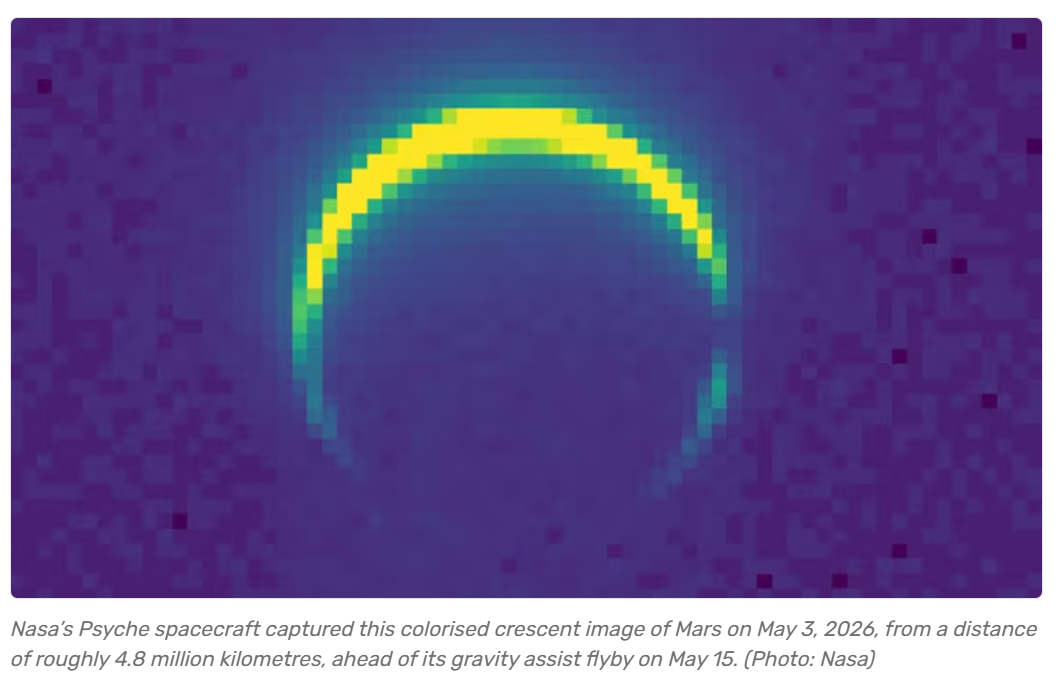
In a significant milestone for deep-space exploration, NASA’s Psyche spacecraft recently captured a rare and striking crescent view of Mars from a distance of approximately 5 million kilometers. This imaging feat occurred during a critical gravity-assist maneuver, where the spacecraft utilized the Red Planet's gravitational pull to slingshot itself toward its ultimate destination: the metal-rich asteroid, 16 Psyche.
Mission Overview and Timeline
Launched on October 13, 2023, the Psyche mission represents NASA’s first endeavor to explore a world that is not made of rock or ice, but largely of metal.
- Journey to the Belt: The spacecraft is currently navigating toward the outer main asteroid belt between Mars and Jupiter.
- Arrival and Orbit: The gravity of Asteroid Psyche is expected to capture the spacecraft in late July 2029.
- Scientific Operations: The primary mission is slated to begin in August 2029. The spacecraft will spend roughly two years in orbit, performing comprehensive mapping, surface photography, and composition analysis.
The Target: Asteroid 16 Psyche
Scientists believe that Asteroid Psyche might be the exposed nickel-iron core of an early planet—a "planetesimal"—that lost its rocky outer layers due to violent collisions billions of years ago. By studying it, researchers hope to gain a "look inside" the cores of terrestrial planets like Earth, which are otherwise unreachable due to extreme heat and pressure.
Spacecraft Features and Propulsion
The Psyche spacecraft, roughly the size of a small van, incorporates cutting-edge deep-space technology:
- Solar-Electric Propulsion: Unlike traditional chemical rockets, Psyche utilizes Xenon gas as propellant. This system uses electricity from solar arrays to accelerate xenon ions, creating a gentle but consistent thrust that allows the craft to gain immense speed over time.
- Efficiency: This propulsion method is highly efficient for long-duration missions, allowing for greater payload capacity and more precise orbital maneuvering.
Scientific Payload: The Instruments of Discovery
To decode the history of the asteroid, the spacecraft carries a suite of high-precision instruments:
- Magnetometer: Designed to detect if the asteroid possesses a remnant magnetic field. Finding such a field would strongly indicate that the asteroid was once the core of a molten planet.
- Gamma-Ray and Neutron Spectrometer: This instrument allows scientists to identify the specific chemical elements (such as iron, nickel, and silicon) that comprise the asteroid's surface material by measuring the energy of particles rebounding from it.
- Multispectral Imager: Comprising a pair of identical cameras with telescopic lenses, this tool will photograph the surface in various wavelengths of light to reveal its topography and geological features.
Strategic Significance for Space Science
The Psyche mission is a prime example of "Discovery Class" missions aimed at fundamental questions of planetary origin. It highlights:
- Origin of Life and Earth: Understanding how planetary cores form is essential to understanding why Earth developed a magnetic field, which shields us from lethal solar radiation.
- Innovation in Interplanetary Navigation: The successful imaging of Mars during the gravity assist demonstrates the precision of modern deep-space navigation and the utility of planetary flybys to save fuel and increase mission longevity.