
Prambanan Temple
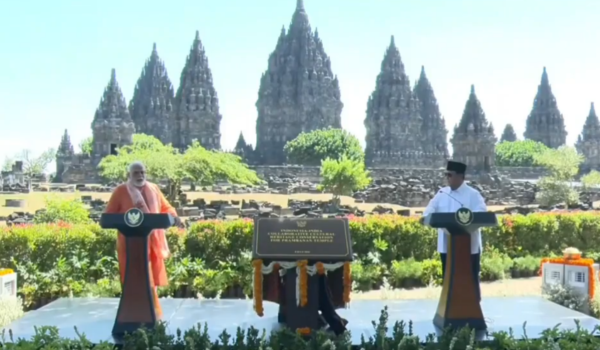
- 10 Jul 2026
In News:
The Prime Minister of India, along with the President of Indonesia, recently visited the Prambanan Temple, a UNESCO World Heritage Site, in Yogyakarta, Indonesia, highlighting the centuries-old civilizational and cultural links between India and Southeast Asia.
About Prambanan Temple
The Prambanan Temple is the largest Hindu temple complex in Indonesia, located in Sleman Regency, Yogyakarta, on the island of Java. Known locally as Roro Jonggrang (Temple of the Slender Virgin), it is one of the finest examples of Hindu temple architecture in Southeast Asia.
Constructed during the 9th century CE by the Sanjaya Dynasty, the temple symbolizes the flourishing of Hindu culture in ancient Java. It is dedicated to the Hindu Trimurti—Lord Shiva (the Destroyer), Lord Vishnu (the Preserver), and Lord Brahma (the Creator).
Recognising its outstanding cultural value, UNESCO inscribed Prambanan as a World Heritage Site in 1991.
Architectural Features
Prambanan reflects a remarkable fusion of indigenous Javanese architectural traditions and the South Indian Pallava style, illustrating the spread of Indian cultural influences across Southeast Asia.
The temple complex comprises 240 temples, with the central sacred compound containing eight principal temples and eight smaller shrines built on a raised platform.
Among these, the Shiva Temple is the largest and most prominent, rising to a height of 47 metres, making it one of the tallest Hindu temples in Southeast Asia. The other principal temples are dedicated to Vishnu and Brahma.
The galleries surrounding the temples are adorned with beautifully carved bas-reliefs depicting episodes from the Ramayana, showcasing the enduring influence of Indian epics on Southeast Asian art and culture.
Although primarily a Hindu religious complex, the Prambanan region also contains several Buddhist temples, reflecting the harmonious coexistence of Hinduism and Buddhism in ancient Java.
Prambanan Temple Restoration
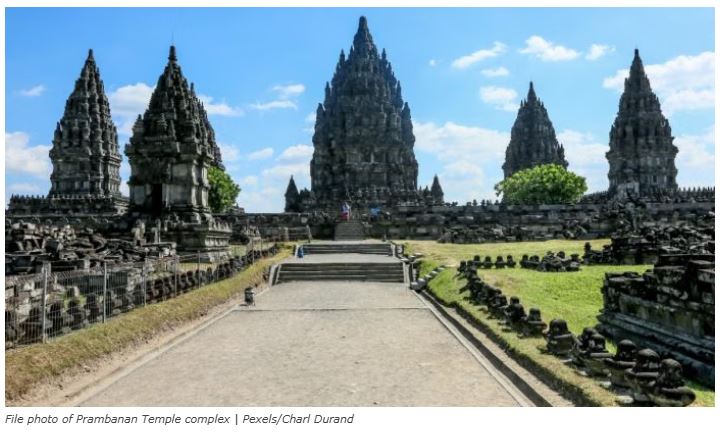
- 18 Mar 2026
In News:
India and Indonesia have recently partnered for the restoration of the Prambanan Temple complex in the Special Region of Yogyakarta, Java. This initiative reflects deep-rooted civilizational ties, cultural diplomacy, and shared heritage between the two nations, while also highlighting India’s growing role in global heritage conservation.
About Prambanan Temple
- The Prambanan Temple is the largest Hindu temple complex in Indonesia, located in Sleman, Yogyakarta (Central Java).
- Built in the 9th century by the Sanjaya dynasty, it represents the flourishing of Hindu culture in Southeast Asia.
- Locally known as Roro Jonggrang (Temple of the Slender Virgin), the complex is dedicated to the Hindu Trimurti—Shiva, Vishnu, and Brahma.
- After being buried and neglected for centuries, it was rediscovered and restored during the 19th century, and later recognised as a UNESCO World Heritage Site in 1991.
Architectural Features
Prambanan reflects a remarkable fusion of indigenous Javanese and South Indian (Pallava) architectural styles, showcasing cultural exchange across regions.
- The complex comprises 240 temples, arranged in concentric layouts
- The central compound includes eight main and eight minor temples built on an elevated platform
- The Shiva Temple, standing at 47 metres, is the tallest and most prominent structure
- Other major temples are dedicated to Brahma and Vishnu
- The walls are adorned with intricate carvings depicting the Ramayana and other Hindu epics, reflecting advanced craftsmanship
Interestingly, while primarily a Hindu complex, the surrounding area also contains Buddhist shrines, indicating religious coexistence and syncretism in ancient Java.