
Padma Awards 2026
- 26 May 2026
In News:
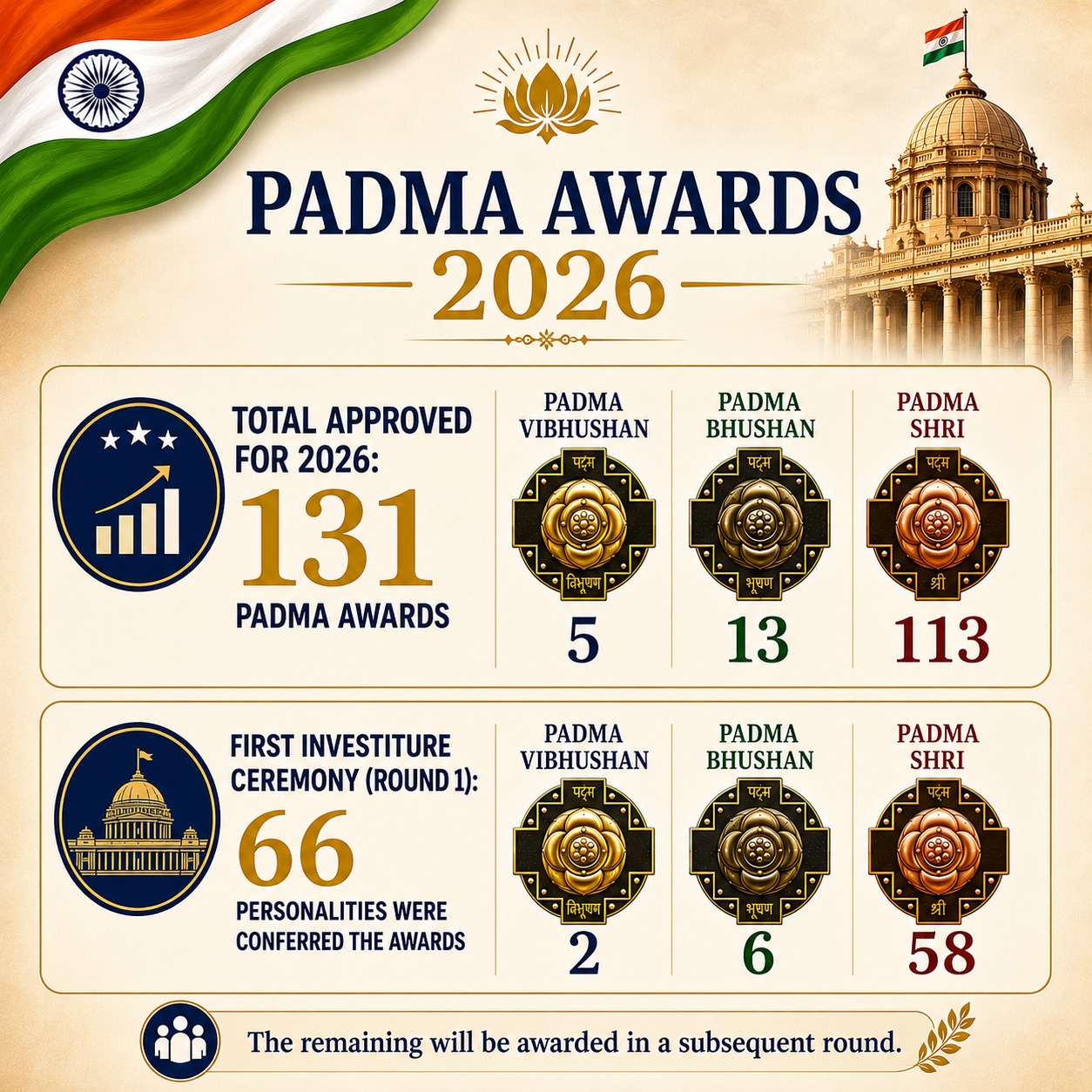
President Droupadi Murmu today conferred Padma Awards to 66 eminent personalities for the year 2026 at the first Civil Investiture Ceremony held at Rashtrapati Bhavan.
About Padma Awards:
The Padma Awards are among the highest civilian honours of India, announced annually on the eve of Republic Day. They are designed to recognise works of distinction and celebrate exceptional achievements or service where an element of public service is involved. The awards are structured into three distinct tiers:
- Padma Vibhushan is conferred for exceptional and distinguished service — the highest of the three tiers.
- Padma Bhushan is conferred for distinguished service of a high order.
- Padma Shri is conferred for distinguished service in any specific field.
History
- The Government of India instituted two civilian awards in 1954 — the Bharat Ratna and the Padma Vibhushan. Originally, the Padma Vibhushan was classified into three tiers: Pahela Varg (First Class), Dusra Varg (Second Class), and Tisra Varg (Third Class). These were subsequently renamed as the Padma Vibhushan, Padma Bhushan, and Padma Shri via a Presidential Notification issued on January 8, 1955.
- The awards have been announced every year since their inception, except for brief suspensions during 1978–1979 and 1993–1997.
Process of Selection
- Open Nominations — The nomination process is heavily democratised and open to the general public. Citizens can nominate inspiring individuals, and self-nomination is also explicitly permitted.
- The Evaluating Committee — All entries are screened by the Padma Awards Committee, which is constituted by the Prime Minister every year. The panel is headed by the Cabinet Secretary and includes the Union Home Secretary, the Secretary to the President, and four to six eminent public personalities.
- Final Approval — The committee's recommendations are submitted directly to the Prime Minister and the President of India for final executive clearance.
Eligibility Criteria
- All individuals, without any distinction of race, occupation, position, or sex, are fully eligible for these awards. However, government servants — including professionals working with Public Sector Undertakings (PSUs) — are generally not eligible. Notably, doctors and scientists are completely exempt from this restriction and remain eligible based on their research, advancements, or clinical service.
Key Features
- Disciplines Covered — Awards are distributed across fields including Art, Social Work, Public Affairs, Science & Engineering, Trade & Industry, Medicine, Literature & Education, Civil Service, and Sports.
- Annual Cap — The maximum number of awards in a single year cannot exceed 120. This cap, however, excludes posthumous awards and those presented to NRIs, Foreigners, or Overseas Citizens of India (OCIs).
- Posthumous Clause — The award is normally not conferred posthumously. However, in highly deserving or exceptional cases, the government can break this convention.
- Five-Year Elapsing Rule — A recipient can only be upgraded to a higher tier if at least five years have elapsed since the conferment of their earlier category. The Awards Committee may relax this rule in extraordinary circumstances.
- Not a Title — In accordance with Article 18 of the Constitution of India, these awards do not amount to a title and cannot be used as a prefix or suffix to the awardee's name. Any commercial or public misuse forfeits the honour.
- Presentation Insignia — Recipients receive a Sanad (a formal certificate) signed directly by the President of India, along with a primary medallion and a small wearable replica for ceremonial state functions.