
PM MITRA Park
- 12 May 2026
In News:
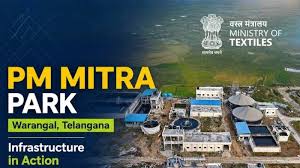
In a significant stride toward making India a global textile powerhouse, the Prime Minister recently inaugurated the nation's first PM MITRA (Pradhan Mantri Mega Integrated Textile Region and Apparel) Park in Warangal, Telangana. This initiative is the cornerstone of the government's "5F" vision—Farm to Fiber to Factory to Fashion to Foreign—aiming to create a self-reliant and internationally competitive textile sector.
Vision and Institutional Framework
The PM MITRA scheme, overseen by the Ministry of Textiles, is designed to overcome the fragmented nature of India’s traditional textile industry. By consolidating the entire value chain—from spinning and weaving to processing and garmenting—into a single geographical zone, the mission seeks to eliminate logistical inefficiencies and reduce the carbon footprint of production.
Implementation Model
These parks are developed through a Special Purpose Vehicle (SPV), a collaborative entity owned by both the State Government and the Government of India. This Public-Private Partnership (PPP) model ensures that the government provides the regulatory and financial foundation, while private players bring in operational efficiency and innovation.
Strategic Geographical Footprint
The government has approved the establishment of seven PM MITRA Parks across the country, strategically located to leverage regional strengths:
- Southern India: Virudhunagar (Tamil Nadu), Warangal (Telangana), and Karnataka.
- Western India: Gujarat and Maharashtra.
- Central & Northern India: Madhya Pradesh and Lucknow (Uttar Pradesh).
These sites can be developed as either Greenfield projects (entirely new infrastructure) or Brownfield projects (upgrading existing facilities).
Key Features and Infrastructure Design
A PM MITRA Park is more than just a manufacturing zone; it is a world-class industrial ecosystem designed with specific land-use allocations to ensure holistic growth:
- Manufacturing Core: 50% of the area is dedicated to pure manufacturing activities.
- Support Utilities: 20% of the land is earmarked for essential utilities, such as power, water, and effluent treatment.
- Commercial Growth: 10% of the area is reserved for commercial development to support business operations and logistics.
The Integrated Value Chain
By integrating spinning, weaving, dyeing, printing, and apparel manufacturing in one location, the parks drastically reduce transport time and costs. This "plug-and-play" infrastructure allows manufacturers to scale quickly without the burden of building individual support systems.
Financial Incentives and Capital Support
To attract investment and ensure the viability of these mega-projects, the Ministry of Textiles provides substantial financial backing:
- Greenfield Projects: Financial assistance of up to ?800 crores per park.
- Brownfield Projects: Support of up to ?500 crores per park.
- State Contribution: Respective State Governments are responsible for providing encumbrance-free land (at least 1,000 acres) and ensuring augmented utility infrastructure like roads and power.