
National Mission for Sustainable Agriculture
- 13 May 2026
In News:
Under the updated framework of the National Mission for Sustainable Agriculture (NMSA), a transformative target has been set: bringing 100 lakh hectares under micro-irrigation over the five-year period from 2025-26 to 2029. This initiative underscores the critical shift from traditional irrigation to precision water management as a cornerstone of national food security.
Evolution and Institutional Framework
- Launched in 2014-15 as one of the eight missions under the National Action Plan on Climate Change (NAPCC), NMSA was designed to mitigate the adverse impacts of weather variability on Indian farming. Since the fiscal year 2022-23, the mission has been integrated into the umbrella scheme of Pradhan Mantri Rashtriya Krishi Vikas Yojana (PMRKVY).
- Operated by the Ministry of Agriculture and Farmers Welfare, the mission acts as a strategic intervention to ensure that agricultural productivity does not come at the cost of environmental degradation.
Strategic Interventions: The Four Pillars of NMSA
The mission employs a multi-pronged strategy to enhance water-use efficiency, improve soil health, and build climate-resilient farming systems:
1. Per Drop More Crop (PDMC): Precision in Water Management
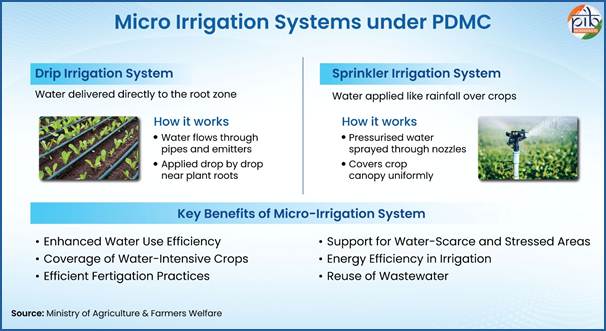
The PDMC initiative is the primary vehicle for achieving the newly set 100 lakh hectare target. By promoting micro-irrigation technologies—specifically drip and sprinkler systems—it aims to maximize crop productivity per unit of water used. This is vital for India, where agriculture consumes nearly 80% of the country’s freshwater resources.
2. Rainfed Area Development (RAD): Diversifying Risks
Recognizing that nearly 60% of India’s cultivated area is rainfed, RAD encourages Integrated Farming Systems (IFS). This approach integrates crops with livestock, fisheries, and horticulture, providing farmers with multiple income streams and a buffer against localized crop failures caused by erratic rainfall.
3. Soil Health Management (SHM): Sustaining the Foundation
Supported by the SHC Scheme, SHM focuses on the scientific testing of soil to promote balanced nutrient application. By discouraging the overuse of chemical fertilizers, it protects long-term soil fertility and reduces the input costs for small and marginal farmers.
4. Climate Change Monitoring and Networking (CCSAMMN)
The CCSAMMN component serves as the mission’s intellectual backbone. It facilitates a bidirectional flow of information: translating high-level scientific research into actionable data for farmers, while feeding grassroots field observations back to research establishments.