
MAVEN Discovers Zwan-Wolf Effect on Mars
- 21 May 2026
In News:
In December 2023, scientists examining data from NASA's MAVEN (Mars Atmosphere and Volatile Evolution) mission stumbled upon something completely unexpected — observations of an atmospheric effect never before seen in Mars' atmosphere. A new study published in Nature Communications now provides the first comprehensive observations of the Zwan-Wolf effect in Mars' atmosphere — a phenomenon previously believed exclusive to planetary magnetospheres like Earth's.
What is the Zwan-Wolf Effect?
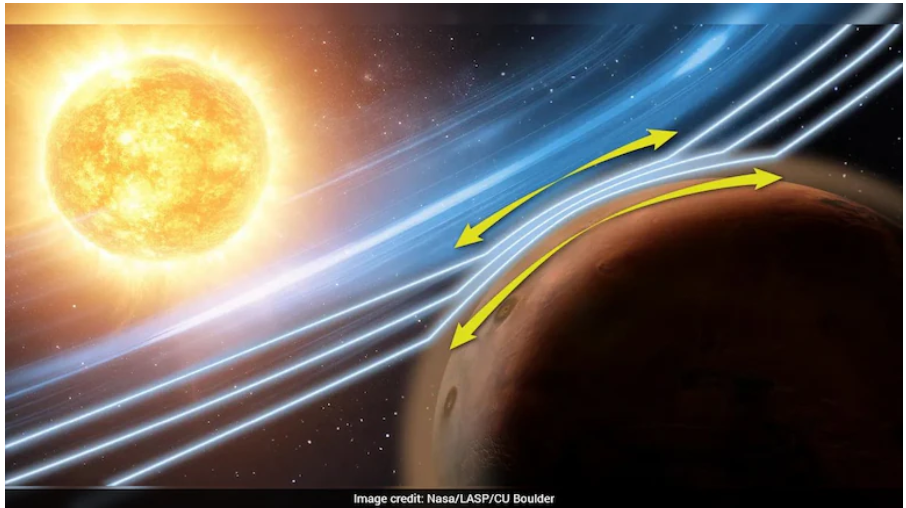
Discovered in 1976, the Zwan-Wolf effect describes a process in which charged particles are squeezed and redistributed along magnetic structures called flux tubes — much like toothpaste being pressed through a tube. When the solar wind — a continuous stream of charged particles emanating from the Sun — approaches a planet's magnetic boundary, it becomes compressed near those boundaries. This creates a pressure gradient that pushes charged particles along magnetic field lines, leaving a region of lower particle density near the stream.
On Earth, this mechanism plays a crucial role in deflecting solar wind and protecting the planet's surface. Until now, it had only been documented within planetary magnetospheres, never in an atmosphere.
The Discovery: Why Mars Makes It Surprising
Unlike Earth, Mars lacks a global magnetic field, which significantly impacts how it interacts with solar wind and space weather. Instead, Mars possesses only an induced magnetosphere — generated by the interaction of solar wind with its ionosphere — that can vary dramatically in size and shape during large solar weather events.
MAVEN detected the Zwan-Wolf effect within Mars' ionosphere — less than 200 km above the surface — where a substantial number of electrically charged particles reside. The detection occurred during a powerful solar storm in December 2023, which appears to have amplified the effect to detectable levels.
Based on their findings, the Zwan-Wolf effect may be occurring constantly in the Martian ionosphere but at levels undetectable by MAVEN's instrumentation — the solar storm effectively made the invisible visible.
Scientific Significance
The discovery carries multiple implications.
- First, it demonstrates that solar wind interactions in unmagnetised planetary atmospheres are far more complex than previously modelled.
- Second, understanding the Zwan-Wolf effect at Mars offers new insight into how this phenomenon might occur at similarly unmagnetised bodies such as Venus and Saturn's moon Titan.
- Third, it advances understanding of Mars' atmospheric loss — MAVEN has already established that Mars lost approximately two-thirds of its early atmosphere to space, a process central to why the planet transitioned from a potentially habitable, water-bearing world to the cold desert observed today.
About MAVEN
Launched in November 2013 and arriving at Mars in September 2014, MAVEN is the first spacecraft mission dedicated to surveying Mars' upper atmosphere. It carries three instrument packages — studying solar wind impacts on the ionosphere, ultraviolet activity in the upper atmosphere, and atmospheric composition through mass spectrometry. Notably, MAVEN lost contact with ground stations on 6 December 2025, and NASA launched an anomaly review board in February 2026 to assess its condition and likelihood of recovery — making this discovery among its potentially final scientific contributions.