
India-Oman Comprehensive Economic Partnership Agreement (CEPA)
- 05 Jun 2026
In News:
The India-Oman Comprehensive Economic Partnership Agreement (CEPA), signed in December 2025, has come into force at a critical juncture, as disruptions in the Strait of Hormuz due to continuing regional conflict have raised serious concerns over global trade, energy supplies, and freight costs across West Asia.
India-Oman Bilateral Relations: Overview
- India and Oman share one of the oldest maritime and commercial partnerships in the Indian Ocean region. Oman is India's oldest strategic partner in the Gulf, and their relationship has evolved into a comprehensive engagement covering trade, energy, defence, connectivity, and people-to-people ties.
- Nearly 700,000 Indians reside in Oman, making the Indian diaspora the Sultanate's largest expatriate community and a vital bridge between the two nations. Bilateral trade stood at USD 11.18 billion in FY 2025-26.
- India imports crude oil, LNG, fertilisers, methanol, and ammonia from Oman, while exporting machinery, petroleum products, iron and steel, rice, ceramics, and engineering goods. Strategically, the two countries cooperate in maritime security and counter-piracy operations, and Oman provides India logistical access to the Duqm Port, enhancing India's presence in the western Indian Ocean.
Why Oman Matters More Now: The Hormuz Factor
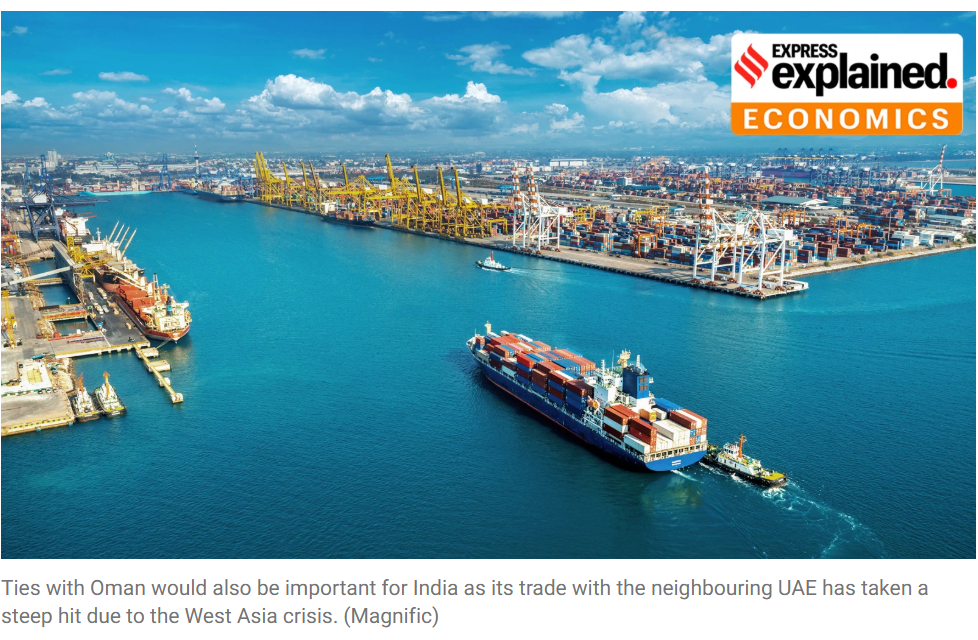
- The Strait of Hormuz is one of the world's most critical maritime chokepoints, through which a substantial portion of global oil and gas trade passes. Ongoing regional conflict has driven up freight costs and disrupted trade flows across West Asia. India-UAE trade, which had crossed $100 billion in the previous financial year, reportedly declined by approximately 35% in April 2026 due to port disruptions.
- Oman offers a strategic advantage in this scenario: unlike many Gulf states whose ports depend on Hormuz access, a significant portion of Oman's coastline lies along the Gulf of Oman and the Arabian Sea — outside the strait. Key ports such as Salalah and Duqm therefore remain accessible even during Hormuz disruptions, making Oman an indispensable partner for India's trade and energy continuity.
Key Provisions of the CEPA
The CEPA is a comprehensive free trade agreement aimed at deepening economic integration. Its major features include: Oman has granted zero-duty access on 98% of tariff lines, covering approximately 99% of India's exports. Prior to the agreement, some Indian goods attracted duties of up to 100% in Oman. The deal aims to diversify trade beyond traditional energy cooperation, enhance investment flows, and strengthen supply chain integration.
- Energy Security: India's energy imports from Oman — crude oil, LNG, fertilisers, methanol, and ammonia — were valued at over $7.2 billion in FY 2025-26. Stable access to Omani supplies significantly reduces India's vulnerability to geopolitical disruptions in the region.
- Export Opportunities: Sectors likely to benefit include machinery and engineering goods, petroleum products, steel and iron, rice and agricultural products, electronics, and consumer goods. Notably, Oman's electronics imports are estimated at around $3 billion annually while India's exports in this segment remain modest, indicating significant untapped potential.