
India’s 1st Satellite-Tagged Ganges Soft-shell Turtle
- 17 May 2026
In News:
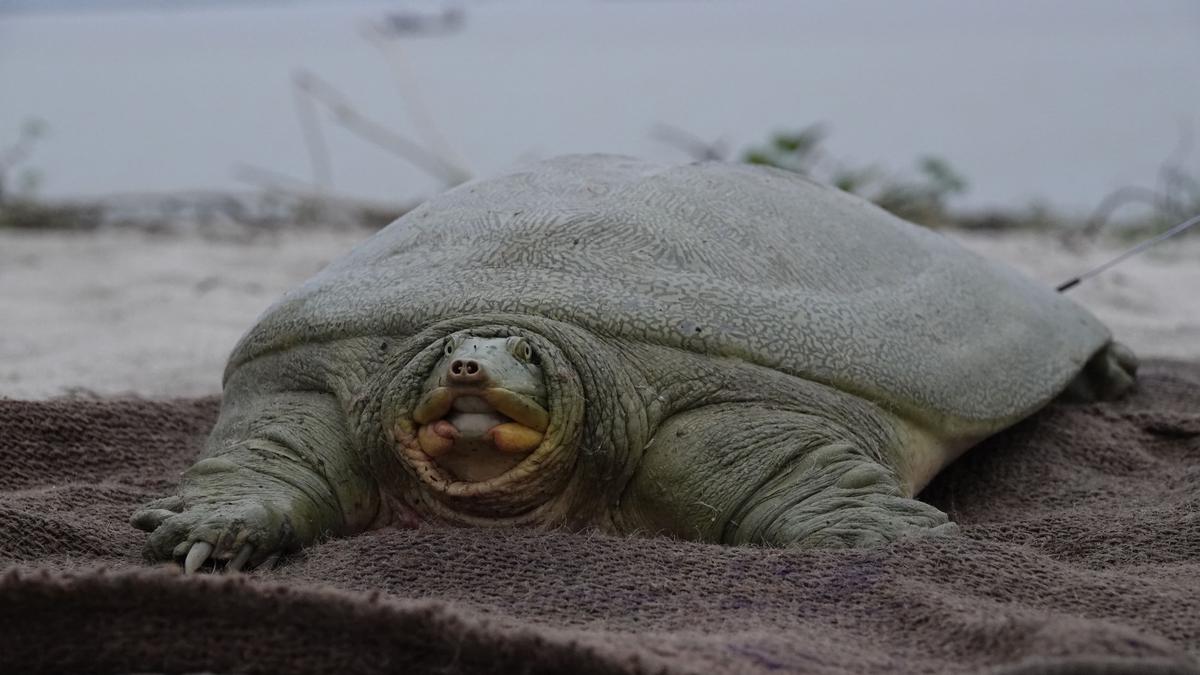
In a pioneering move for freshwater conservation, India’s first satellite-tagged Ganges soft-shell turtle (Nilssonia gangetica) was released into the Kaziranga National Park and Tiger Reserve in Assam. This landmark event, which coincided with Endangered Species Day on May 15, 2026, represents a significant technological and scientific leap in monitoring aquatic wildlife within the Brahmaputra river basin.
The project was executed by the Wildlife Institute of India (WII) under the Ministry of Environment, Forest and Climate Change (MoEFCC), in collaboration with the Assam Forest Department and with funding from the National Geographic Society. Under veterinary supervision, a healthy adult turtle was fitted with a satellite transmitter and released along the northern bank of the Brahmaputra River.
The Satellite-Tagging Initiative: Objectives and Significance
Freshwater ecosystems face severe ecological pressures, yet riverine reptiles historically receive less conservation tracking compared to terrestrial megafauna. Satellite telemetry bridges this critical data gap.
- Tracking Spatial Dynamics: The primarily objective of the initiative is to map the turtle's precise seasonal movement patterns and home range within highly dynamic river corridors.
- Identifying Critical Micro-Habitats: The telemetry data will allow scientists to pinpoint essential nesting, breeding, and basking grounds, allowing for targeted spatial protections rather than broad, unmanageable mandates.
- Informed Active Management: In a river basin heavily impacted by shifting sandbanks and seasonal floods, real-time data ensures that habitat management strategies remain adaptive and scientifically robust.
Species Profile:
The Ganges soft-shell turtle is a large, freshwater species native to the northern plains of the Indian subcontinent, distributed across the Indus, Ganga, Brahmaputra, Narmada, and Mahanadi river systems.
Morphological and Behavioral Traits
It is uniquely distinguished from other riverine turtles by prominent, arrowhead-shaped markings on the dorsal surface of its head. It possesses an oval, green carapace with compressed, flexible edges that enable rapid underwater locomotion. It features an elongated neck and a tube-like snout adapted for breathing while remaining submerged or buried in turbid, muddy riverbeds.
Ecological Role
As an omnivorous apex predator and apex scavenger within riverine food webs, the species performs a crucial regulatory role. By feeding on dead, decaying organic matter and carrion, it acts as a natural biological filter, maintaining water quality and preventing the proliferation of pathogens across the aquatic ecosystem.
Threat Matrix
Despite its historical distribution, populations are declining rapidly due to a combination of anthropogenic stressors:
- Habitat Destruction: Severe riverbed degradation caused by commercial sand mining and large-scale bank alterations.
- Exploitation: Persistent illegal poaching for its meat and calipee (the fatty cartilage layer prized in traditional medicine and exotic cuisine markets).
- Bycatch Mortality: Incidental drowning resulting from entanglement in commercial fishing nets.
Legal and Conservation Status
The species is afforded the highest tiers of domestic and international protection:
- Wildlife Protection Act (WPA), 1972: Schedule I (affording it absolute legal protection and the highest penalties for wildlife crimes).
- IUCN Red List Status: Endangered.
- CITES: Appendix I (prohibiting all international commercial trade).
Assam and Kaziranga: A Global Freshwater Turtle Hotspot
The release highlights the unique ecological position of Northeast India. Assam functions as one of Asia's richest turtle habitats, supporting 21 distinct turtle species. This high concentration renders the region a global priority zone for freshwater chelonian conservation.
The Kaziranga landscape alone—a 1,302 square kilometer floodplain ecosystem recognized as a UNESCO World Heritage Site—hosts five of India’s eight known soft-shell turtle species. Its intricate matrix of rivers, wetlands (beels), and seasonal alluvial grasslands offers an ideal sanctuary for testing next-generation wildlife tracking technologies.