
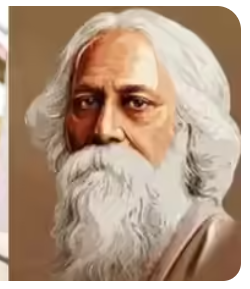
Gurudev Rabindranath Tagore
- 10 May 2026
In News:
On the occasion of Pochishe Boishakh (the 25th day of the Bengali month of Baishakh), the Prime Minister of India paid a heartfelt tribute to Gurudev Rabindranath Tagore, describing him as a "timeless voice" who continues to guide the nation's moral and intellectual identity. As a polymath who transcended the boundaries of art, education, and politics, Tagore remains a central figure in the Indian Renaissance and a global ambassador of humanism.
Early Life and Philosophical Roots
- Born on May 7, 1861, into the illustrious Jorasanko Tagore family of Bengal, Rabindranath was the son of Maharshi Debendranath Tagore, a leading light of the Brahmo Samaj. Growing up amidst the Bengal Renaissance, he was deeply influenced by a period of intellectual awakening that sought to synthesize traditional Indian wisdom with modern rationalism.
- His core philosophy was centered on Universalism and Harmony. He believed in the inherent unity of the world, rejecting narrow nationalism in favor of a "single nest" where all of humanity could reside in peace.
Contributions to the National Movement and Self-Reliance
While Tagore often remained distant from active party politics, his influence on the Indian freedom struggle was profound and spiritual.
- The Mantra of Atmashakti: He pioneered the concept of Atmashakti (Self-Strength/Self-Reliance), urging Indians to focus on social reform and moral education rather than solely on political agitation.
- A Global Protest: In a powerful act of defiance against British colonial atrocities, Tagore renounced his Knighthood in 1919 following the Jallianwala Bagh Massacre, marking a significant moment in India's struggle for dignity.
- The Anthem of Nations: He holds the unique distinction of being the only person to compose the national anthems of two sovereign nations: India's Jana Gana Mana and Bangladesh's Amar Shonar Bangla.
- Rural Reconstruction: Long before modern rural development programs, Tagore established Sriniketan in 1922, initiating practical experiments in agricultural self-reliance and community upliftment.
Literary Brilliance and Artistic Versatility
Tagore’s creative output was staggering in its scope and depth.
- Gitanjali and the Nobel Prize: In 1913, he became the first Asian to win the Nobel Prize in Literature for Gitanjali (Song Offerings), a collection that bridged Eastern spirituality and Western literary forms.
- Novels and Plays: His works like Ghare-Baire (The Home and the World) and Gora explored complex themes of identity, tradition, and the conflict between narrow nationalism and global humanism.
- Rabindra Sangeet and Painting: He founded a unique genre of music known as Rabindra Sangeet, which remains the heartbeat of Bengali culture. Remarkably, he took up painting in his 60s, producing nearly 3,000 works that broke traditional aesthetic norms.
Visionary Educationist: Santiniketan and Visva-Bharati
Dissatisfied with the "factory-like" colonial education system, Tagore founded Santiniketan in 1901. This later evolved into Visva-Bharati University (1921), established with the motto “Yatra visvam bhabatyeknidam” (Where the world makes a home in a single nest). His educational philosophy emphasized learning in the lap of nature and the amalgamation of Eastern and Western cultures.
An Enduring Legacy of Peace
In the aftermath of World War I, Tagore travelled extensively as a global peacemaker, warning against the dangers of "intellectual parochiality" and the darkness of moral decay. He passed away on August 7, 1941, but his legacy remains a "lambent light" for modern India.