
Geneva Conventions & the "Hummus Trail" Controversy
- 11 Jul 2026
In News:
The Geneva Conventions of 1949 have come into focus following the "Hummus Trail" controversy, after the Hind Rajab Foundation (HRF) filed a legal petition seeking the arrest of an Israeli soldier vacationing in Himachal Pradesh over alleged war crimes committed in Gaza. The incident has raised questions regarding India's obligations under International Humanitarian Law (IHL) and the principle of universal jurisdiction.
What is the Hummus Trail?
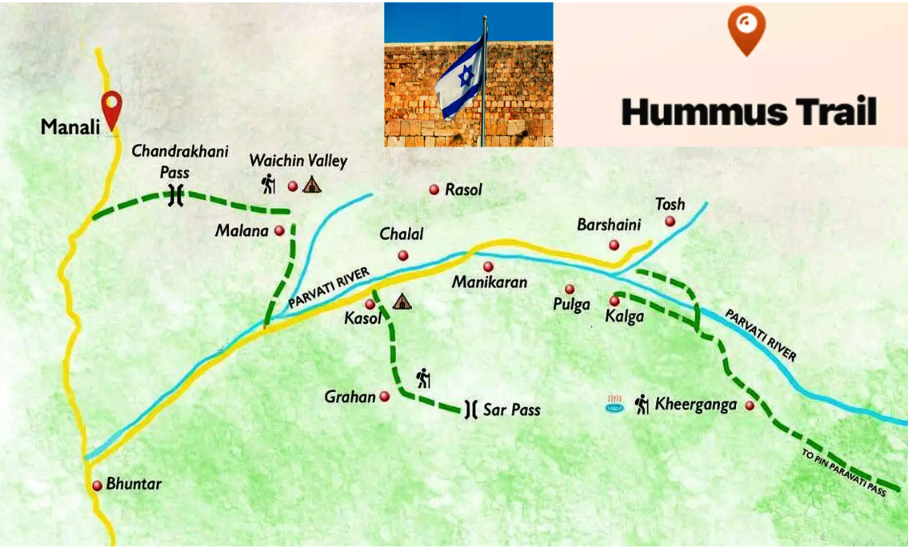
The Hummus Trail is an informal term describing a network of Indian destinations that are popular among young Israeli travellers, particularly those who have recently completed their mandatory military service. Inspired by the earlier Hippie (Hashish) Trail, it includes destinations such as Kasol, Dharamkot, Rishikesh, Pushkar, Goa, Hampi, Gokarna, Kodaikanal, and the Andaman & Nicobar Islands.
Many of these visitors undertake the Tiul Gadol ("Big Trip"), a traditional post-military journey lasting from six months to a year, often supported by post-service financial benefits. India receives nearly 80,000 Israeli tourists annually, and in 2026, Israel allocated 4 million New Israeli Shekels (NIS) to strengthen tourism cooperation with India.
Geneva Conventions, 1949
The Four Geneva Conventions of 1949, together with their Additional Protocols, form the foundation of International Humanitarian Law (IHL). They establish humanitarian rules applicable during armed conflicts by protecting persons who are not, or are no longer, participating in hostilities.
- First Geneva Convention: Protects wounded and sick members of armed forces on land.
- Second Geneva Convention: Protects wounded, sick and shipwrecked military personnel at sea.
- Third Geneva Convention: Protects prisoners of war.
- Fourth Geneva Convention: Protects civilians during armed conflict and defines grave breaches, including wilful killing, torture, unlawful deportation and extensive destruction of property not justified by military necessity.
Universal Jurisdiction
One of the most significant features of the Geneva Conventions is the principle of universal jurisdiction. It obligates every State Party to search for, prosecute or extradite persons accused of committing grave breaches, irrespective of the nationality of the accused or the victims, and regardless of where the alleged offence occurred.
This principle seeks to ensure that perpetrators of serious violations of international humanitarian law do not escape accountability by crossing national borders.
India's Legal Framework
India incorporated its obligations under the Geneva Conventions through the Geneva Conventions Act, 1960.
The Act criminalises acts classified as grave breaches under the Geneva Conventions and empowers Indian authorities to prosecute individuals accused of such offences if they are found within Indian territory, irrespective of their nationality or the place where the alleged crime was committed.
Apart from criminal prosecution, the Government of India also retains sovereign powers under immigration laws to deport foreign nationals when considered necessary in the national interest.
Significance
The controversy highlights the increasing importance of international humanitarian law in domestic legal systems. It also underscores the practical relevance of universal jurisdiction, which allows national courts to deal with certain international crimes irrespective of territorial or nationality links.
For India, the issue presents a delicate diplomatic challenge. While maintaining strong strategic relations with Israel, India must also uphold its international legal commitments under the Geneva Conventions and navigate evolving global legal proceedings, including the ongoing case instituted by South Africa against Israel before the International Court of Justice (ICJ).