
European Central Bank (ECB)
- 10 May 2026
In News:
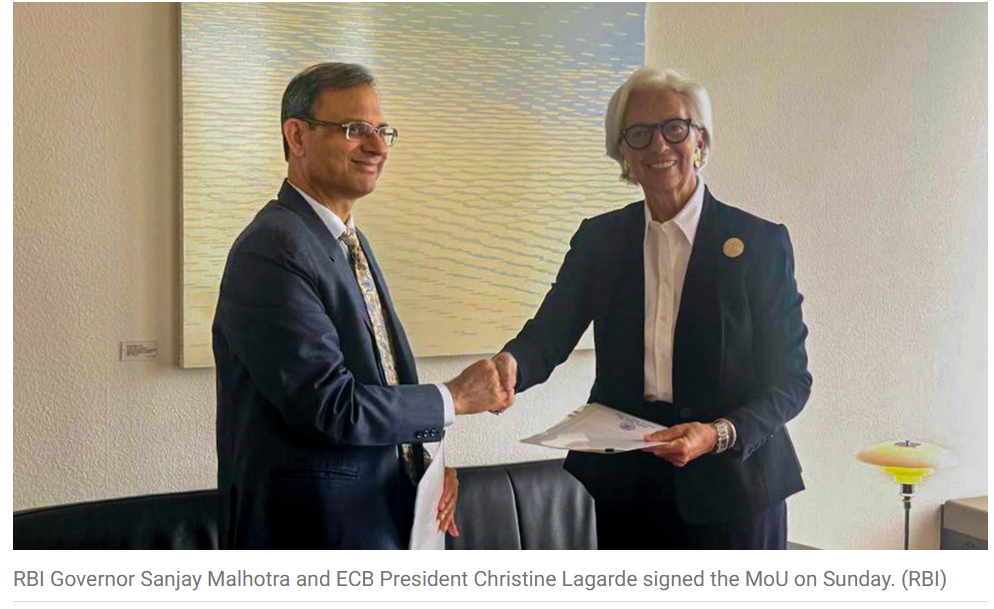
Recently, the Reserve Bank of India (RBI) and the European Central Bank (ECB) have signed a revised Memorandum of Understanding (MoU). This agreement establishes a structured framework for the exchange of information and best practices, reflecting the growing necessity for coordinated central banking in an increasingly interconnected global economy.
As noted by ECB President Christine Lagarde, such partnerships are essential to monitor systemic risks and sustain global cooperation amid evolving financial sector developments.
European Central Bank (ECB): An Overview
The ECB serves as the prime monetary authority for the European Union (EU) and is the central pillar of the Eurosystem and the European System of Central Banks (ESCB). It is one of the most influential financial institutions globally, overseeing a combined balance sheet of approximately €7 trillion.
- Establishment: Founded on June 1, 1998, under the Maastricht Treaty, it preceded the official launch of the Euro on January 1, 1999.
- Institutional Status: It was formally recognized as an official EU institution on December 1, 2009, through the Treaty of Lisbon.
- Headquarters: Frankfurt, Germany.
- Ownership: The ECB's capital stock of €11 billion is owned by the central banks of all 27 EU member states. Individual shares are determined based on a "capital key" reflecting each nation’s population and GDP.
Objectives and Expansion of the Eurozone
The primary mandate of the ECB is to maintain price stability within the Eurozone. By keeping consumer price inflation low and stable, the bank supports sustainable economic growth and job creation.
While the Eurozone began with 11 members, it has expanded to 21 countries as of 2026. Recent milestones include:
- Croatia: Joined the Eurozone in January 2023.
- Bulgaria: Became the latest member to adopt the Euro in January 2026.
Core Functions of the ECB
The ECB operates through a sophisticated governance structure to manage the world’s second most important reserve currency.
- Monetary Policy Formulation: The Governing Council sets key interest rates and defines monetary objectives for the Eurozone to control liquidity and inflation.
- Currency Issuance: The ECB holds the exclusive legal right to authorize the issuance of Euro banknotes. It also oversees the volume of Euro coins minted by individual member states.
- Foreign Exchange Management: It manages the foreign exchange reserves of the member states and conducts market operations to influence exchange rates when necessary.
- Payment Systems: The bank operates T2 (formerly TARGET2), a real-time gross settlement system that ensures the smooth and secure transfer of large-value payments across Europe.
- Policy Enforcement: The Executive Board is responsible for implementing the Governing Council's decisions and provides direct instructions to the national central banks of the Eurozone.
Strategic Significance of the MoU for India
The renewed agreement between the RBI and the ECB carries profound implications for India’s economic diplomacy and financial security:
- Framework for Information Exchange: The MoU facilitates a regular dialogue on central banking challenges, including digital currency development (CBDCs), inflation targeting, and climate-related financial risks.
- Monitoring Systemic Risks: Collaboration between two major central banks allows for a more comprehensive assessment of global financial vulnerabilities, protecting the domestic economy from external shocks.
- Global Financial Governance: By strengthening ties with the ECB, India enhances its footprint in global monetary policy discussions, ensuring that the perspectives of emerging economies are considered in international financial standards.
- Best Practices: The partnership enables the RBI to adopt and adapt sophisticated tools for financial oversight and payment system management used in the Eurozone.