
Delhi Ridge Ecosystem
- 16 May 2026
In News:
The Delhi government has officially notified approximately 670 hectares of Delhi’s Central Ridge as a "Reserved Forest" under Section 20 of the Indian Forest Act, 1927. This statutory declaration grants this highly fragmented urban eco-sensitive zone the highest tier of domestic legal protection.
Geomorphology and Zonal Classification
Geographical Profile
- Origin: The northernmost extension of the ancient Aravalli Range, which stands as one of the world's oldest fold mountain systems.
- Topography: Spans 35 km across Delhi; characterized by undulating terrain, highly weathered quartzitic rocks, and thin, nutrient-poor topsoil.
- Macro-Climate Function: Acts as a critical natural barrier shielding Delhi from the hot, dry desert winds (Loo) blowing in from Rajasthan.
The Four Distinct Zones
Spread over nearly 8,000 hectares, the ridge is divided into four non-contiguous zones:
- Northern Ridge (Kamla Nehru): The smallest patch; holds immense historical value tied to the 1857 Uprising.
- Central Ridge: Covers ~864 hectares; 670 hectares of this specific zone were recently notified as a Reserved Forest.
- South-Central Ridge (Mehrauli): Contains ecologically vital patches like Sanjay Van.
- Southern Ridge (Asola Bhatti): The largest contiguous section; contains the Asola Bhatti Wildlife Sanctuary and bears deep scars from historic, unregulated quartzite and sand mining.
Ecological Significance: "The Green Lungs"
- Climate Regulation: Functions as Delhi’s primary carbon sink and oxygen provider, mitigating the Urban Heat Island (UHI) effect and absorbing particulate matter PM2.5and PM10.
- Native Vegetation Type: Classified as a Tropical Dry Deciduous and Thorny Scrub Forest. Native, drought-resilient flora includes Dhauk (Anogeissus pendula), Salai, Palash, and native Babul.
- Ecosystem Engineers: Native termites maintain soil health by recycling nutrients and improving moisture retention. Experts strongly oppose chemical anti-termite plans, warning they destroy this crucial "living soil."
Legal Framework: Reserved Forests
Reserved Forests represent the baseline of strict statutory conservation in India's environmental jurisprudence.
- Statutory Standing: Notified under Section 20 of the Indian Forest Act, 1927. They enjoy the highest degree of statutory protection for state-managed forests and account for 55.1% of India's total Recorded Forest Area (RFA).
- The Governance Rule: They operate under a Prohibited-by-Default regime. All human activities (such as cattle grazing, hunting, and timber extraction) are barred unless explicitly permitted through a written order by a designated Forest Officer. This stands in contrast to Protected Forests, where activities are generally permitted unless explicitly banned.
- Settlement of Rights: Before final notification under Section 20, a Forest Settlement Officer must legally investigate, adjust, or extinguish any existing customary or land rights claimed by local communities to ensure undisputed state boundaries.
- Administrative Authority: Reserved Forests are declared and managed exclusively by State and UT Governments. This differentiates them from National Parks and Sanctuaries, which fall under the stricter mandates of the Central Wildlife (Protection) Act, 1972.
Major Threats and Restoration Dilemmas
- Invasive Alien Species: The colonial-era introduction of Vilayati Kikar (Prosopis juliflora) has resulted in a severe ecological crisis. This invasive weed aggressively outcompetes other flora, depletes groundwater reserves with its deep roots, and forms a dense canopy that chokes out native Aravalli flora.
- Urban Encroachment: Infrastructure sprawl, road widening, and illegal settlements cause severe habitat fragmentation, breaking contiguous wildlife corridors into isolated patches.
- The "Native" Plantation Dilemma: Municipal drives frequently plant popular Indian trees like Mango, Jamun, and Shisham. Because these species are water-intensive and unsuited to the rocky, arid terrain, the plantations fail the moment artificial irrigation stops.
- Commercialization Bias: The Forest Research Institute (FRI) Working Plan (2026-27) faces criticism for treating the Ridge as a commercial timber plantation (focusing on timber volume increments) rather than an irreplaceable biodiversity hotspot.
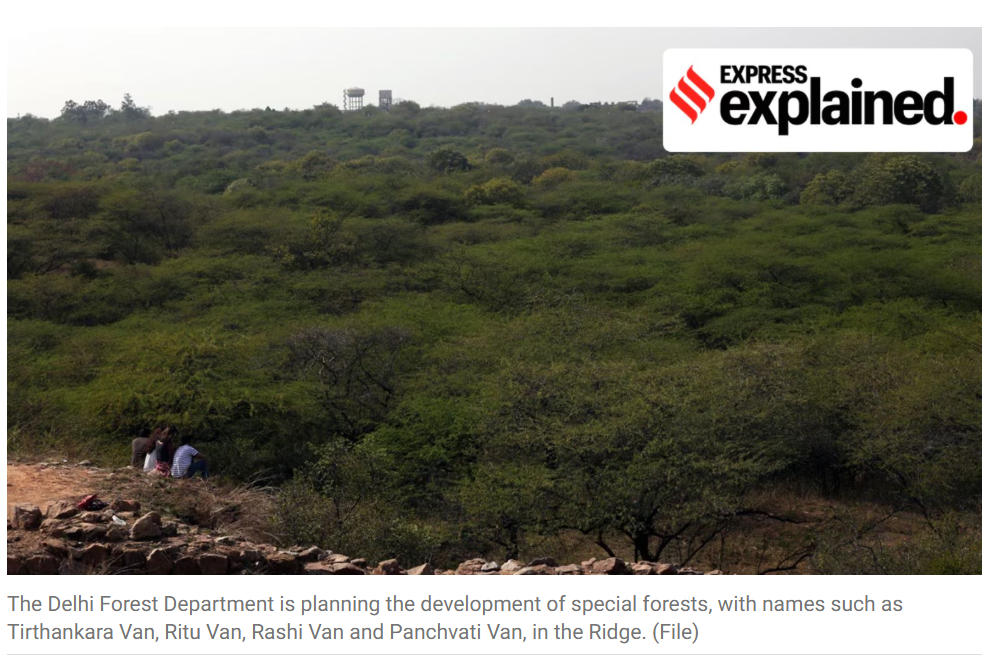
- Artificial Landscaping: Creating themed public parks (Tirthankara Van, Panchvati Van) involving hardscaping violates the Forest (Conservation) Act, 1980. Furthermore, ultra-dense plantation models like the Miyawaki Method are ecologically incompatible with the Ridge's natural dry-scrub ecosystem.
Way Forward
- Scientific Rewilding: Shift focus from commercial silviculture to genuine ecological restoration by systematically clearing Vilayati Kikar and replanting native Dhauk, Salai, and local wild lianas.
- Strict Enforcement: Leverage digital geofencing and zero-tolerance policies to protect the newly notified 670 hectares of Central Ridge from municipal encroachment and hardscape development.
- Soil Conservation: Halt chemical interventions against native termites to preserve the soil microbiome, allowing natural nutrient cycling and moisture retention to continue.
- Trans-boundary Management: Collaborate across state lines with Haryana and Rajasthan to establish a contiguous Aravalli ecological corridor, structurally halting the expansion of the Thar Desert.