
Coal Gasification Scheme
- 16 May 2026
In News:
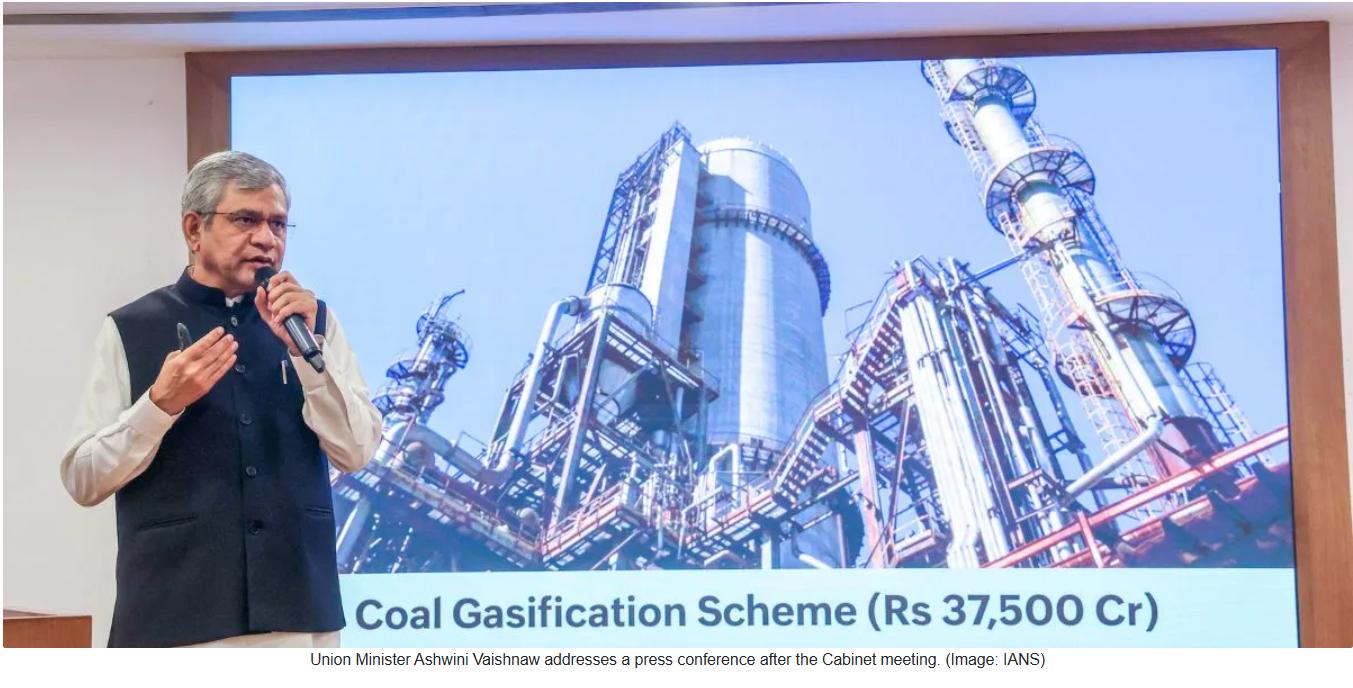
The Union Cabinet approved the “Scheme for Promotion of New Surface Coal/Lignite Gasification Projects for Production of Syngas and Downstream Products” with a financial outlay of Rs. 37,500 crore.
This initiative represents a strategic shift in India’s energy policy: shifting away from the direct combustion of solid fossil fuels toward advanced thermochemical conversion. Amid rising geopolitical supply chain vulnerabilities in West Asia, the scheme aims to reduce India’s high-value hydrocarbon and chemical import bill, which reached approximately Rs. 2.77 lakh crore in FY2025 for substitutable commodities alone.
Understanding the Technology: Coal Gasification and Syngas
- Coal gasification is a high-temperature, high-pressure thermo-chemical process rather than conventional burning.
- Instead of directly combusting coal to generate steam for electricity, gasification subjects coal or lignite to a controlled, oxygen-lean atmosphere with steam. This breaks down the molecular bonds of the hydrocarbon chain, triggering partial oxidation.
- The primary output of this process is Synthesis Gas (Syngas), a gas mixture composed mostly of Carbon Monoxide (CO) and Hydrogen (H2).
The Surface vs. Underground Distinction
- Surface Gasification: The primary focus of this Cabinet-approved scheme. Coal is extracted via traditional mining methods and processed above ground in highly engineered industrial reactors.
- Underground Coal Gasification (UCG): Involves gasifying coal in situ while it is still buried deep within unmined seams by injecting air or oxygen through injection wells and drawing the generated syngas to the surface through production wells.
Industrial Applications of Syngas
Once generated, syngas serves as a versatile chemical feedstock that can be converted into several downstream industrial products:
- Fertilizers: Providing the basic chemical components needed to manufacture Ammonia and Urea.
- Alternative Fuel and Energy: Processing into Synthetic Natural Gas (SNG), Methanol, Ethanol, and Dimethyl Ether (DME).
- Industrial Chemicals: Generating crucial inputs like Ammonium Nitrate (essential for civil explosives and mining infrastructure).
- Hydrogen Economy: Serving as an alternative source for pure industrial Hydrogen extraction.
Salient Features and Financial Architecture of the Scheme
The operational and financial mechanics of the scheme are designed to mitigate risks for private and public sector investments in this capital-intensive sector:
- Target Capacity: The scheme explicitly targets the gasification of approximately 75 MillionTonnes (MT) of coal and lignite. This will serve as a core pillar to achieve the broader national cumulative target of 100 MT by 2030 set under the National Coal Gasification Mission (2021).
- Incentive Outlay and Capital Subsidy: Out of the Rs. 37,500 crore framework, the government provides a fiscal grant capped at a maximum of 20% of the total cost of Plant and Machinery.
- Milestone-Linked De-risking: To prevent capital hoarding and project delays, the financial incentive is disbursed in four equal installments, each tied to the verifiable achievement of specific physical project milestones.
- Equitable Allocation Caps: To prevent market monopolization and encourage diverse participation, the financial guidelines enforce strict upper thresholds:
- Capped at Rs. 5,000 crore for any single gasification project.
- Capped at Rs. 9,000 crore for any single downstream product category (with explicit exemptions granted to Synthetic Natural Gas and Urea).
- Capped at Rs. 12,000 crore for any single corporate entity group across all bids under the scheme.
- Co-existence of Incentives: The policy does not restrict operations; these fiscal benefits are in addition to, and independent of, any incentives gained under the commercial coal mining regime or other state and central line ministries.
- Technology Agnosticism with an Indigenous Focus: While the guidelines remain technology-neutral, the selection framework prioritizes the deployment of domestic engineering capabilities to reduce reliance on foreign Engineering, Procurement, and Construction (EPC) contractors.
- Competitive Bidding Design: Projects will be awarded through a transparent bidding mechanism. Bids will be evaluated using an objective benchmarking framework that evaluates project cost, raw coal input requirements, and net syngas output efficiency.
Policy Reform: Long-Term Fuel Security
A key obstacle for capital-intensive energy projects has been the risk of fuel supply disruptions. To address this, the government introduced a major structural reform alongside the financial package:
- 30-Year Coal Linkage Tenure: Under the "Production of Syngas leading to Coal Gasification" sub-sector within the Non-Regulated Sector (NRS) linkage auction framework, the government extended the guaranteed coal linkage tenure up to 30 years.
- This policy reform aligns fuel availability with the typical operational lifespan of an advanced chemical plant, offering long-term regulatory certainty to de-risk institutional investments.
Strategic, Economic, and Fiscal Benefits
The implementation of the Surface Coal Gasification scheme offers several multi-dimensional benefits for India's macroeconomy:
Macroeconomic and Import Substitution
India holds one of the largest resource bases globally, with 401 billion tonnes of estimated coal reserves and 47 billion tonnes of lignite reserves. Solid coal accounts for over 55% of the country's primary energy mix.
Despite this abundance, India remains highly vulnerable to global supply chain shocks due to its heavy reliance on chemical imports. Surface gasification allows India to utilize its abundant domestic solid fuels to substitute for high-value imported commodities:
- Natural Gas: Substituting for Liquefied Natural Gas (LNG), where India currently imports over 50% of its domestic requirements.
- Industrial Feedstocks: Reducing foreign dependence on Ammonia (nearly 100% imported) and Methanol (extensively imported at 80% to 90% of total consumption).
- Agricultural Security: Boosting self-reliance in Urea, where import dependencies still hover around 20%.
Capital Mobilization and Employment Generation
- The state’s initial Rs. 37,500 crore fiscal layout is projected to function as multiplier seed capital, expected to mobilize private and public investments worth Rs. 2.5 to 3.0 lakh crore across 25 planned industrial projects.
- Furthermore, this industrial shift is expected to generate approximately 50,000 direct and indirect jobs, diversifying employment in India’s underdeveloped, coal-bearing geographic regions.
Fiscal Gains for the State
- Far from being a net drain on the exchequer, the industrial utilization of the targeted 75 MT of coal and lignite is projected to generate Rs. 6,300 crore in annual mineral revenue through standard royalties and mining levies, supplemented by long-term Goods and Services Tax (GST) collections from high-value downstream chemical sales.