
Coal Gasification Scheme
- 16 May 2026
In News:
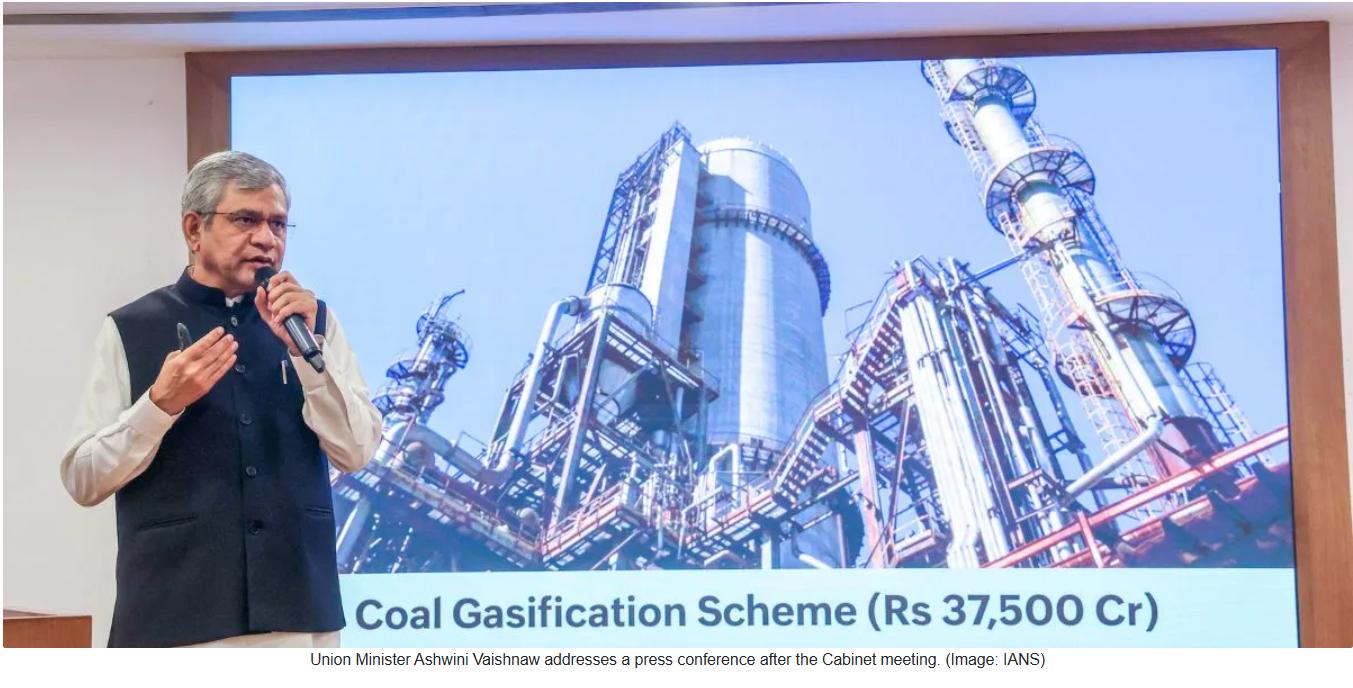
The Union Cabinet approved the “Scheme for Promotion of New Surface Coal/Lignite Gasification Projects for Production of Syngas and Downstream Products” with a financial outlay of Rs. 37,500 crore.
This initiative represents a strategic shift in India’s energy policy: shifting away from the direct combustion of solid fossil fuels toward advanced thermochemical conversion. Amid rising geopolitical supply chain vulnerabilities in West Asia, the scheme aims to reduce India’s high-value hydrocarbon and chemical import bill, which reached approximately Rs. 2.77 lakh crore in FY2025 for substitutable commodities alone.
Understanding the Technology: Coal Gasification and Syngas
- Coal gasification is a high-temperature, high-pressure thermo-chemical process rather than conventional burning.
- Instead of directly combusting coal to generate steam for electricity, gasification subjects coal or lignite to a controlled, oxygen-lean atmosphere with steam. This breaks down the molecular bonds of the hydrocarbon chain, triggering partial oxidation.
- The primary output of this process is Synthesis Gas (Syngas), a gas mixture composed mostly of Carbon Monoxide (CO) and Hydrogen (H2).
The Surface vs. Underground Distinction
- Surface Gasification: The primary focus of this Cabinet-approved scheme. Coal is extracted via traditional mining methods and processed above ground in highly engineered industrial reactors.
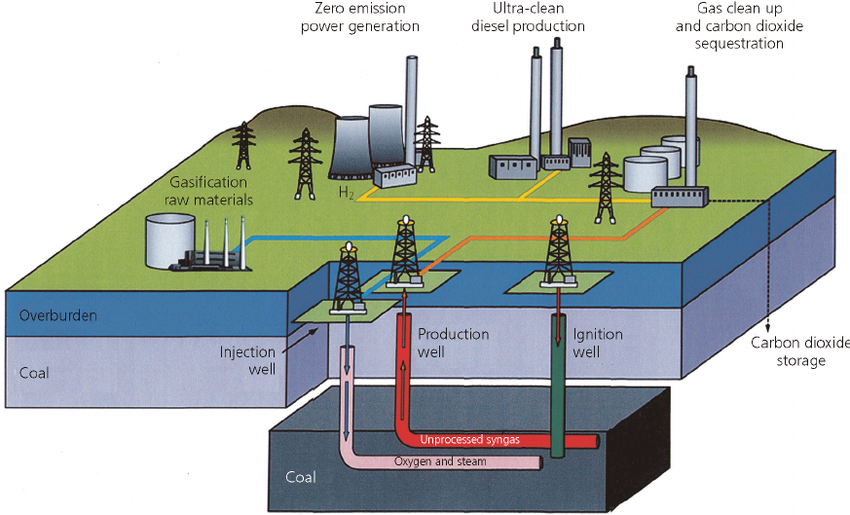
- Underground Coal Gasification (UCG): Involves gasifying coal in situ while it is still buried deep within unmined seams by injecting air or oxygen through injection wells and drawing the generated syngas to the surface through production wells.
Industrial Applications of Syngas
Once generated, syngas serves as a versatile chemical feedstock that can be converted into several downstream industrial products:
- Fertilizers: Providing the basic chemical components needed to manufacture Ammonia and Urea.
- Alternative Fuel and Energy: Processing into Synthetic Natural Gas (SNG), Methanol, Ethanol, and Dimethyl Ether (DME).
- Industrial Chemicals: Generating crucial inputs like Ammonium Nitrate (essential for civil explosives and mining infrastructure).
- Hydrogen Economy: Serving as an alternative source for pure industrial Hydrogen extraction.
Salient Features and Financial Architecture of the Scheme
The operational and financial mechanics of the scheme are designed to mitigate risks for private and public sector investments in this capital-intensive sector:
- Target Capacity: The scheme explicitly targets the gasification of approximately 75 MillionTonnes (MT) of coal and lignite. This will serve as a core pillar to achieve the broader national cumulative target of 100 MT by 2030 set under the National Coal Gasification Mission (2021).
- Incentive Outlay and Capital Subsidy: Out of the Rs. 37,500 crore framework, the government provides a fiscal grant capped at a maximum of 20% of the total cost of Plant and Machinery.
- Milestone-Linked De-risking: To prevent capital hoarding and project delays, the financial incentive is disbursed in four equal installments, each tied to the verifiable achievement of specific physical project milestones.
- Equitable Allocation Caps: To prevent market monopolization and encourage diverse participation, the financial guidelines enforce strict upper thresholds:
- Capped at Rs. 5,000 crore for any single gasification project.
- Capped at Rs. 9,000 crore for any single downstream product category (with explicit exemptions granted to Synthetic Natural Gas and Urea).
- Capped at Rs. 12,000 crore for any single corporate entity group across all bids under the scheme.
- Co-existence of Incentives: The policy does not restrict operations; these fiscal benefits are in addition to, and independent of, any incentives gained under the commercial coal mining regime or other state and central line ministries.
- Technology Agnosticism with an Indigenous Focus: While the guidelines remain technology-neutral, the selection framework prioritizes the deployment of domestic engineering capabilities to reduce reliance on foreign Engineering, Procurement, and Construction (EPC) contractors.
- Competitive Bidding Design: Projects will be awarded through a transparent bidding mechanism. Bids will be evaluated using an objective benchmarking framework that evaluates project cost, raw coal input requirements, and net syngas output efficiency.
Policy Reform: Long-Term Fuel Security
A key obstacle for capital-intensive energy projects has been the risk of fuel supply disruptions. To address this, the government introduced a major structural reform alongside the financial package:
- 30-Year Coal Linkage Tenure: Under the "Production of Syngas leading to Coal Gasification" sub-sector within the Non-Regulated Sector (NRS) linkage auction framework, the government extended the guaranteed coal linkage tenure up to 30 years.
- This policy reform aligns fuel availability with the typical operational lifespan of an advanced chemical plant, offering long-term regulatory certainty to de-risk institutional investments.
Strategic, Economic, and Fiscal Benefits
The implementation of the Surface Coal Gasification scheme offers several multi-dimensional benefits for India's macroeconomy:
Macroeconomic and Import Substitution
India holds one of the largest resource bases globally, with 401 billion tonnes of estimated coal reserves and 47 billion tonnes of lignite reserves. Solid coal accounts for over 55% of the country's primary energy mix.
Despite this abundance, India remains highly vulnerable to global supply chain shocks due to its heavy reliance on chemical imports. Surface gasification allows India to utilize its abundant domestic solid fuels to substitute for high-value imported commodities:
- Natural Gas: Substituting for Liquefied Natural Gas (LNG), where India currently imports over 50% of its domestic requirements.
- Industrial Feedstocks: Reducing foreign dependence on Ammonia (nearly 100% imported) and Methanol (extensively imported at 80% to 90% of total consumption).
- Agricultural Security: Boosting self-reliance in Urea, where import dependencies still hover around 20%.
Capital Mobilization and Employment Generation
- The state’s initial Rs. 37,500 crore fiscal layout is projected to function as multiplier seed capital, expected to mobilize private and public investments worth Rs. 2.5 to 3.0 lakh crore across 25 planned industrial projects.
- Furthermore, this industrial shift is expected to generate approximately 50,000 direct and indirect jobs, diversifying employment in India’s underdeveloped, coal-bearing geographic regions.
Fiscal Gains for the State
- Far from being a net drain on the exchequer, the industrial utilization of the targeted 75 MT of coal and lignite is projected to generate Rs. 6,300 crore in annual mineral revenue through standard royalties and mining levies, supplemented by long-term Goods and Services Tax (GST) collections from high-value downstream chemical sales.
Coal Gasification Incentive Scheme
- 07 Apr 2026
In News:
India has unveiled an ambitious roadmap to reduce its dependency on imported petroleum, ammonia, and fertilizers through the promotion of coal gasification technology.
Overview and Objectives
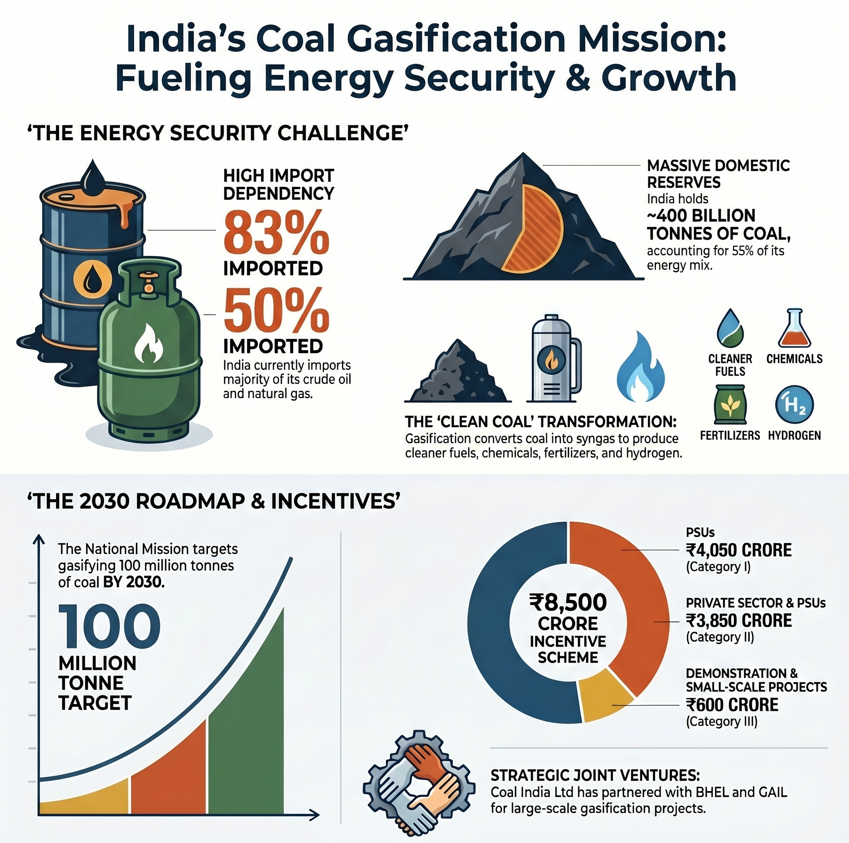
- Approved by the Union Cabinet, the Coal Gasification Incentive Scheme allocates ?8,500 crore to promote coal and lignite gasification projects involving both public sector undertakings (PSUs) and private players.
- The scheme's primary target is to achieve 100 million tonnes of coal gasification by 2030, positioning it as a key component of India's clean coal transition strategy.
Project Categories
The scheme classifies projects into three categories:
|
Category |
Deion |
|
Category I |
PSU-led projects |
|
Category II |
Private sector and PSU joint projects |
|
Category III |
Demonstration and small-scale projects |
This tiered structure encourages participation across the spectrum—from large-scale industrial ventures to pilot projects that test emerging technologies.
Understanding Coal Gasification
The Process
Coal gasification is a thermo-chemical process that converts coal into syngas (synthetic gas), composed primarily of:
- Carbon monoxide (CO)
- Hydrogen (H?)
- Carbon dioxide (CO?)
- Methane (CH?)
- Water vapour (H?O)
The process involves reacting coal at high temperatures (1000–1400°C) with controlled amounts of oxygen and steam.
Steps in Coal Gasification
- Preparation — Coal is finely crushed to increase surface area for efficient reaction
- Gasification reactor — Powdered coal enters a reactor with limited oxygen/air and steam
- Chemical reactions — Partial oxidation breaks coal down into syngas components
- Gas cleaning — Impurities such as tar, sulfur, and dust are removed from raw syngas
Strategic Significance for India
Energy Security
By leveraging domestic coal reserves, India can substantially reduce its reliance on imported petroleum and related products, insulating the economy from global price volatility and supply disruptions.
Industrial Applications
The syngas produced through coal gasification serves as feedstock for manufacturing:
- Ammonia and fertilizers
- Methanol and synthetic fuels
- Chemicals and petrochemical intermediates
This diversification supports the broader goal of Atmanirbhar Bharat in critical industrial sectors.
Environmental Considerations
While coal gasification is positioned within the "clean coal" framework, it represents an incremental improvement over direct coal combustion. The technology enables:
- More efficient capture of pollutants during gas cleaning
- Potential integration with carbon capture technologies
- Controlled emissions compared to conventional coal use
Coal Ministry Hosts Industry Interaction on Coal Gasification (ET)
- 16 Feb 2024
Why is it in the News?
The Ministry of Coal has announced it will host an Industry Interaction on February 16, 2024, in Hyderabad to discuss the development of coal and lignite gasification projects across India.
What is Coal Gasification?
- Coal gasification is a process where coal undergoes partial oxidation with air, oxygen, steam, or carbon dioxide to produce a fuel gas.
- This gas serves as an alternative to piped natural gas or methane for energy generation.
- Underground Coal Gasification (UCG) is a technique involving the conversion of coal into gas within the seam, extracted through wells.
- Production of Syngas: This process yields Syngas, a mixture primarily comprising methane (CH4), carbon monoxide (CO), hydrogen (H2), carbon dioxide (CO2), and water vapour (H2O).
- Syngas finds applications in producing fertilisers, fuels, solvents, and synthetic materials.
- Significance: In manufacturing, steel companies traditionally rely on costly imported coking coal. Syngas derived from coal gasification offers a cost-effective alternative.
- It is utilized in electricity generation, chemical feedstock production, and hydrogen-based applications like ammonia production and fueling a hydrogen economy.
Advantages of Coal Gasification:
- Coal gasification offers a solution to local pollution issues.
- It is deemed environmentally cleaner than direct coal combustion.
- Decreasing dependence on imported natural gas, methanol, ammonia, and other vital commodities, enhances energy security.
- This technology has the potential to mitigate environmental impacts by curbing carbon emissions and promoting sustainable approaches, aligning with India's global objectives for a more environmentally sustainable future.
Concerns Associated with Coal Gasification Plants?
- The main disadvantage of coal gasification is that it is an expensive process.
- The process can produce a number of harmful emissions, including carbon dioxide, sulphur dioxide, nitrogen oxides, and mercury.
- The process produces a lot of ash, which can pollute the environment.
- The process uses a lot of water, which can lead to water shortages in areas where it is used.
Centre approves incentive of Rs 8,500 crore for coal gasification projects (Indian Express)
- 25 Jan 2024
Why is it in the News?
In a bid to achieve the target of coal gasification of 100 million tonnes (MT) of coal by 2023 in India, the government recently approved Rs 8,500 crore incentives.
What is Coal Gasification?
- Coal gasification is a thermo-chemical procedure wherein the pressure and heat of the gasifier disintegrate coal into its chemical components.
- The resulting "syngas" are mostly carbon monoxide (CO) and hydrogen, with some other gaseous substances thrown in for good measure.
- Coal gasification is an in-situ method wherein oxygen is infused into the seam together with water and ignited at high temperatures, causing coal to partly oxidised into hydrogen, CO, carbon dioxide (CO2), methane (CH4), and hydrogen sulphide (H2S).
- Ex-situ reactors are designed to simulate the gasification process above the ground's surface.
- Sulphur in coal is transformed to H2S and trace volumes of carbonyl sulphide during the gasification process (COS).
- Acid gas removal technology can easily and cost-effectively discard these sulphur compounds.
- There is no scrubber sludge produced by coal gasification plants, which necessitates careful and expensive disposal.
- The majority of the wash water is reprocessed, and residual wastewater from gasification plants can be treated effectively.
- As a result, coal gasification is regarded as a cleaner coal technology when compared to coal combustion.
- Furthermore, coal could be used to generate a range of products using clean coal innovations such as hydrogen, methanol, and fertilisers via coal gasification.
- Carbon fibres and plastic composites made from coal power plant ash/residue.
How can it be used?
- Syngas, according to proponents of coal gasification, can be used to generate power, in energy-efficient fuel cell technology, or as chemical "building components" for industrial applications.
- The hydrogen can also be extracted and used to power a hydrogen economy.
- Coal gas can also be transformed into a transportation fuel to be used in automobiles as a replacement for gasoline, but it is less efficient than the current output and combustion of petroleum-based gasoline.
- Coal gasification is said to be more efficient than traditional coal burning since it can use the gases two times: the coal gases are first purified of contaminants before being fired inside a turbine to produce energy.
- The gas turbine exhaust heat can be then collected and used to produce steam for a steam turbine generator.
- This is known as a combined process, and according to DOE, a coal gasification processing facility using this dual method can possibly attain an efficiency of 50% or higher, compared to the customary coal power plant, which is typically just above 30%.
Significance of Coal Gasification:
- India announced environmental targets as its Nationally Determined Contribution (NDC) under the Paris Agreement in 2016.
- In order to meet these objectives, coal gasification aids in the decrease of emission levels and the advancement of non-fossil fuel-based energy resources.
- The syngas produced by coal gasification can be used to generate urea and a variety of products such as methanol, Dimethyl ether (DME), and olefins, allowing India to minimise imports and become self-sufficient.
- Syngas CO and H2 are essential reducing agents for steel production and are regarded as an environmentally friendly technique of steel production because they reduce the import of furnace oil.
- India has ambitious plans to produce active pharmaceutical ingredients (API) domestically rather than importing them from China.
- As a result, the potential of Syngas requirement for making APIs, as well as methanol as a solvent, is being investigated.
- The synthesis gas can be used in an Integrated Gasification Combined Cycle (IGCC) system to generate electricity in an efficient and environmentally friendly manner.
Initiatives taken by India:
- The Ministry of Coal, through Atmanirbhar Bharat Abhiyaan, has taken the initiative, National Coal Gasification Mission, that is to utilise coal through coal gasification, with the goal of achieving 100 MT coal gasification by 2030.
- It has also been recommended that all coal companies assign a nodal officer and formulate a plan for gasifying at least 10 per cent of their coal production.
- SHAKTI policy was implemented in coal gasification projects to minimise operating costs by allocating long-term coal linkages through auction.