
Blue Micromoon
- 06 Jun 2026
In News:
Recently, skywatchers witnessed a rare Blue Micromoon, a simultaneous occurrence of a Blue Moon and a Micromoon. NASA described it as the farthest, smallest, and dimmest full Moon of 2026, with the next Blue Micromoon not expected until 2053.
What Is a Blue Micromoon?
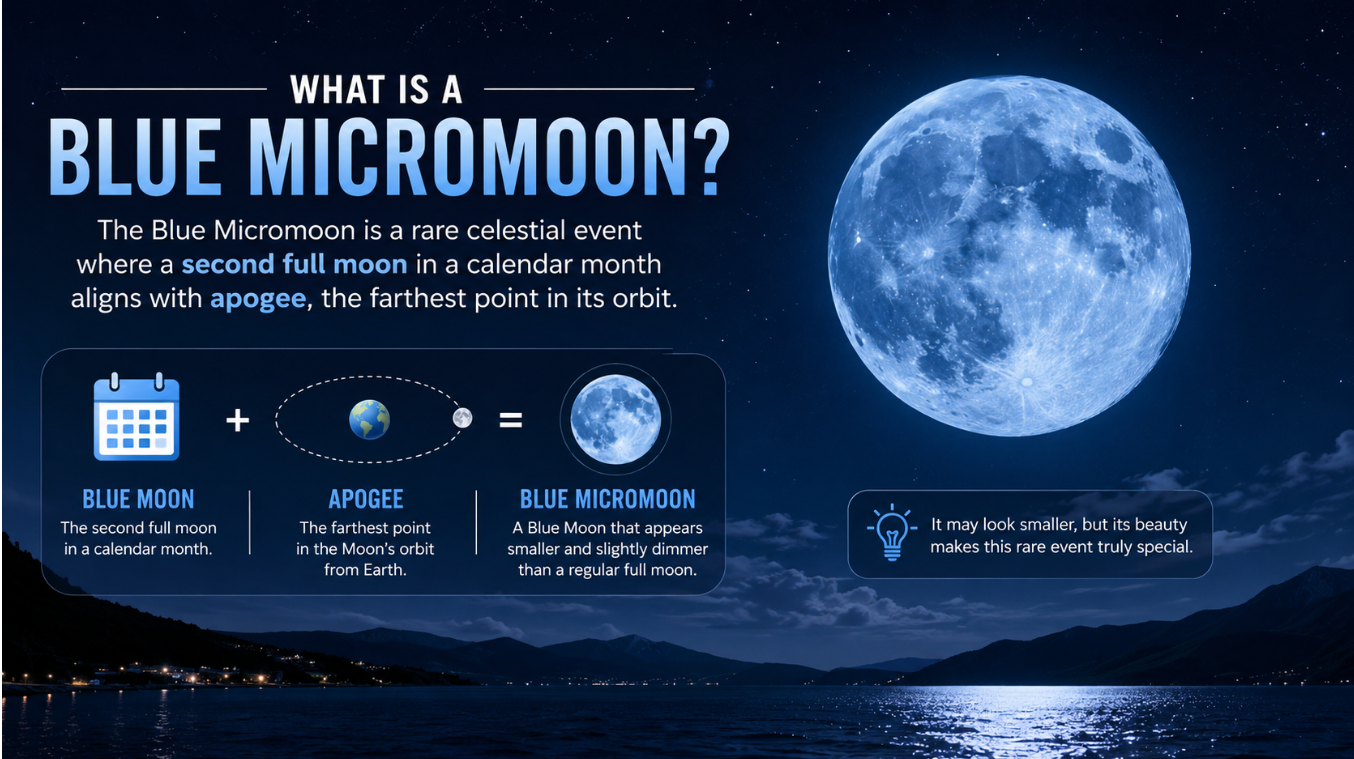
A Blue Micromoon is the rare coincidence of two distinct lunar phenomena:
- A Blue Moon refers to the second full moon occurring within a single calendar month. Because the interval between two full moons averages about 29.5 days — slightly shorter than most calendar months — every two to three years a calendar year includes 13 full moons, producing this "extra" full moon.
- A Micromoon occurs when a full moon coincides with apogee — the farthest point in the Moon's elliptical orbit around Earth. The opposite of a micromoon is a supermoon, which occurs when a full moon reaches perigee, or its closest point to Earth.
Why Doesn't It Look Blue?
Despite the name, the moon does not appear blue. The name has nothing to do with the moon's colour — it appears as a warm orange near the horizon due to atmospheric scattering. A genuinely bluish tint can only appear when rare atmospheric conditions — such as volcanic ash or dense smoke — scatter red wavelengths of light.
Key Orbital Mechanics
The Moon's orbit around Earth is elliptical, completing one cycle every 27.3 days. Because the orbit is not a perfect circle, the Moon's distance from Earth varies continuously. When the fully illuminated phase coincides with the orbital extreme of apogee, the angular diameter of the lunar disk appears compressed — about 7% smaller than an average full moon. The coincidence of this orbital position with the calendar anomaly of a Blue Moon is what makes the Blue Micromoon so rare.
Rarity
The next Blue Micromoon will not be seen until at least July 2053, making this a phenomenon with a gap of approximately 27 years. A standard Blue Moon recurs every 2–3 years; a Micromoon is more common on its own; but their simultaneous alignment is exceedingly infrequent.