
Barda Wildlife Sanctuary
- 20 May 2026
In News:
With the 16th Asiatic Lion Census (May 2025) recording 891 lions in Gujarat — a 32% rise from 674 in 2020 — conservation attention has sharply shifted to Barda Wildlife Sanctuary as India races to establish a second, genetically secure habitat for Panthera leo persica, the world's last surviving population of wild Asiatic lions.
The Single-Point-of-Failure Problem
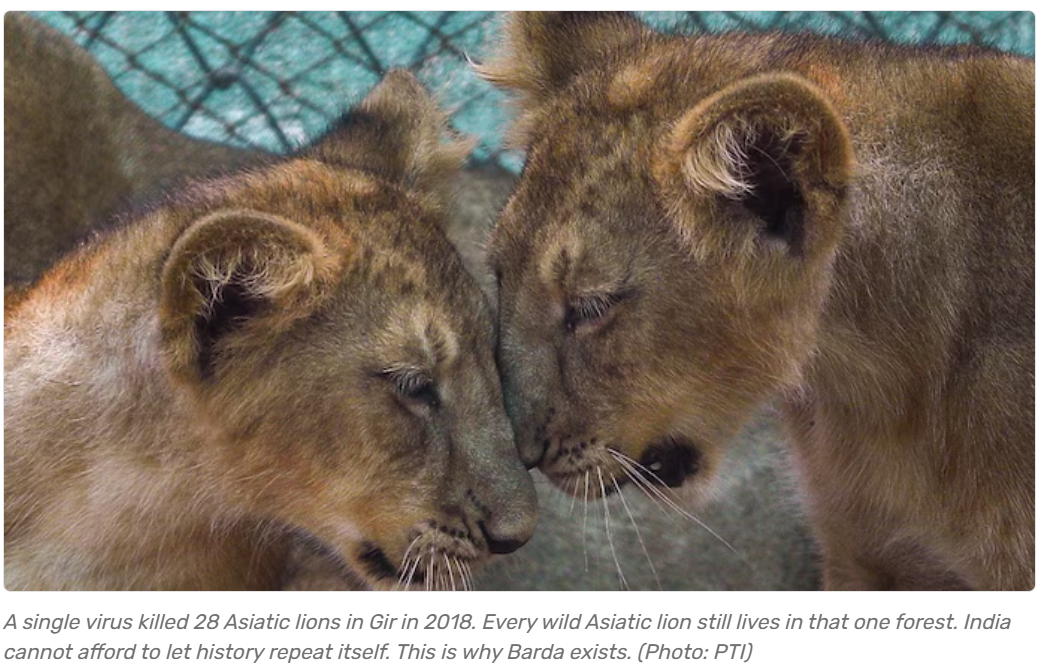
Every wild Asiatic lion on Earth inhabits a single forest — Gir, Gujarat. This geographic concentration represents one of conservation science's most dangerous configurations: a single point of failure. The consequences became starkly visible in 2018, when Canine Distemper Virus, spread by feral dogs on Gir's periphery, killed 28 lions within weeks. Had the outbreak spread further, it could have triggered a species-level extinction event.
Gir covers just 1,412 sq km. Of the 891 lions counted in 2025, over 507 now live outside the Gir Protected Area — on farmland, near open wells, and along railway tracks — creating dangerous human-wildlife conflict. Population growth, paradoxically, has amplified vulnerability rather than reduced it.
About Barda Wildlife Sanctuary
- Located in the Barda Hills of Gujarat, approximately 100 km west of Gir near the coastal city of Porbandar, Barda Wildlife Sanctuary spans 192.31 sq km of rugged, semi-arid terrain in the Saurashtra region.
- Known locally as Jam Barda, it was historically a private hunting ground for the royal families of Jamnagar and Porbandar. The sanctuary is drained by the Bileshvary and Joghri rivers, with Khambala and Fodara dams within its landscape. Local communities including Maldharis, Bharvads, Rabaris, and Gadhvis inhabit surrounding areas.
- Its flora encompasses approximately 650 plant and tree species including Babul, Bamboo, Amli, and Jamun, alongside medicinal plants. Fauna includes leopards, wolves, sambar deer, chinkara, hyenas, nilgai, and diverse avifauna such as crested serpent eagles.
Conservation Milestones
Lions had been absent from Barda since 1879 — a silence of 143 years. The Gir-Barda Project was initiated in 1979 to restore the sanctuary as a satellite lion habitat. After sustained ecological restoration, a male lion walked in independently in 2023. Five lionesses were subsequently translocated under scientific supervision, bred naturally, and produced 11 cubs. The 2025 census recorded 17 lions at Barda.
It has since been designated Satellite Population 8 under Project Lion — PM Modi's ?2,927 crore national conservation programme — making Barda the first fully protected satellite lion habitat in Gujarat.
Scientific Interventions
Prey base restoration was the immediate priority. Early surveys found only 119 chital (spotted deer) across Barda. The Gujarat Forest Department employed the Boma technique — an African method using funnel-shaped canvas enclosures to gently herd animals — to translocate chital from Gir (where population exceeds 90,000), avoiding the risks of capture myopathy associated with chemical tranquilisers.
Genetic vulnerability poses an equally serious long-term threat. Historical hunting reduced Asiatic lions to fewer than 50 individuals in the early 20th century, causing severe genetic bottlenecks. Scientists are now deploying satellite telemetry and targeted relocations to maximise genetic diversity within Barda's pride, strengthening disease resistance and reproductive viability.
On World Lion Day 2025, Gujarat announced ?180 crore for Barda's development, including a ?75 crore safari park.
Broader Policy Context
India is hosting the first-ever IBCA (International Big Cat Alliance) Summit in New Delhi on 1–2 June 2026, underscoring the global significance of big cat conservation. Union Environment Minister Bhupender Yadav recently reiterated the scientific consensus: one forest is categorically insufficient to secure the species' future.