
Agni-1 Missile
- 24 May 2026
In News:
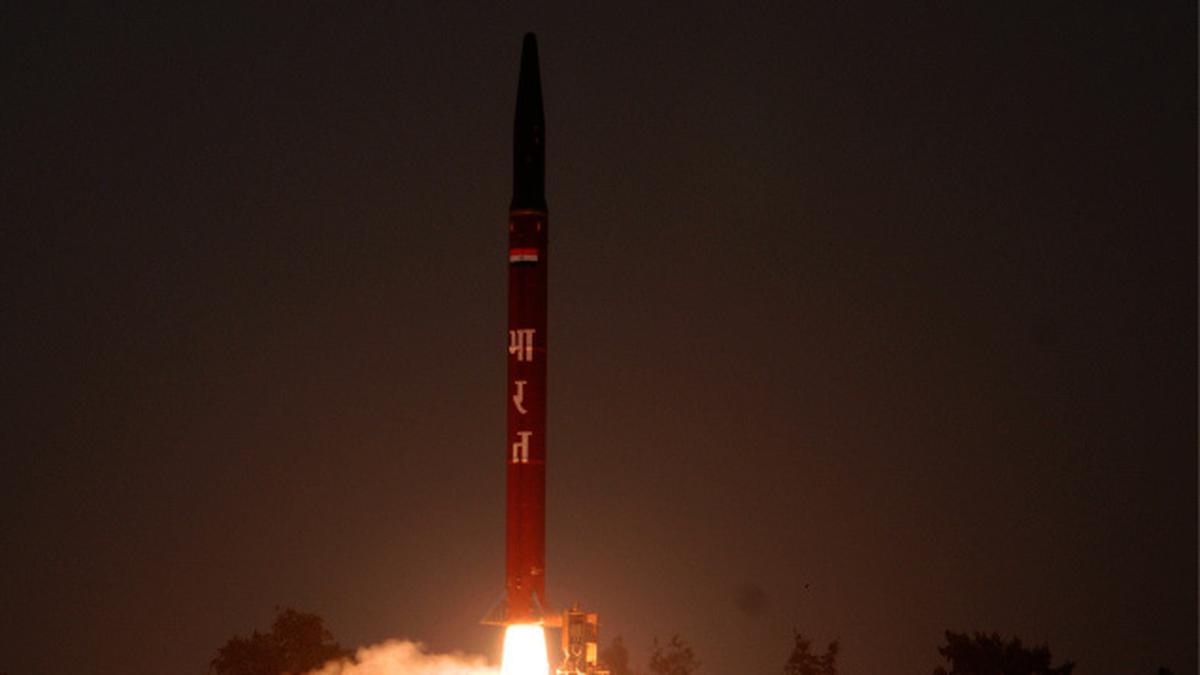
India successfully test-launched the Short Range Ballistic Missile (SRBM) Agni-I from the Integrated Test Range (ITR), Chandipur, Odisha, under the aegis of the Strategic Forces Command (SFC). The Ministry of Defence confirmed that the launch validated all operational and technical parameters. The test was conducted as part of a routine training exercise — signalling operational readiness rather than a developmental milestone.
About Agni-I: Key Features
- Type: Single-stage, solid-fuel Short Range Ballistic Missile (SRBM)
- Range: 700–1,200 km (heavier payload reduces range; lighter payload enables MRBM-class reach)
- Propulsion: Solid-propellant booster derived from ISRO's SLV-3 technology
- Warhead: Nuclear-capable; also carries conventional warheads
- Mobility: Deployable via rail-based platforms and road-mobile Transporter Erector Launchers (TELs) — enabling survivable second-strike positioning
- Induction: First deployed by the Indian Army's Strategic Forces Command in 2007
- Origin: Developed under India's Integrated Guided Missile Development Programme (IGMDP), 1983 — the landmark initiative that also produced Prithvi, Trishul, Akash, and Nag
The Agni Family: India's Strategic Backbone
The Agni series constitutes the core of India's nuclear triad's land-based component, spanning a comprehensive strike envelope:
|
Missile |
Type |
Range |
|
Agni-I |
SRBM/MRBM |
700–1,200 km |
|
Agni-II |
MRBM |
~2,000 km |
|
Agni-III |
IRBM |
~3,000 km |
|
Agni-IV |
IRBM |
~3,500–4,000 km |
|
Agni-V |
ICBM |
>5,000 km |
|
Agni Prime |
MRBM |
~1,000–2,000 km (advanced) |
Critical Context: MIRV Test and Escalating Capability
- The Agni-I test follows another significant achievementwhen India successfully flight-tested an advanced Agni missile fitted with a Multiple Independently Targetable Re-entry Vehicle (MIRV) system from Dr APJ Abdul Kalam Island, Odisha. The missile carried multiple payloads directed at different targets spatially distributed across a large area of the Indian Ocean Region, tracked by multiple ground-based and ship-mounted stations throughout the trajectory.
- MIRV capability i.e. the ability to deliver multiple warheads from a single missile to strike different targets simultaneously, is considered a quantum leap in strategic deterrence, as it exponentially complicates an adversary's missile defence calculations.
Strategic Significance
- Credible Minimum Deterrence: Regular Agni series tests are essential for maintaining operational readiness and validating deterrent credibility — particularly in the context of India's No First Use (NFU) nuclear doctrine, which requires assured second-strike capability. A road-mobile, solid-fuelled missile like Agni-I is ideally suited for survivable second-strike posturing.
- Layered Deterrence: The twin tests — Agni-I (short-range battlefield deterrence) and MIRV-equipped Agni (strategic deterrence at intercontinental scale) — within weeks of each other demonstrate India's full-spectrum deterrence architecture, covering both tactical and strategic nuclear scenarios.
- Geopolitical Signalling: These tests reinforce India's strategic deterrence posture at a time of heightened regional security tensions — including continued Pakistani nuclear modernisation, China's expanding ICBM arsenal, and the post-Pahalgam crisis security environment in South Asia.