
25 Years of Pradhan Mantri Gram Sadak Yojana
- 13 May 2026
In News:
The Union Ministry of Rural Development recently marked the Silver Jubilee of the Pradhan Mantri Gram Sadak Yojana (PMGSY) in Bhairunda, Madhya Pradesh. This milestone was distinguished by the national launch of PMGSY-IV, a strategic evolution of India’s flagship rural infrastructure program. Since its inception in 2000, PMGSY has transitioned from a basic connectivity project into a high-tech engine for socio-economic transformation, bridging the rural-urban divide and fostering a "Viksit Bharat."
The Evolution of a Rural Lifeline (2000–2024)
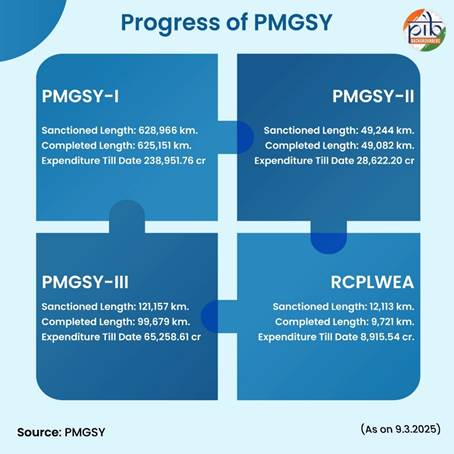
PMGSY began as a Centrally Sponsored Scheme to provide all-weather road connectivity to unconnected rural habitations. Over two and a half decades, its scope has expanded through distinct phases:
- Phase-I (2000): Focused on establishing the first link for previously isolated habitations.
- Phase-II (2013): Shifted the objective toward upgrading existing rural routes to streamline the movement of goods and people to service hubs.
- RCPLWEA (2016): A specialized vertical for 44 districts affected by Left Wing Extremism (LWE). By facilitating the mobility of security forces and integrating underserved populations, this initiative is a cornerstone in the goal to make India "Naxal-free" by March 2026.
- Phase-III (2019): Focused on "Through Routes" that link villages to critical social infrastructure like Gramin Agricultural Markets (GrAMs), hospitals, and schools. As of late 2025, over 80% of the 1,25,000 km target has been met.
PMGSY-IV (2024–2029): The Next Frontier
Launched with a financial outlay of ?70,125 crore, Phase IV aims to construct 62,500 km of roads to connect 25,000 remaining unconnected habitations.
New Connectivity Criteria
Eligibility for Phase IV is based on Census 2011 data:
- Plain Areas: Habitations with a population of 500 .
- NE & Himalayan States/UTs: Habitations with a population of 250 .
- Special Categories: Tribal (Schedule V) areas, Aspirational Districts/Blocks, and desert areas.
Convergence and Inclusion
PMGSY-IV is intricately linked with tribal development schemes such as PM-JANMAN and the Dharti Aaba Janjatiya Gram Utkarsh Abhiyan, ensuring that the most marginalized tribal settlements receive priority connectivity.
Digital Governance and Quality Assurance
The success of PMGSY is anchored in its rigorous Three-Tier Quality Control mechanism, which ensures that infrastructure is both durable and transparently built:
- First Tier: Internal quality control by state executing agencies.
- Second Tier: Monitoring by independent State Quality Monitors (SQM).
- Third Tier: Oversight by National Quality Monitors (NQM) under the National Rural Infrastructure Development Agency (NRIDA).
Technology acts as a force multiplier in this framework. The OMMAS (Online Management, Monitoring, and Accounting System) provides real-time tracking, while the e-MARG platform monitors maintenance during the 5-year Defect Liability Period, linking contractor payments directly to road performance. Furthermore, all alignments are now mapped via the PM Gati Shakti portal and the PMGSY Gram Sadak Survey App to prevent infrastructure overlap.
Green Technology and Sustainability
Aligning with global climate goals, PMGSY-IV mandates the use of "Green Technologies." As of mid-2025, over 1.24 lakh km of roads have been constructed using:
- Waste Utilization: Waste plastic, fly ash, and construction debris.
- Cold Mix Technology: Reduces the carbon footprint by eliminating the need to heat bitumen.
- Full Depth Reclamation (FDR): Recycles existing road base, reducing the need for stone aggregate mining.
- Bio-Engineering: Use of geosynthetics and cell-filled concrete to stabilize roads in flood-prone and mountainous terrains.