
Union Budget 2026–27 and the Rise of India’s Orange Economy
- 04 Feb 2026
In News:
The Union Budget 2026–27 marks a decisive shift in India’s development strategy by placing creative industries at the heart of a services-led growth model. By investing in digital content creation, design education, and skill development, the government has signalled strong support for the Orange Economy, a sector where ideas, culture and intellectual property generate economic value.
Understanding the Orange Economy
The Orange Economy, also known as the Creative Economy, refers to knowledge-based activities where value arises from creativity, cultural heritage, and intellectual property rather than physical production.
- The term was popularised by Iván Duque Márquez and Felipe Buitrago in their 2013 book The Orange Economy: An Infinite Opportunity.
- The colour orange symbolises culture, identity and creativity across civilizations.
- Globally, the creative economy generates over $2 trillion annually and supports nearly 50 million jobs.
For India, this sector represents the intersection of culture, technology, and entrepreneurship.
Key Budget Proposals for the Creative Sector
1. AVGC Content Creator Labs
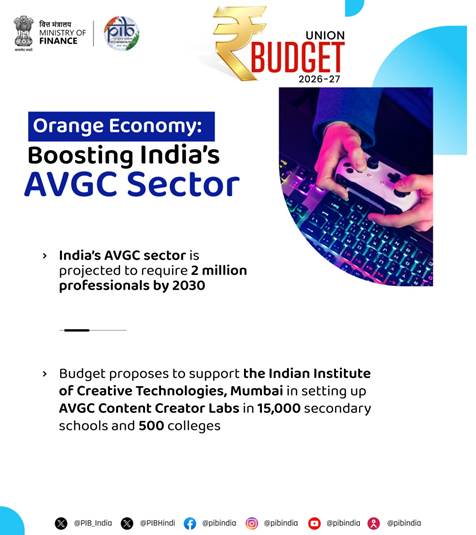
The Budget proposes setting up Animation, Visual Effects, Gaming and Comics (AVGC) Content Creator Labs in:
- 15,000 secondary schools
- 500 colleges
These labs will be anchored by the Indian Institute of Creative Technologies (IICT), Mumbai, envisioned as a premier institution for creative technology training.
Financial Allocation: ?250 crore earmarked for AVGC talent development.
Objective: Early exposure to digital storytelling tools, immersive technologies and creative entrepreneurship.
2. Expansion of Design Education
A new campus of the National Institute of Design (NID) will be established in Eastern India through a competitive “challenge route”.
Significance:
- Addresses shortage of trained designers
- Supports product innovation and branding for MSMEs
- Reduces regional disparities in access to design education
Why the Orange Economy Matters for India
1. Economic Growth Driver
- India’s media and entertainment sector was valued at ?2.5 trillion in 2024 (Economic Survey 2025–26).
- Creative exports grew by 20% in 2023–24, earning over $11 billion.
This highlights the sector’s potential to become a major contributor to services exports and GDP growth.
2. Employment Generation
- Employs around 8% of India’s workforce
- Offers large-scale opportunities for youth, freelancers, women and gig workers
- AVGC sector alone projected to need 2 million professionals by 2030
The sector’s low entry barriers and digital reach make it a powerful employment engine.
3. Strengthening Soft Power
Creative industries export stories, culture and intellectual property, enhancing India’s global influence.
- Indian films, gaming content, music, and digital art expand India’s cultural footprint
- Promotes Brand India globally
Thus, the Orange Economy is not just economic policy, but also cultural diplomacy.
4. Democratization of Creative Opportunity
By establishing AVGC labs in schools and colleges beyond metros, the budget aims to:
- Provide access to high-end creative tools in semi-urban and rural areas
- Unlock hidden talent across regions
- Reduce digital and opportunity divides
This aligns with the vision of inclusive and distributed growth.
India’s Structural Advantages
India is well-positioned to lead in the creative economy due to:
- A young demographic profile
- Rapid urbanisation and rising incomes
- Expanding internet and smartphone penetration
- Strong tradition of storytelling, arts and crafts
When combined with digital platforms, these factors create a fertile ecosystem for creative entrepreneurship.