
Meghalaya’s Living Root Bridges
- 01 Feb 2026
In News:
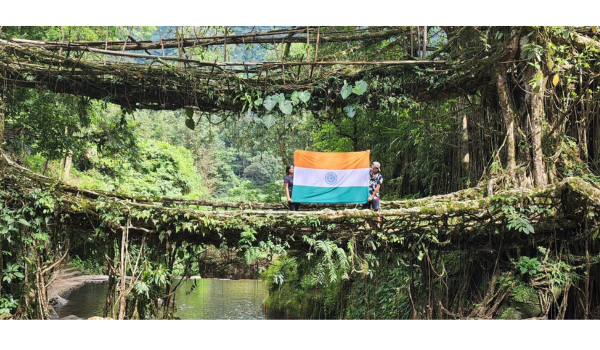
India has formally submitted the Living Root Bridges of Meghalaya for inscription on the UNESCO World Heritage List under the title “Jingkieng Jri / Lyu Chrai Cultural Landscape” for the 2026–27 evaluation cycle. These bioengineered bridges, developed by indigenous communities, represent a rare example of living architecture, blending ecological knowledge, cultural traditions, and sustainable engineering.
What are Living Root Bridges?
Known locally as Jingkieng Jri (Khasi) or Lyu Chrai (Jaintia), these bridges are found across the southern slopes of the Khasi and Jaintia Hills in the state of Meghalaya.
They are:
- Living structures, grown rather than built
- Crafted using the aerial roots of the Ficus elastica (Indian rubber tree)
- Developed over 15–30 years
- Capable of spanning 15 to 250 feet
- Durable for several centuries with proper care
Construction Process: Indigenous Bioengineering
The bridges are a result of traditional tree-shaping techniques perfected over generations:
- Young aerial roots of Ficus trees are guided across streams using hollowed trunks of Areca catechu.
- These trunks protect the roots and direct their growth.
- A temporary bamboo scaffold supports the structure during early stages.
- Over time, roots thicken and undergo inosculation (natural fusion), forming a strong, self-supporting bridge.
- As the bridge matures, the support materials decay, leaving a resilient living structure.
This method reflects deep ecological understanding and sustainable resource use.
Cultural Landscape Significance
The nomination recognises not just the bridges but an entire cultural landscape shaped by the Khasi and Jaintia tribes. The bridges embody:
- Community-based land management
- Intergenerational knowledge transfer
- Spiritual reverence for Mei Ramew (Mother Earth)
- Harmony between human activity and fragile hill ecosystems
Thus, they represent intangible cultural heritage expressed through a tangible living form.
Why UNESCO Recognition Matters
Inclusion in the UNESCO World Heritage List would:
- Provide global recognition of indigenous ecological knowledge
- Strengthen conservation and sustainable tourism efforts
- Encourage preservation of traditional practices amid modernization
- Highlight nature-based solutions in climate-resilient infrastructure
Institutional Role in Nomination
The nomination dossier was submitted by India’s Permanent Representative to UNESCO with contributions from:
- Archaeological Survey of India
- Ministry of External Affairs
- Government of Meghalaya
- Local indigenous communities, who remain the primary custodians