
India Energy Week (IEW) 2026
- 01 Feb 2026
In News:
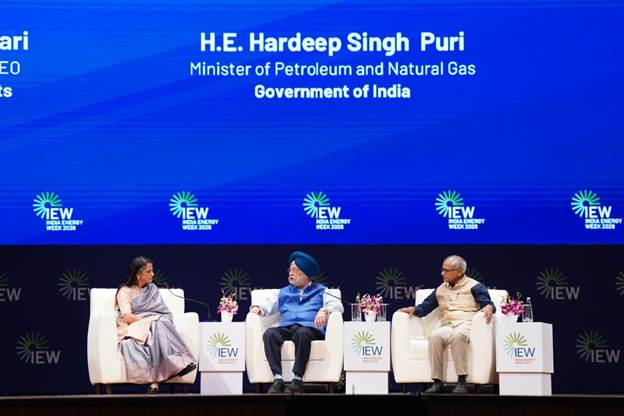
India Energy Week (IEW) 2026, held in Goa, concluded with India reaffirming its position as a resilient and credible energy leader amid global geopolitical volatility. The event highlighted India’s dual strategy: ensuring energy security through diversified conventional supplies while accelerating the transition toward cleaner fuels.
India’s Energy Strategy: Resilience in a Volatile World
Union Petroleum and Natural Gas Minister Hardeep Singh Puri emphasised that India has successfully navigated successive global disruptions by:
- Diversifying crude oil and gas import sources
- Strengthening domestic exploration
- Expanding clean energy adoption
India today ranks as:
- 3rd-largest energy consumer
- 4th-largest refining hub
- Among the top exporters of petroleum products
Despite global price shocks, India maintained stable domestic fuel and LPG prices, shielding consumers through policy and Oil Marketing Company (OMC) interventions.
Paradigm Shift: From Energy Transition to “Energy Addition”
A key theme at IEW 2026 was that the global transition is not about replacing fossil fuels overnight but about “energy addition”:
- Continued investment in oil and gas for stability
- Rapid scale-up of biofuels, LNG, green hydrogen, and renewables
This balanced approach recognises developmental realities while pursuing climate goals.
Domestic Exploration & Upstream Reforms
India aims to reduce import dependence by boosting domestic production through:
- Hydrocarbon Exploration Licensing Policy (HELP)
- Open Acreage Licensing Policy (OALP)
- Discovered Small Fields (DSF) rounds
- Oilfields (Regulation & Development) Amendment Act, 2025
- Petroleum and Natural Gas Rules, 2025
These reforms aim to improve ease of doing business and attract global investment into India’s sedimentary basins.
Downstream and Infrastructure Reforms
- Unified Pipeline Tariff (UPT) under One Nation, One Gas Grid to reduce regional disparities
- Integration of refining and petrochemicals to enhance value addition
- Digitalisation and AI-driven optimisation to improve logistics and operational resilience
Clean Energy Acceleration
India’s energy transition efforts include:
- 20% ethanol blending achieved in 2025
- Expansion of Compressed Biogas (CBG) with a 5% blending target by 2030
- Scaling Green Hydrogen under the National Green Hydrogen Mission
- Growth in solar and wind capacity, with India ranking among the top global producers
India has already achieved 50% of its installed electricity capacity from non-fossil sources, five years ahead of its 2030 target.
Global Partnerships: India–UAE Energy Ties
At IEW 2026, the United Arab Emirates reaffirmed its role as a reliable energy partner:
- 4th-largest source of India’s oil imports
- Key LPG supplier
- Bilateral trade target: USD 200 billion by 2032
The UAE highlighted underinvestment in energy as a global risk, echoing India’s call for balanced investment across energy types.
Role of States: Goa’s Renewable Vision
As host, Goa presented a roadmap to achieve 100% renewable energy by 2050, linking:
- Green Economy (clean energy growth)
- Blue Economy (sustainable ocean resource use)
This reflects sub-national participation in India’s climate strategy.
Energy Security: India’s Current Status
Achievements:
- 3rd globally in solar capacity
- 4th in wind and overall renewable capacity
- Strong refining and export capabilities
Challenges:
- Still the 3rd-largest net energy importer
- Ranking drop in the World Economic Forum Energy Transition Index