
16th Finance Commission
- 03 Feb 2026
In News:
The 16th Finance Commission (FC), constituted in 2023 under the chairmanship of Arvind Panagariya, has had its recommendations accepted by the Union Government for implementation during the award period 2026–27 to 2030–31. Its report focuses on balancing fiscal federalism, macroeconomic stability, and performance-driven governance amid rising expenditure pressures and climate-related risks.
What is the Finance Commission?
The Finance Commission is a constitutional body under Article 280 of the Indian Constitution.
Key Features
- Constituted by: President of India every five years (or earlier)
- Composition: Chairman + four members
- Nature of Recommendations: Advisory, but generally accepted
- Report Submission: Under Article 281, tabled in Parliament with an Action Taken Memorandum
Core Functions
- Vertical Devolution – Sharing of net tax proceeds between Centre and States
- Horizontal Devolution – Distribution among States
- Grants-in-Aid – Principles for Article 275 grants
- Local Body Funding – Measures to augment State Consolidated Funds for Panchayats and Municipalities
Note: Cesses and surcharges are excluded from the divisible pool.
Key Recommendations of the 16th Finance Commission
Vertical Devolution
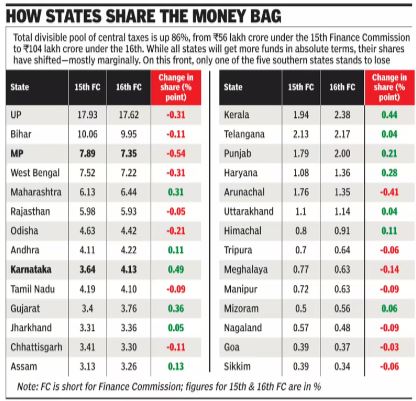
- States’ share of the divisible tax pool retained at 41%, same as the 15th FC.
- However, the Commission flagged a shrinking effective pool due to rising cesses and surcharges, which are not shared.
- It proposed a future “grand bargain” to rationalise these levies and widen the divisible pool.
Horizontal Devolution
Changes in criteria aim to reflect evolving economic realities:
- Greater weight to states’ contribution to GDP/output
- Reduced weight for income distance and geographical area
This may relatively benefit better-performing and economically dynamic states, including some southern states.
Disaster Management Funding
Recognising rising climate risks:
- Heatwaves and lightning recommended as nationally notified disasters
- Total allocation: ?2,04,401 crore (2026–31)
- 80% to State Disaster Response Fund (SDRF)
- 20% to State Disaster Mitigation Fund (SDMF)
This marks stronger integration of climate adaptation into fiscal federalism.
Grants to Local Bodies
- Total allocation: ?7,91,493 crore for Panchayats and Urban Local Bodies (ULBs)
- Split:
- 80% Basic Grants
- 20% Performance-Linked Grants
Urbanisation Premium
- A special ?10,000 crore incentive fund to encourage the merger of peri-urban areas into larger ULBs for better planning and service delivery.
Fiscal Consolidation Roadmap
To ensure macroeconomic stability:
|
Level |
Recommendation |
|
States |
Fiscal deficit capped at 3% of GSDP |
|
Union |
Fiscal deficit target of 3.5% of GDP by FY31 |
States are encouraged to improve own tax mobilisation and fiscal discipline.
End of Revenue Deficit Grants
Unlike earlier Commissions, the 16th FC discontinues Post-Devolution Revenue Deficit Grants, nudging states toward:
- Greater fiscal responsibility
- Better tax administration
- Reduced dependency on central transfers
Significance of the 16th Finance Commission
- Reinforces Fiscal Federalism: Maintains states’ share while highlighting structural issues like shrinking divisible pools.
- Promotes Performance-Based Federalism: Greater weight to output and performance incentivises economic efficiency.
- Mainstreams Climate Risks: Inclusion of heatwaves and lightning signals evolving understanding of disaster vulnerability.
- Strengthens Local Governance: Substantial grants and performance criteria enhance decentralisation.
- Focus on Fiscal Discipline: Clear deficit targets align with long-term macroeconomic stability.
Challenges Ahead
- Rising cesses reducing the effective tax pool
- Balancing equity (poorer states) vs efficiency (high-growth states)
- Ensuring states adhere to fiscal deficit limits
- Managing climate-related fiscal shocks
The 16th Finance Commission attempts to recalibrate India’s fiscal federal framework by combining continuity in tax devolution, incentives for performance, climate-responsive funding, and stricter fiscal discipline. Its recommendations reflect a shift toward output-linked and responsibility-driven federalism, crucial for sustaining India’s growth trajectory while preserving macroeconomic stability.