
Tapanuli Orangutan
- 16 Dec 2025
In News:
Scientists have warned that Cyclone Senyar-triggered floods and landslides in northern Sumatra may have killed 6–11% of the remaining Tapanuli orangutan population, pushing the species closer to extinction.
About the Tapanuli Orangutan
- The Tapanuli orangutan is the rarest great ape species in the world, formally identified as a distinct species in 2017. Fewer than 800 individuals are believed to survive in the wild.
- Habitat and Distribution
- Tapanuli orangutans are found only in the Batang Toru Ecosystem in North Sumatra, Indonesia.
- Their range is highly fragmented and restricted to upland and submontane rainforests south of Lake Toba, covering less than 3% of their historical range.
- Evidence suggests they were originally better adapted to lower-altitude forests but were pushed into higher terrain due to habitat loss.
- IUCN Status: The species is listed as Critically Endangered on the IUCN Red List due to its extremely small and declining population, restricted range, and ongoing threats.
Physical Characteristics
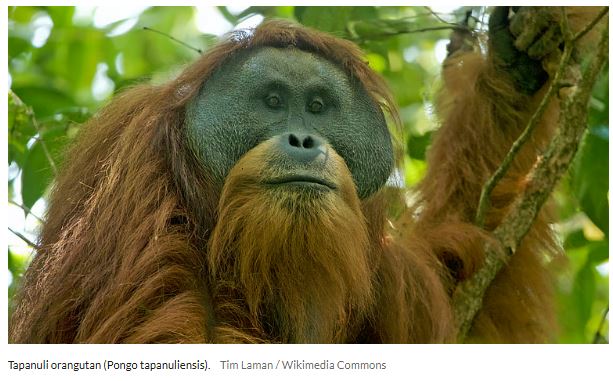
- Tapanuli orangutans resemble other orangutans in size but have distinct features. They possess smaller skulls, flatter faces, and thicker, frizzier orange fur. Adult flanged males have beards and moustaches, with flatter cheek pads covered in light-colored fuzz.
Behaviour and Ecology
- These orangutans are arboreal and largely solitary, spending most of their lives in the forest canopy.
- They are highly intelligent and known for tool use, using sticks and branches as hooks, scratchers, or to extract insects. Social learning and cultural transmission of behaviors have also been observed.
- Their life history is extremely slow, with one of the longest mother–offspring bonds in mammals (7–11 years). Males exhibit bimaturism, with two forms: unflanged males (smaller, no cheek pads) and dominant flanged males (large cheek pads and throat sacs).
- A unique ecological trait is their diet, which includes certain caterpillars and pinecones not known to be eaten by other orangutan species.
Why the Species is Extremely Vulnerable
The Tapanuli orangutan’s risk of extinction is amplified by:
- Extremely small total population
- Highly restricted and fragmented habitat
- Slow reproduction rate
- Increasing frequency of extreme weather events linked to climate change
- Ongoing habitat pressures from development and infrastructure
Even minor increases in mortality can have irreversible population-level consequences.
Conservation Significance
The Tapanuli orangutan represents the most ancient lineage of orangutans, despite being the most recently described. Its survival is crucial for preserving global great ape diversity and evolutionary history.
The recent cyclone highlights how climate-related disasters can become “extinction-level events” for species already on the brink.