
Rare Early-Universe Supernova Observed by JWST
- 16 Dec 2025
In News:
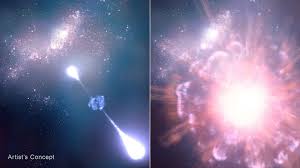
Astronomers using the James Webb Space Telescope (JWST) have detected a rare supernova in the early universe. The discovery was linked to a distant gamma-ray burst (GRB) that helped scientists trace the explosive death of a massive star dating back to just a few hundred million years after the Big Bang.
What is a Supernova?
A supernova is a powerful and catastrophic explosion marking the end of a star’s life cycle. It is among the most energetic events in the universe.
During a supernova, a star releases an enormous amount of energy in a short time — sometimes emitting more energy in a few seconds than the Sun will produce in its entire lifetime. These explosions can briefly outshine entire galaxies and are visible across vast cosmic distances.
Types of Supernovae
- Type I Supernova: This occurs in a binary star system where a white dwarf star pulls matter from a companion star. When the accumulated mass crosses a critical limit, a runaway nuclear reaction triggers a thermonuclear explosion.
- Type II Supernova: This occurs when a massive star exhausts its nuclear fuel. Without the outward pressure from fusion, gravity causes the core to collapse, leading to a violent explosion known as a core-collapse supernova.
Role of Supernovae in the Universe
Supernovae play a crucial role in cosmic evolution. They are the primary sources of heavy elements such as iron, gold, and uranium, which are later incorporated into new stars, planets, and even living organisms. Thus, they are fundamental to the chemical enrichment of the universe.
How Common are Supernovae?
In a galaxy like the Milky Way, astronomers estimate that about two to three supernovae occur per century. However, since the universe contains billions of galaxies, astronomers observe hundreds of supernovae every year beyond our galaxy.
Significance of the JWST Discovery
The recent observation is particularly important because it captures a supernova from the early universe, only a few hundred million years after the Big Bang. Studying such ancient stellar explosions helps scientists understand:
- The formation of the first generations of stars
- Early chemical enrichment of the universe
- The evolution of galaxies in the cosmic dawn era
The high sensitivity and infrared capabilities of the James Webb Space Telescope make it uniquely suited to observe such distant and ancient cosmic events.