
Onchocerciasis
- 09 Dec 2025
In News:
In a historic milestone, Niger has become the first country in Africa to eliminate onchocerciasis, also known as river blindness, as verified by the World Health Organization (WHO). Niger is the fifth country globally to achieve this, joining Colombia, Ecuador, Guatemala and Mexico in halting the transmission of the parasitic disease.
What is Onchocerciasis?
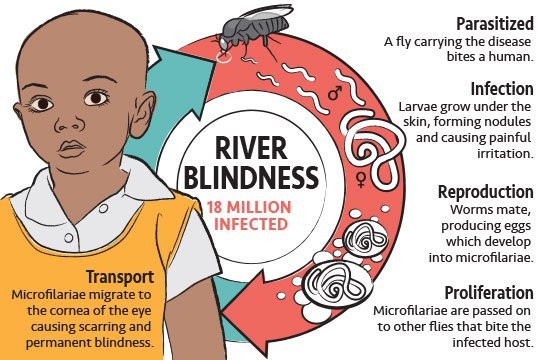
- Onchocerciasis, commonly called river blindness, is a neglected tropical parasitic disease caused by the filarial worm Onchocerca volvulus.
- The parasite is transmitted to humans through repeated bites of infected Simulium blackflies, which breed near fast-flowing rivers and streams.
- Globally, over 99% of cases occur in sub-Saharan Africa and Yemen, with smaller endemic pockets in parts of Latin America. River blindness is the second leading infectious cause of blindness worldwide, after trachoma.
Transmission and Symptoms
- Vector: Bites from infected blackflies introduce larvae into human skin.
- Disease Process: Larvae develop into adult worms under the skin, producing microfilariae that cause severe inflammation.
- Symptoms:
- Skin: Severe itching, rashes, thickening and depigmentation.
- Eyes: Lesions leading to visual impairment and, in advanced cases, permanent blindness.
- Other: Firm nodules under skin; early exposure in children has been linked to epilepsy in some regions.
Treatment and Elimination Strategy
The primary treatment is ivermectin (Mectizan®), administered once or twice a year over 10–15 years- the lifespan of adult worms - to interrupt transmission. Mass drug administration with ivermectin, often supported by global partners, is central to elimination efforts.
Elimination requires high therapeutic coverage, consistent surveillance, vector control where feasible, and strong community participation over many years.
Niger’s Path to Elimination
- Niger’s success reflects decades of coordinated public health action. The country first joined regional control efforts such as the Onchocerciasis Control Programme (OCP) and later the African Programme for Onchocerciasis Control (APOC), involving regular ivermectin distribution and monitoring activities.
- After achieving onchocerciasis control, Niger submitted its elimination dossier to WHO and met the technical criteria for interrupting transmission by early 2025. This was confirmed through sustained surveillance and absence of new infections.
- WHO praised Niger’s commitment and leadership, noting that the achievement ended a long period of human suffering and economic burden associated with river blindness in affected communities.
Global and Regional Significance
- Niger’s milestone is significant for Africa’s public health landscape. It demonstrates that elimination of neglected tropical diseases (NTDs)once considered extremely challenging is achievable with sustained effort, partnerships, and community engagement.
- Niger also previously eliminated Guinea-worm disease (dracunculiasis) in 2013, showcasing its capacity for tackling major parasitic diseases.
- The country’s success provides a model for other African nations still battling onchocerciasis, offering strategic lessons for integrated NTD programmes and WHO’s roadmap to eliminate multiple neglected diseases by 2030.
Onchocerciasis
- 03 Feb 2025
In News:
The World Health Organization (WHO) officially verified Niger as the first country in the African Region and the fifth globally to eliminate onchocerciasis (river blindness) by interrupting the transmission of the parasite Onchocerca volvulus.
What is Onchocerciasis (River Blindness)?
- A parasitic disease caused by the worm Onchocerca volvulus.
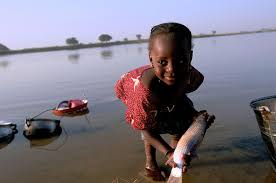
- Transmitted by infective blackflies, primarily found in riverine areas.
- Causes severe itching, disfiguring skin conditions, and irreversible blindness.
- It is the second leading infectious cause of blindness globally (after trachoma).
- Predominantly affects rural populations in sub-Saharan Africa, Yemen, and parts of Latin America.
Niger’s Elimination Strategy and Achievements:
Historical Background:
- 1976–1989: Under the WHO Onchocerciasis Control Programme (OCP), Niger used vector control via insecticide spraying, reducing disease transmission.
- 2008–2019: Mass Drug Administration (MDA) with ivermectin and albendazole was carried out, primarily for lymphatic filariasis (LF), but also effectively interrupted onchocerciasis transmission in co-endemic areas.
Assessment and Surveillance:
- 2014: Niger began preliminary assessments following the end of LF MDA.
- Entomological and epidemiological surveys confirmed disease elimination:
- Prevalence dropped from 60% to 0.02%.
- No ongoing transmission of O. volvulus.
Key Contributors to Success:
- Partnerships: Collaborative efforts between the Government of Niger, WHO, Merck Sharpe & Dohme (MSD), and various NGOs.
- Medicine Donation: MSD’s donation of ivermectin.
- Surveillance & Flexibility: Continuous monitoring allowed strategic adaptation.
- Previous Success: Niger was certified free of Guinea-worm disease in 2013.
Global and Regional Significance:
- Niger becomes the fifth country globally to eliminate onchocerciasis:
- Other four countries:
- Colombia (2013)
- Ecuador (2014)
- Mexico (2015)
- Guatemala (2016) (All from the WHO Region of the Americas)
- Other four countries:
- WHO African Region:
- 21 countries have eliminated at least one Neglected Tropical Disease (NTD).
- Onchocerciasis is the second NTD eliminated in Niger after Guinea-worm.