
Sudden Stratospheric Warming (SSW)
- 12 Dec 2025
In News:
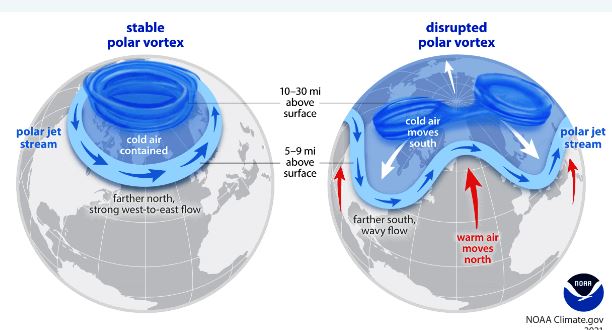
Meteorologists have recently warned of a potential Sudden Stratospheric Warming (SSW) event, which may cause below-average temperatures across parts of the United States and other mid-latitude regions later this month.
What is Sudden Stratospheric Warming?
- Sudden Stratospheric Warming (SSW) is a phenomenon marked by a rapid increase in stratospheric temperatures, sometimes by 30–50°C within a few days.
- It results in the weakening, displacement, or splitting of the polar vortex, a cold air system usually confined to the polar regions.
Mechanism of SSW
- SSW events are triggered by large-scale atmospheric (Rossby) waves generated in the troposphere.
- These waves propagate upward into the stratosphere and break over the polar vortex, similar to ocean waves.
- If sufficiently strong:
- The westerly winds of the polar vortex weaken or reverse to easterlies
- The vortex loses its circular symmetry
- This causes descending air to warm adiabatically, leading to sudden temperature rise in the stratosphere.
Impact of SSW
- The weakened or split polar vortex allows cold Arctic air to spill southward into the mid-latitudes.
- This can result in:
- Cold waves
- Severe winter weather
- Below-normal temperatures over regions such as:
- North America
- Europe
- Asia
Polar Vortex: Key Features
- A large, persistent low-pressure system containing cold air around both poles.
- Extends from:
- Tropopause
- Through the stratosphere
- Up to the mesosphere (above ~50 km)
- Seasonal behavior:
- Stronger in winter
- Weaker in summer
- During winter, it can expand and interact with the jet stream, pushing cold air southward.
Role of Jet Streams
- Jet streams are narrow bands of strong winds located in the upper troposphere (~9–12 km altitude).
- They act as a conduit for polar air outbreaks during polar vortex disturbances.
- Such interactions are common during Northern Hemisphere winters.