
National Mission on Edible Oils (NMEO)
- 13 Dec 2025
In News:
The Government of India is implementing the National Mission on Edible Oils (NMEO) through two components -NMEO–Oil Palm (NMEO-OP) and NMEO–Oilseeds (NMEO-OS), to reduce India’s heavy dependence on edible oil imports. In 2023–24, imports met about 56% of domestic edible oil demand.
NMEO – Oil Palm (NMEO-OP)
- About:Launched in 2021 as a Centrally Sponsored Scheme, NMEO-OP aims to expand oil palm cultivation and increase domestic Crude Palm Oil (CPO) production.
- Financial Outlay: ?11,040 crore
- Key Features
- Viability Price (VP): Price assurance mechanism to protect farmers from fluctuations in global CPO prices
- Higher Subsidies: Assistance for planting material increased significantly (up to ?29,000/ha) along with maintenance support
- Rejuvenation Aid: ?250 per plant for replacing old palms
- Regional Focus: Special emphasis on North-East India and traditional states like Andhra Pradesh and Telangana
- Targets
- Area Expansion: 6.5 lakh hectares under oil palm by 2025–26
- Production:
- 11.2 lakh tonnes CPO by 2025–26
- 28 lakh tonnes CPO by 2029–30
- Consumption Benchmark: Maintain edible oil consumption at 19 kg/person/year till 2025–26
- Progress
- 2.5 lakh hectares added under NMEO-OP (as of Nov 2025)
- Total oil palm area reached 6.2 lakh hectares
- CPO production rose from 1.91 lakh tonnes (2014–15) to 3.8 lakh tonnes (2024–25)
NMEO – Oilseeds (NMEO-OS)
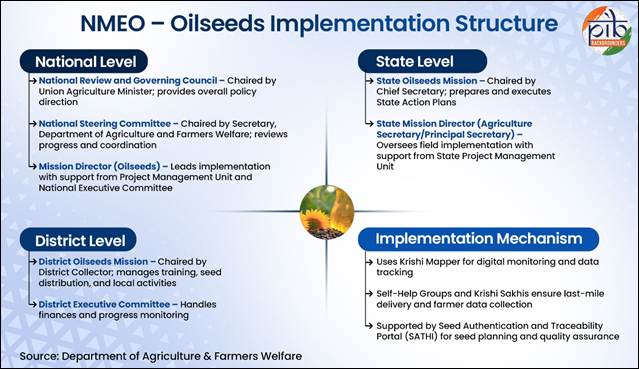
- About:Approved in 2024 for the period 2024–25 to 2030–31, NMEO-OS focuses on achieving self-sufficiency in edible oils by boosting production of major oilseed crops.
- Coverage: Targets 9 major oilseed crops including:Mustard, Groundnut, Soybean, Sunflower, Sesame, Safflower, Niger, Castor, and Linseed
- Also promotes oils from secondary sources such as cottonseed, rice bran, coconut, and tree-borne oilseeds (neem, jatropha, karanja, mahua, simarouba).
Key Objectives
- Bridge yield gaps via improved seeds and technologies
- Expand area using fallow lands and intercropping
- Strengthen seed systems and market access
- Promote value addition and higher farmer returns
Targets
- Increase oilseed area from 29 million ha (2022–23) to 33 million ha (2030–31)
- Raise oilseed production from 39 million tonnes to 69.7 million tonnes
- Add 40 lakh hectares through crop diversification and fallow land use
Combined Impact of NMEO
Together, NMEO-OP and NMEO-OS aim to produce 25.45 million tonnes of edible oil by 2030–31, meeting about 72% of India’s domestic demand.
Implementation Support
- Self-Help Groups and Krishi Sakhis act as Community Agriculture Service Providers (CASPs)
- Use of Krishi Mapper digital platform for real-time monitoring
Oilseeds in India — Key Facts
- Oilseeds are India’s second most important crop group after food grains
- Cover 14.3% of gross cropped area
- Provide 12–13% of dietary energy
- Major producing states: Rajasthan (mustard), Madhya Pradesh (soybean), Gujarat, Maharashtra
- Oil palm concentrated in Andhra Pradesh & Telangana, expanding in North-East states
Economic Importance
- Key source of dietary fats and vitamins (A, D, E, K)
- Important cash crops for farmer income
- Contribute ~8% of agricultural exports
- Domestic edible oil production: 12.18 million tonnes (2023–24) vs high demand
Reasons for Import Dependence
- Decline in self-sufficiency after import duty reductions post-WTO reforms
- 76% oilseed area is rainfed, making production climate-vulnerable
- Rising consumption: Rural intake up 83.68%, urban up 48.74% (2004–05 to 2022–23)