
NITI Aayog report “Roadmap on AI for Inclusive Societal Development”
- 11 Oct 2025
In News:
NITI Aayog has unveiled its strategic report “Roadmap on AI for Inclusive Societal Development”, which presents a comprehensive vision for leveraging Artificial Intelligence (AI) to strengthen India’s vast informal economy through enhanced digital inclusion, skilling, and social protection systems.
Status of India’s Informal Workforce
- Scale and Economic Role: Approximately 490 million Indians—about 90% of the national workforce—are engaged in informal employment spanning agriculture, construction, and services, together contributing nearly half of India’s GDP (MoLE, 2024).
- Rural Dominance: Over 80% of rural labourers operate without written contracts or social security coverage, especially in construction, handicrafts, and retail sectors.
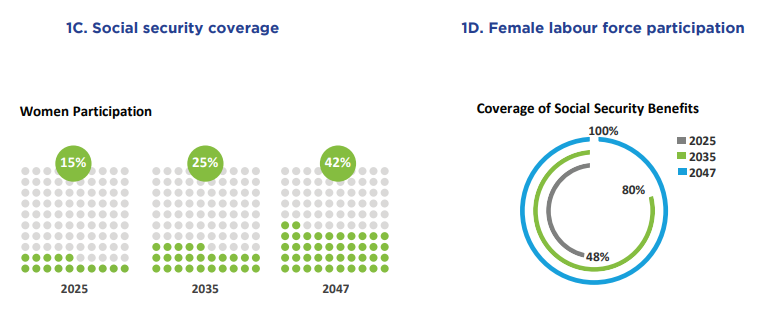
- Gendered Vulnerability: Women constitute around 55% of the informal workforce, with significant representation in home-based and agricultural activities (ILO, 2023).
- Low Productivity and Earnings: Informal sector productivity remains roughly one-fourth that of the formal economy, perpetuating low wages and economic insecurity.
- Emergence of Urban Informality: The gig and platform economy has created a new informal class, with nearly 7.5 million platform workers (NITI Aayog, 2022) still outside formal labour protections.
Core Challenges
- Financial Instability: Over three-fourths of informal workers earn below ?10,000 per month and face limited access to affordable credit or insurance (PLFS, 2024).
- Market Inefficiencies: Only about 12% of small producers or artisans access digital or organized markets directly, remaining dependent on intermediaries.
- Digital and Skill Divide: Around 70% of informal workers lack basic digital literacy, impeding their participation in AI-integrated economies.
- Weak Social Protection: Just one-third of eligible informal workers are registered under welfare schemes such as e-Shram or PM-SYM.
- Policy Fragmentation: Overlapping databases and weak institutional coordination hinder effective benefit delivery and erode worker trust.
Transformative Potential of AI
- Financial Empowerment: AI-based credit assessment tools (e.g., SBI YONO, Setu.ai) can facilitate microloans for workers lacking traditional financial records.
- Digital Public Infrastructure (DPI): Platforms such as Aadhaar, UPI, and e-Shram can establish verifiable worker identities, improving transparency in wage payments and welfare targeting.
- Smart Contracts and Blockchain: Use of blockchain for wage traceability and supply chain verification (e.g., Tata Steel Foundation’s pilot in Jharkhand) can curb exploitation.
- AI-driven Skilling: Adaptive learning ecosystems like Skill India Digital can deliver personalized, voice-enabled vernacular micro-courses for re-skilling informal workers.
- Predictive Governance: AI-based data analytics can enhance targeting and timeliness of welfare delivery (e.g., integration with PM-Kisan data systems).
Major Recommendations
- Launch of ‘Digital ShramSetu Mission’: Create an AI-enabled national platform integrating social security, skilling, and livelihood databases for informal workers.
- Sector-specific AI Models: Focus on high-impact areas—agriculture, construction, logistics, and retail—for productivity enhancement.
- Inclusive Design: Develop voice-first, multilingual AI interfaces to ensure accessibility for low-literacy populations.
- Public–Private Collaboration: Promote partnerships among government agencies, startups, and tech firms for scalable innovation in informal ecosystems.
- Responsible AI Charter: Establish a framework ensuring transparency, privacy, and inclusivity in AI deployment for social sectors.
- AI-based Skilling Framework: Institutionalize micro-credential courses and continuous re-skilling under Skill India 2.0.
- Impact Evaluation Mechanism: Implement real-time data-driven monitoring to assess inclusion, income enhancement, and service delivery outcomes.