
LVM3-M5 Launch Vehicle
- 05 Nov 2025
In News:
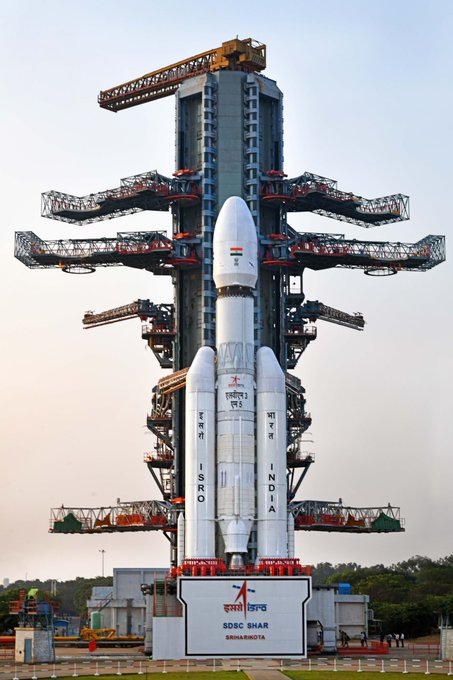
The Indian Space Research Organisation (ISRO) successfully launched CMS-03 (GSAT-7R), India’s heaviest communication satellite, aboard the LVM3-M5 launch vehicle from Sriharikota. The mission strengthens India’s strategic communication architecture, particularly maritime and defence networks, while reinforcing self-reliance in heavy satellite launch capability.
CMS-03 (GSAT-7R)
- CMS-03, also known as GSAT-7R, is an advanced multi-band communication satellite designed to enhance secure, high-capacity communication links across land and oceanic regions.
- It replaces the ageing GSAT-7 “Rukmini” and significantly expands India’s maritime communication footprint.
- Developed by: ISRO under the Department of Space, with all stages, subsystems, and payloads built using indigenous technology.
- Key Objectives:
- To provide secure, high-bandwidth communication for defence, especially the Indian Navy.
- To enhance network-centric warfare, fleet coordination, and maritime domain awareness.
- To strengthen India’s digital, strategic, and disaster management communication infrastructure.
- To expand India’s oceanic communication footprint under Atmanirbhar Bharat.
- Major Features
- Mass: 4,410 kg — heaviest Indian satellite launched from Indian soil.
- Bands & Payloads: Multi-band communication including C, extended-C, Ku, Ka, and support for UHF & S bands for strategic defence applications.
- High-throughput transponders supporting broadband, satellite internet, and real-time secure data flow.
- Coverage: Entire Indian mainland and wide Indian Ocean Region (IOR), including remote and contested waters.
- Mission Life: ~15 years.
- Role in Naval Operations:
- Backbone of the Navy’s communication grid.
- Supports secure voice, video, and data links between warships, submarines, aircraft, and command centres.
- Enhances situational awareness, joint operations, and maritime security.
LVM3-M5
- The Launch Vehicle Mark-III (LVM3), known as the “Baahubali” of Indian rockets, is ISRO’s most powerful three-stage heavy-lift launcher capable of placing 4-tonne class satellites into Geosynchronous Transfer Orbit (GTO).
- Key Objectives:
- To ensure self-reliance in launching heavy communication and strategic satellites.
- To reduce dependence on foreign launch services.
- To support future deep-space, high-mass, and crewed platforms.
- Key Features
- Three-stage configuration:
- Two S200 solid boosters
- One L110 liquid core stage
- C25 cryogenic upper stage with an indigenously developed engine
- Three-stage configuration:
- Capabilities:
- 4,000 kg to GTO
- 8,000 kg to Low Earth Orbit (LEO)
- Mass & Size: 641 tonnes; 43.5 metres tall.
- Cryogenic re-ignition test conducted for future multi-satellite deployment.
- Developed by Vikram Sarabhai Space Centre (VSSC) with enhanced payload efficiency (~10%).
- Proven reliability in eight consecutive missions, including Chandrayaan-3 and now CMS-03.
- Candidate launcher for future Gaganyaan crewed missions.