
India’s First Indigenous Hydrogen Fuel Cell Vessel
- 15 Dec 2025
In News:
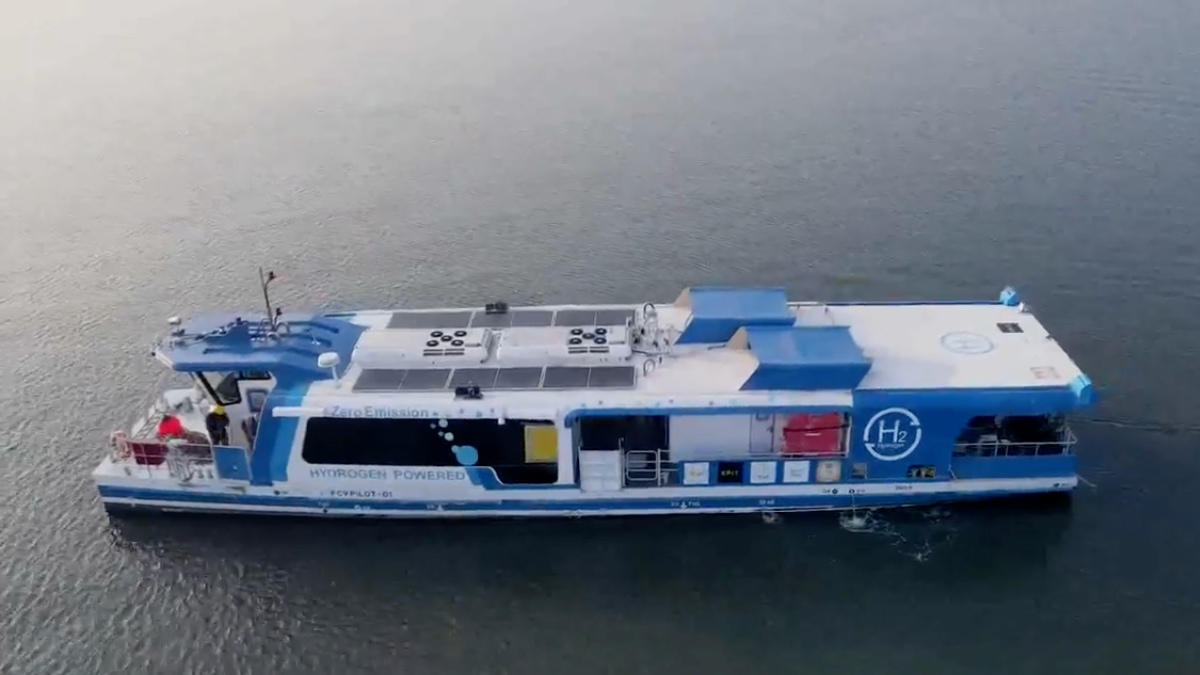
India has launched its first fully indigenous hydrogen fuel cell passenger vessel in Varanasi, marking a major milestone in the country’s transition to clean and sustainable inland water transport. The vessel was flagged off at Namo Ghat by the Union Minister for Ports, Shipping and Waterways, Sarbananda Sonowal, symbolising India’s commitment to green mobility and low-carbon infrastructure.
Technological Features of the Vessel
- The vessel has been designed and built indigenously by Cochin Shipyard Limited in collaboration with the Inland Waterways Authority of India (IWAI), which also owns the vessel.
- At its core is a Low-Temperature Proton Exchange Membrane (LT-PEM) fuel cell system. A Proton Exchange Membrane Fuel Cell (PEMFC) generates electricity through an electrochemical reaction between hydrogen and oxygen, without combustion. The only by-product of this process is water vapour, making it a near-zero emission technology.
- The vessel operates through a hybrid energy system, integrating:
- Hydrogen fuel cells
- Battery storage
- Solar power support
This design ensures energy efficiency, operational reliability, and reduced dependence on fossil fuels.
Strategic Policy Alignment
The launch aligns with India’s long-term maritime and climate strategies, including:
- Maritime India Vision 2030 (MIV 2030) – Focuses on sustainable port and waterways infrastructure, digitalisation, and alternative fuels.
- Maritime Amrit Kaal Vision 2047 (MAKV 2047) – Envisions India as a global maritime leader with green and smart transport systems.
It also contributes to India’s broader commitment to achieve net-zero emissions by 2070 by promoting clean energy in transport.
Significance for Inland Water Transport
The introduction of a hydrogen-powered vessel positions Varanasi at the forefront of India’s green waterways initiative. Inland waterways are being promoted as an energy-efficient and cost-effective mode of transport, and this step adds a sustainability dimension.
Key impacts include:
- Reduction in carbon emissions and air pollution in river cities
- Noise-free and pollution-free passenger travel
- Improved connectivity for pilgrims and tourists along the ghats
- Contribution to decongesting roads and lowering logistics costs
- Demonstration of indigenous clean technology leadership
Wider Environmental and Economic Implications
Hydrogen fuel cell technology is emerging as a critical pillar in India’s clean energy transition. Its use in inland waterways demonstrates sectoral decarbonisation beyond road and rail transport.
The project showcases:
- Growth of green shipbuilding capability in India
- Promotion of innovation-driven infrastructure
- Integration of renewable energy with mobility solutions
It also strengthens India’s position in the evolving global market for green maritime technology.