
Supreme Court’s 2026 Guidelines on Timely Delivery of Reserved Judgments and Bail Orders
- 01 Jun 2026
In News:
In a landmark judgment aimed at addressing judicial delays, a Bench comprising Chief Justice of India Surya Kant and Justice Joymalya Bagchi issued binding directions to all High Courts mandating pronouncement of reserved judgments within three months and same-day or next-day delivery of bail orders. The Court held that undue delay in delivering judgments is not merely an administrative lapse but a violation of the fundamental right to life and personal liberty under Article 21 of the Constitution.
Background of the Case
The directions arose from a writ petition filed by four convicts belonging to Scheduled Tribes (STs) and Other Backward Classes (OBCs), serving life sentences. Their criminal appeals before the Jharkhand High Court had been reserved in 2022 but were pronounced only in 2025, resulting in a delay of nearly three years. The petitioners argued that such delays infringed their right to a speedy trial, which the Supreme Court has consistently held extends beyond trial courts to appellate proceedings as well.
The Court treated the issue as a systemic challenge affecting judicial administration across the country rather than an isolated instance.
Key Directions Issued by the Supreme Court
1. Three-Month Deadline for Reserved Judgments: All High Courts must deliver reasoned judgments within three months of reserving them after completion of hearings.
2. Expedited Bail Orders
- Bail applications should preferably be pronounced and uploaded on the same day.
- If reserved, the order must be pronounced and uploaded on the next working day without exception.
- Orders granting bail or suspension of sentence must be immediately communicated to jail authorities to ensure release on the same day or the next day, subject to legal requirements.
3. Timely Upload of Judgments
- Where only the operative portion is pronounced, the detailed reasoned judgment must be uploaded within 7 days, extendable to 15 days in exceptional circumstances.
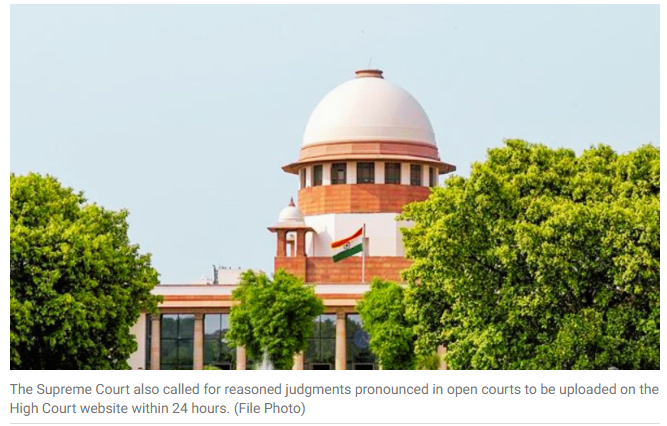
- Where a complete judgment is pronounced in open court, it must be uploaded on the High Court website within 24 hours.
4. Clarifications After Reservation
Any clarification sought after reserving judgment must be obtained:
- Within 7 days in criminal appeals involving incarcerated appellants.
- Within one month in all other matters.
Institutional Monitoring and Accountability
To ensure compliance, the Court introduced an automated monitoring framework:
- Monthly automated emails must be sent to the Chief Justice of each High Court listing pending reserved judgments.
- Cases pending beyond two months may be circulated confidentially to concerned benches.
Escalation Mechanism for Delays
If a judgment is not delivered within three months:
- The Registrar General must place the matter before the Chief Justice.
- The Chief Justice must notify the concerned bench within two weeks.
- If delays persist, the Chief Justice may reassign the case to another bench.
- Litigants can file applications seeking early pronouncement after three months.
- After four months, parties may seek withdrawal and reassignment of the matter.
Significance
The judgment transforms timely justice from an administrative expectation into an enforceable litigant right, strengthening judicial accountability and access to justice. It builds upon the principles laid down in the landmark case of Anil Rai v. State of Bihar (2001), where similar concerns were raised but implementation remained uneven.