
Sample Registration Survey 2024
- 24 May 2026
In News:
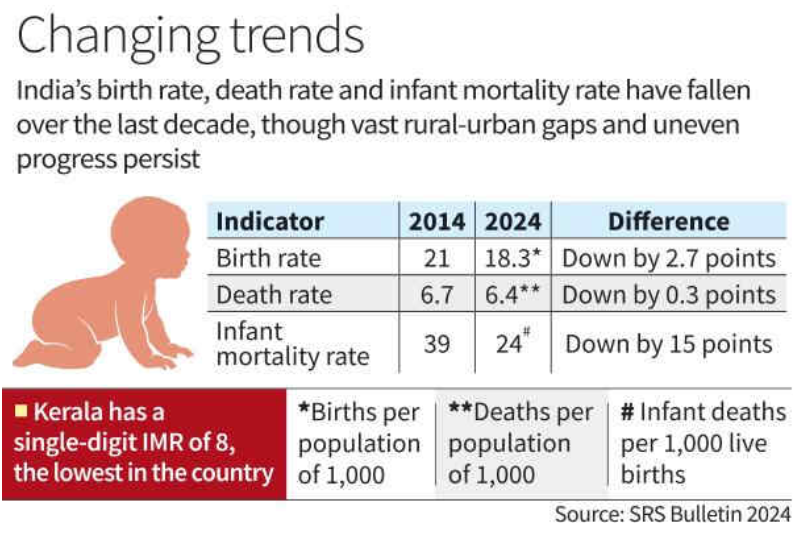
The SRS Bulletin released by the Registrar General of India shows that India's crude birth rate has declined to 18.3 births per 1,000 population in 2024 from 21 in 2014 and 36.9 in 1971, reflecting a major demographic transition over the past five decades. The data signals that India has entered an advanced stage of demographic change — with profound implications for health policy, fiscal planning, and political representation.
About the Sample Registration System (SRS)
- The SRS is one of the world's largest demographic surveys, conducted by the Office of the Registrar General & Census Commissioner (ORGI) under the Ministry of Home Affairs.
- It provides reliable annual estimates of birth rate, death rate, infant mortality rate (IMR), Total Fertility Rate (TFR), and other fertility-mortality indicators at national and sub-national levels.
- Data is collected through continuous enumeration by field workers and biannual independent surveys across 8,800 villages and urban blocks covering over 8.8 million people.
Key Data Points: SRS 2024
- Birth Rate: Fell from 21 in 2014 to 18.3 in 2024. The highest birth rate was recorded in Bihar (26.8), while the lowest was in Andaman & Nicobar Islands (9.9).
- Death Rate: Declined from 6.7 to 6.4 per 1,000 population. The natural growth rate has slowed to 11.9. The highest death rate was recorded in Chhattisgarh (8.4), and the lowest in Chandigarh (3.9).
- Infant Mortality Rate (IMR): IMR fell from 39 in 2014 to 24 per 1,000 live births in 2024 — a 38% decline over ten years and less than one-fifth of the 1971 level. The maximum IMR was in Chhattisgarh (36) and the minimum in Manipur (2).
- Under-5 Mortality Rate (U5MR): Fell to 28 per 1,000 live births in 2024.
- Total Fertility Rate (TFR) — Critical Headline: India's TFR has declined to 1.9 in 2024 — below the replacement-level fertility of 2.1 needed to maintain stable population levels. Rural women recorded a TFR of 2.1 versus urban women at 1.5 — a significant urban-rural fertility divide.
Persisting Regional Disparities
Kerala has India's lowest IMR among major states at 8, while Tamil Nadu stands at 11 and Maharashtra at 13. On the other hand, Chhattisgarh has the highest IMR at 36, followed by Madhya Pradesh and Uttar Pradesh at 35 each. "Despite substantial progress, one in every 42 infants in India still dies before completing one year of life. In rural India, the figure is even worse — one in every 37 infants."
Demographic Transition: Implications
- Sub-replacement TFR and Delimitation: India's TFR falling below 2.1 has major political implications. Southern and western states — which adopted family planning earlier — risk losing parliamentary seats in the delimitation exercise (post-2026 Census), while high-fertility states like Bihar and Uttar Pradesh may gain representation. This north-south demographic divergence is a politically sensitive constitutional issue.
- Ageing Population: A declining birth rate alongside improving life expectancy will accelerate the old-age dependency ratio — shifting India's demographic dividend toward a dependency burden over the coming decades, requiring urgent policy responses in pension, healthcare, and labour market frameworks.
- Health Infrastructure Gaps: Wide rural-urban and inter-state differences in demographic and health outcomes highlight the need for targeted healthcare investments — particularly in the Empowered Action Group (EAG) states of Bihar, UP, MP, Chhattisgarh, Rajasthan, Odisha, Jharkhand, and Uttarakhand, which continue to lag on most health indicators.