
India-UAE: From Transactional Ties to a Comprehensive Strategic Partnership
- 19 May 2026
In News:
Prime Minister Narendra Modi's recent official visit to the United Arab Emirates concluded with a series of landmark agreements spanning energy security, defence industry, artificial intelligence, maritime infrastructure, and digital finance — signalling a qualitative leap in one of India's most consequential bilateral relationships.
Key Outcomes of the Visit
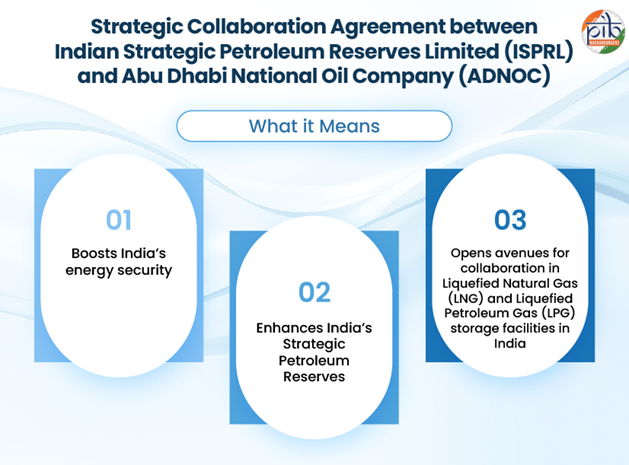
- Energy Security emerged as a cornerstone. Indian Strategic Petroleum Reserves Limited (ISPRL) and Abu Dhabi National Oil Company (ADNOC) formalised an arrangement to store up to 30 million barrels of crude oil in India's Strategic Petroleum Reserve (SPR) facilities at Visakhapatnam and the upcoming Chandikol site in Odisha, while also exploring commercial crude storage at Fujairah in the UAE. Separately, Indian Oil Corporation Limited (IOCL) secured a long-term LPG supply agreement with ADNOC Gas, reinforcing India's hydrocarbon import resilience.
- Strategic Defence Cooperation advanced well beyond conventional buyer-seller dynamics. A comprehensive defence industrial framework was established covering joint innovation, cyber defence, maritime security, and secure communication systems — a significant step toward co-development of advanced military technology.
- Capital and Technology Inflows were substantial. UAE entities committed USD 5 billion in investments into India, including USD 1 billion by the Abu Dhabi Investment Authority (ADIA) into the National Investment and Infrastructure Fund (NIIF) for priority infrastructure. On the technology front, India's Centre for Development of Advanced Computing (C-DAC) and UAE's G42 signed a term sheet to build an 8 Exaflop Supercomputing Cluster, boosting the IndiaAI Mission considerably.
- Maritime and Skill Development: Cochin Shipyard Limited and Dubai's Drydocks World inked an MoU to establish a ship repair cluster at Vadinar, Gujarat, under India's Maritime Development Fund Scheme. A tripartite pact was also signed for training and deploying a skilled maritime workforce — directly supporting the Make in India and Skill India missions.
Strategic Significance
India-UAE bilateral merchandise trade crossed USD 100 billion for the first time, reaching USD 101.25 billion in FY 2025–26. Under the Comprehensive Economic Partnership Agreement (CEPA), both nations aim to double non-oil trade to USD 200 billion by 2032. Cumulative FDI from the UAE into India between April 2000 and March 2025 stood at USD 22.84 billion, making the UAE India's seventh-largest foreign investor.
Beyond trade, the UAE serves as a linchpin in India's "Think West" policy — anchoring minilateral formats like I2U2 (India, Israel, UAE, USA) and the India-Middle East-Europe Economic Corridor (IMEC). Digital integration has advanced through UPI-AANI payment linkage and RuPay-JAYWAN card connectivity, while the Local Currency Settlement (INR-AED) system reduces dollar dependence. India also reiterated the critical importance of unimpeded navigation through the Strait of Hormuz for global energy and food security.
Challenges Ahead
Despite rapid progress, structural challenges persist: a trade deficit driven by crude imports, non-tariff barriers under CEPA, China's deepening footprint in UAE ports and technology zones, labour vulnerabilities facing the approximately 3.5 million Indian diaspora in the UAE, and financing bottlenecks constraining IMEC's full operationalisation.