
Digital Hub for Reference and Unique Virtual Address (DHRUVA)
- 07 Dec 2025
In News:
The Department of Posts (DoP) under the Ministry of Communications has proposed a new digital addressing framework called DHRUVA (Digital Hub for Reference and Unique Virtual Address). It aims to create a standardised, interoperable, and user-centric digital address system as part of India’s Digital Public Infrastructure (DPI) initiatives.
What is DHRUVA?
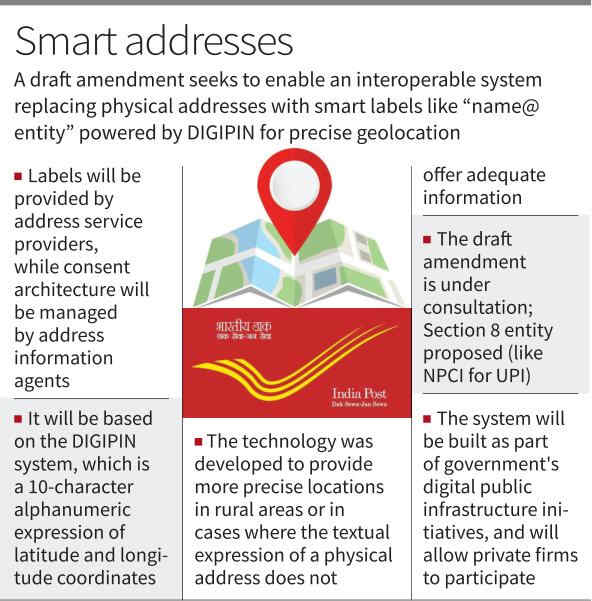
DHRUVA is designed as a national digital address framework that allows individuals to use UPI-like virtual address labels such as “name@entity” instead of repeatedly sharing full physical addresses.
These virtual labels act as proxies for real-world locations and are built on the concept of Address-as-a-Service (AaaS), a system for secure, consent-based management and sharing of address data.
Key Features
1. Virtual Address Labels: Users will be able to share a simple label (similar to a UPI ID or email ID) instead of filling out detailed address forms across platforms.
2. Consent-Based Access: Users can authorise companies to access their address information for a limited duration, after which access must be renewed. This gives citizens control over who can view their address.
3. Interoperability &Standardisation: DHRUVA aims to standardise address formats and ensure interoperability across government services, e-commerce platforms, logistics providers, and emergency services.
4. Public–Private Participation: Private firms can participate in the ecosystem, similar to how the UPI system involves banks and fintech firms. A not-for-profit entity (on the lines of NPCI) may oversee operations under government supervision.
DIGIPIN: Foundational Layer
DHRUVA builds upon the DIGIPIN (Digital Postal Index Number) system.
Key Facts about DIGIPIN:
- Developed by the Department of Posts with IIT Hyderabad and NRSC, ISRO
- A 10-character alphanumeric code representing precise geographic coordinates
- Each code corresponds to roughly a 4 m × 4 m grid (earlier approximated as ~14 sq m area)
- Open-source and covers the entire territory of India
- Useful in areas where traditional textual addresses are unclear or absent
DIGIPIN improves location accuracy for rural areas, logistics, emergency response, and public service delivery.
Institutional Framework
- Address labels will be issued by Address Service Providers (ASPs)
- Consent management will be handled by Address Information Agents (AIAs)
- The platform will be designed with multilingual and mobile-first access
- It may integrate with identity systems like Aadhaar for verification
Significance
- Reduces repetitive address entry across digital platforms
- Enhances privacy through consent-based data sharing
- Improves e-governance, e-commerce, logistics, and emergency services
- Strengthens India’s digital infrastructure alongside Aadhaar and UPI